

Marijuana-related crime, sales decreased last year in Denver, according to study

The 2023 annual report from the Denver Department of Excise and Licenses showed marijuana sales decreasing in 2022 and criminal offenses related to marijuana remaining a small portion of the city’s overall crime.
On Jan. 1, 2014, Denver became the first U.S. city allowing regulated retail marijuana sales.
In years since, Denver has developed ordinances to regulate, license and tax medical and retail marijuana, making the city “the gold standard for cannabis regulation and a worldwide leader,” according to a letter from Mayor Michael B. Hancock included in the report.
Colorado marijuana sales tank in 2022 after pandemic-induced high
According to the annual report, crime related to marijuana decreased in the past year and makes up a small percentage of overall crime in Denver.
Sales in marijuana, both medical and retail, have also decreased.
The Office of Marijuana Policy within the Department of Excise and Licenses compiled the report to give a transparent picture of the first municipality with legalized and regulated recreational cannabis sales in America.
In 2022, retail sales of marijuana were in their ninth year. The timeline of marijuana legalization is as follows.
- 2000: Colorado voters approved Amendment 20, legalizing medical marijuana.
- 2005: Denver voters approved an initiated ordinance to allow possession of up to one ounce of marijuana.
- 2007: Denver voters approved an initiated ordinance making enforcement of laws against private marijuana use and possession by adults the lowest law enforcement priority.
- 2010: Denver adopted the Medical Marijuana Code governing the regulation and licensure of medical marijuana businesses.
- 2012: Colorado voters approved Amendment 64, legalizing marijuana for adult use.
- 2013: Denver adopted the Retail Marijuana Code governing the regulation and licensure of retail marijuana businesses. Denver approved a special sales tax on retail marijuana between 3.5% and 15%.
- 2014: Retail sales of marijuana started on Jan. 1.
- 2016: City Council adopted a cap on retail marijuana stores and retail marijuana cultivation facilities and prohibited new medical marijuana stores and medical marijuana cultivation facilities.
- 2019: The state legislature adopted new licenses for marijuana hospitality businesses and marijuana delivery businesses.
- 2020: The state legislature adopted criteria for qualifying as a marijuana social equity licensee.
- 2021: Denver passed comprehensive changes to the city’s marijuana laws, including a marijuana social equity program and creation of a local license for marijuana hospitality businesses and marijuana delivery businesses.
In 2023, 877 licenses operated in 443 locations in Denver, with 492 being retail and 385 being medical.
Medical cannabis store licenses have been steadily going down since 2016, with 152 in 2022 and 144 in 2023. Retail cannabis store licenses have steadily increased since 2015, with 178 in 2022 and 188 in 2023.
Marijuana sales, both retail and medical, decreased 28% in Denver in 2022, with $497 million in marijuana revenue in 2022 as compared to $689 million in 2021, according to the report.
Prior to 2022, sales had been steadily increasing.
Thousands flock to Denver for psychedelic conference, including celebrity speakers
Gross sales in Denver for medical marijuana decreased 44%, from $189 million in 2021 to $106.4 million in 2022.
Gross retail sales decreased 22%, from $500.6 million in 2021 to $390.2 million in 2022.
Some critics applauded the drop in cannabis sales numbers.
Luke Niforatos, executive vice president of the anti-marijuana group Smart Approaches to Marijuana, said the decline in sales should be “celebrated.”
“Big Marijuana profited off of increased addiction and use throughout COVID-19 lockdowns and the isolation that so many Coloradans felt during those years,” he told The Denver Gazette in prior interview. “What we are seeing now is likely a return to the pre-pandemic average use. This decrease should be celebrated, but we need to do more to educate the public on the harms of marijuana use and hopefully we will continue to see these numbers decline.”
When it comes to crime, marijuana-related offenses make up a small portion of Denver’s overall crime and decreased over the past year.
Total marijuana offenses make up 1% of overall reported offenses in Denver, according to the report.
In 2022, there were a total of 263 offenses reported to the Denver Police Department that had a clear connection or relation to marijuana out of 87,791 total criminal offenses in Denver.
Marijuana-related offenses where licensed marijuana businesses were the victims or perpetrators of a crime represented 0.19% of overall crime in Denver, with 162 total offenses.
Ninety-six percent of the industry-related offenses were burglary or attempted burglary, with 156 offenses. Theft made up the other 4%, or six offenses.
Violent offenses related to the licensed marijuana industry are “rare” and include homicide, rape, robbery and aggravated assault, according to the report.
In 2022, there were 14 violent offenses related to the marijuana industry, which is one per every 564 overall offenses.
Citations and bookings for violations of marijuana laws have decreased overall from 2021 to 2022. In 2021, there were 290 total arrests or citations for marijuana violations compared to 121 in 2022.
Denver’s fentanyl crisis is focus of next mayor’s race debate
Over the years, overall impaired driving arrests have been on the decline in Denver, which can be attributed to factors such as public education campaigns and the rising popularity of ride-sharing services.
“When Amendment 64 to legalize marijuana was put to Colorado voters, many feared that youth marijuana use and crime would skyrocket,” Hancock wrote in the letter. “To date, none of the extreme negative predictions about about legalization have come to pass in the Mile High City.”
Denver still has work to do, however, according to Hancock. The city is continuously improving and evolving, particularly when it comes to social equity in the cannabis industry.
“Denver has developed a multipronged approach to remove barriers and implement changes through its social equity program so there is more equitable access to the cannabis industry and the city can achieve the full promise of legalization,” Hancock wrote.
In 2021, Denver began a partnership to give free entrepreneurial assistance programs for aspiring cannabis business owners disproportionately impacted by marijuana prohibition, according to Hancock.
“I am proud of the foundation my Administration has built over the past decade and their dedicated efforts to ensure a bright future for this industry,” Hancock wrote.



Tiered or capped? Battle over Colorado’s income taxes might come down to one number
Marianne Goodland
marianne.goodland@coloradopolitics.com
Updated 5 hours ago
The battle between two competing ballot measures — one seeking to cap Colorado’s income tax rate, the other pushing for a tiered system depending on income levels — might come down to whichever ballot proposal gets one more vote. The...
10th Circuit says landowner cannot sue ex-Routt County judge for statements in decision
Michael Karlik
michael.karlik@coloradopolitics.com
Updated 7 hours ago
A Routt County landowner cannot sue a former judge for his allegedly inaccurate statements in a case where the landowner was not a party, the Denver-based federal appeals court decided on Wednesday. Anne Fitzsimmons, who lives in Germany, owns a...
Rubio crushes Vance in Western Conservative Summit 2028 straw poll
Kiara Moore
kiara.moore@washingtonexaminer.com
Updated 11 hours ago
Secretary of State Marco Rubio came out on top in this past weekend’s nonpartisan straw poll at the Western Conservative Summit, outpacing a packed field of would-be 2028 presidential hopefuls. Hosted by the Centennial Institute, Colorado Christian University’s public policy...

Supreme Court to open next term with major climate change case
Jack Birle
jack-birle@coloradopolitics.com
Updated 10 hours ago
The Supreme Court’s next term will begin in October with major cases about costly climate change lawsuits and immigration. The high court announced the cases it will hear in the first month of its upcoming term, as the justices remain...

New Colorado laws going into effect cover AI disclosures, medical marijuana access and gambling limits
Marissa Ventrelli
marissa.ventrelli@coloradopolitics.com
Updated 11 hours ago
More than 100 new Colorado laws take effect Aug. 12, bringing changes to chatbot safety rules, psychedelic research, campus wellness checks and sports betting restrictions. Here is a look at some of those laws set to take effect. The law:...

National House Democrats add Colorado seats held by Lauren Boebert, Jeff Hurd to target list
Ernest Luning
ernest.luning@coloradopolitics.com
Updated 9 hours ago
The national House Democrats’ campaign arm on Wednesday added the Colorado congressional district held by Republican U.S. Reps. Jeff Hurd and Lauren Boebert to the list of targeted seats the party believes are vulnerable in this year’s midterms. The Democratic...

Bennet settles campaign finance complaints, admits violating state law
Marianne Goodland
marianne.goodland@coloradopolitics.com
Updated 7 hours ago
U.S. Sen. Michael Bennet’s gubernatorial campaign has agreed to pay a $7,433 fine for using his Senate campaign account to pay for gubernatorial campaign travel expenses. The July 31 settlement includes an admission by Bennet and his campaign that they...

Colorado to implement new laws on jail standards, safe haven rules, and agricultural labeling
Marissa Ventrelli
marissa.ventrelli@coloradopolitics.com
Updated 13 hours ago
In mid-August every year, a slew of recently passed laws in Colorado go into effect 90 days after the end of the legislative session. This year, all bills without a specified effective date or safety clause — a provision stating...
Colorado records 17th wolf death, a yearling tied to livestock losses
Marianne Goodland
marianne.goodland@coloradopolitics.com
Updated 9 hours ago
A yearling male wolf in Grand County has become the 17th wolf to die in Colorado in the past two years. Colorado Parks and Wildlife announced that its staff killed the wolf on Aug. 4 because it was believed to...
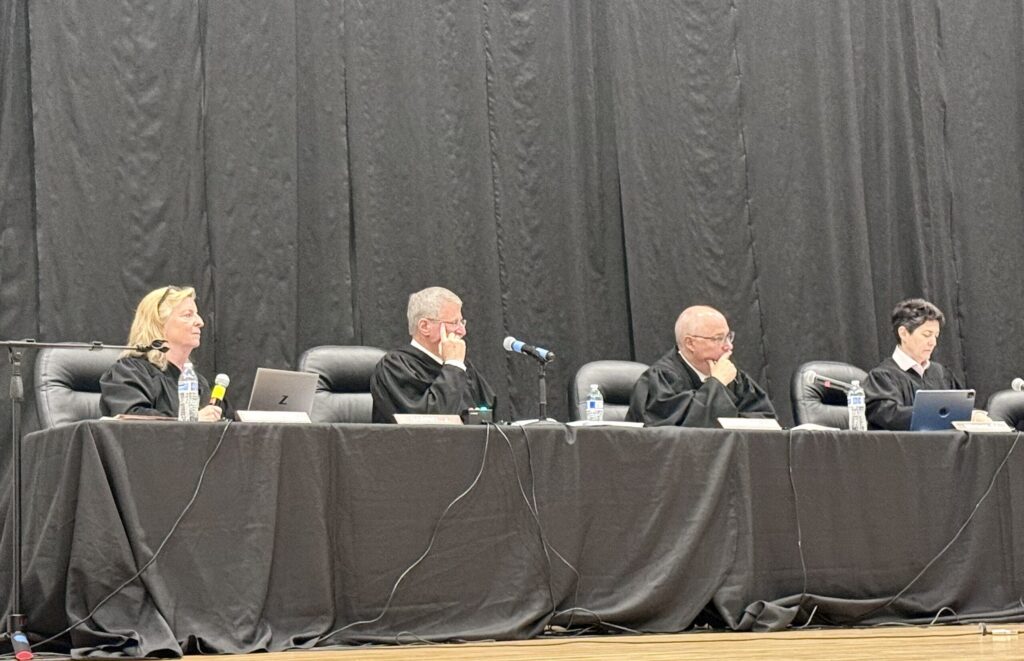
Parole, appeals deadlines and restitution: Colorado justices accept cases
Michael Karlik
michael.karlik@coloradopolitics.com
Updated 1 day ago
The Colorado Supreme Court announced on Monday that it will determine how a defendant’s parole-eligibility date should be calculated in instances where a new trial results in a sentence being imposed retroactively to the date of the original, since-overturned sentence....
PREV
PREVIOUS

Mobolade announces new office to build government-community relationships
The city of Colorado Springs is going to put more energy into community partnerships through a new dynamic team of two. The new Mayor’s Office of Community Affairs will focus on engagement with community leaders, neighborhoods, interest groups, and community organizations, according to a Wednesday news release. Colorado Springs Mayor Yemi Mobolade unveils new city organizational […]

Water pipeline burst prompts weeklong campsite closures at Lake Pueblo State Park
Campgrounds are closing and other facilities are impacted at Colorado’s busiest state park due to a water pipe burst, Colorado Parks and Wildlife announced Wednesday. Staff detected the leak in the pipeline, which feeds two water towers serving Lake Pueblo State Park, below Pueblo Dam on Monday, the department said in a Twitter post. First […]