

When rights come into conflict | BIDLACK
Back when I was teaching the intro American government class to my students at the Air Force Academy, one concept I admit I worked hard to make sure cadets understood was that in almost every case of conflict requiring policy makers to make a decision, there was no simple and obvious right or wrong. Indeed, most issues, and nearly every contentious issue were then – and remains to this day – about rights that are in conflict. Courts especially, but sometimes legislatures, are called upon to settle differences between two or more competing good ideas that have proven orthogonal to each other. The Constitution is all about rights, but more importantly, understanding rights when they are in variance with each other.
An example of such rights in conflict can be found in the First Amendment, in that you have a right to free speech, but that right is not unlimited (even though free speech was declared “inalienable” in Jefferson’s words). You have no right to, say, claim the car you are selling gets 1,000 miles-per-gallon. You also cannot freely yell “fire” in a crowded theater (unless, and this is important, the theater is actually on fire).
Rights in conflict can divide people who believe, rightly, that they have “right” on their side. News outlets, understanding the vital role of a free press in a free society, might want to have access to actions in a court room. But lawyers for a defendant might argue the presence of cameras in the courtroom might influence a jury against their client’s right to a free, fair and speedy trial. Rights in conflict are tough.
Which, of course, brings me to Montana, and a follow-up to an earlier column.
My regular reader (Hi Jeff!) will recall that back in October of last year, I noted that an environmental group in Montana was suing over the Forest Service’s use of fire-retardants, dropped from aircraft. Those opposed noted that roughly 1% of the time, the fire bombers missed their targets and the water and chemicals that make up the fire-fighting slurry ended up in streams, rivers and lakes.
Now, only missing 1% of the time is pretty impressive, but when you understand that they fly thousands of such missions every fire season, that means tens of flights end up dumping the chemicals in the wrong place. Hence the lawsuit, pitting two “goods” against each other: the desire to control potentially catastrophic wildfires with the desire for clean and unpolluted rivers and streams.
Stay up to speed: Sign-up for daily opinion in your inbox Monday-Friday
Fast forward to the most recent Out West Roundup found in Colorado Politics, and we see a federal judge has ruled on the case. Despite more than 200 loads of slurry hitting waterways instead of fires over the last decade, the federal judge overseeing the case ruled the Forest Service can continue to drop the retardant, even as the judge acknowledged the damage done when the drops missed their targets. A coalition of groups, including folks from the fire-ravaged town of Paradise, California – where 85 people died and the entire town was wiped out – argued a court ban on such drops would cost lives and ensure greater property damage.
Clearly, the judge in this case had to rule on rights in conflict, rather than a right opposed by a “wrong.” Were I still teaching, this would have been a great example to use with cadets, as military operations have often been, and will continue to be, in conflict with other rights over the years my students will spend in uniform.
Another CoPo story that got my attention was from Oklahoma, a deep-red state with a long and proud Ntive American tradition. It seems the state legislature there passed a law that would allow Native American students to wear tribal regalia at their graduation ceremonies from high school and college. Amazingly (well, not so amazing, considering the hard-right governor involved) Gov. Kevin Stitt vetoed that bill. Stitt himself is a member of the Cherokee Nation, so his veto was a bit surprising. He argued this decision should be made by every individual school district or college. In other words, the rights of students should vary based on where they went to school. I differ.
Happily, the state legislature actually overrode the governor’s veto, and now those Native Americans state-wide who wish to honor their tribal history at their graduation ceremonies will be able to do so. I bring up this story in part to point out the shameful behavior of Oklahoma’s governor, and in part to brag on our own, Jared Polis.
Readers may recall another column of mine from not to long ago, wherein I noted some of the interesting bills Polis had signed into law, including a new state law that allowed, you guessed it, the wear of native regalia at graduations. Colorado’s bill had passed the state House unanimously and won in the Senate by a large margin, and Polis signed it into law. I can’t find any evidence that it was even a little controversial.
So, there you have it, actual follow-up by your humble columnist (Editor: finally!). In the case of the fire retardant, I confess to still seeing both sides of the issue as vitally important, but ultimately, I side (for what it’s worth) with the judge: I approve of continued fire-retardant drops, especially as we enter a summer that threatens to be a rough one in terms of wildfires.
And I’m proud that in Colorado, it wasn’t even controversial or contentious that native people can honor their history. Once again, it’s good to be in Colorado.
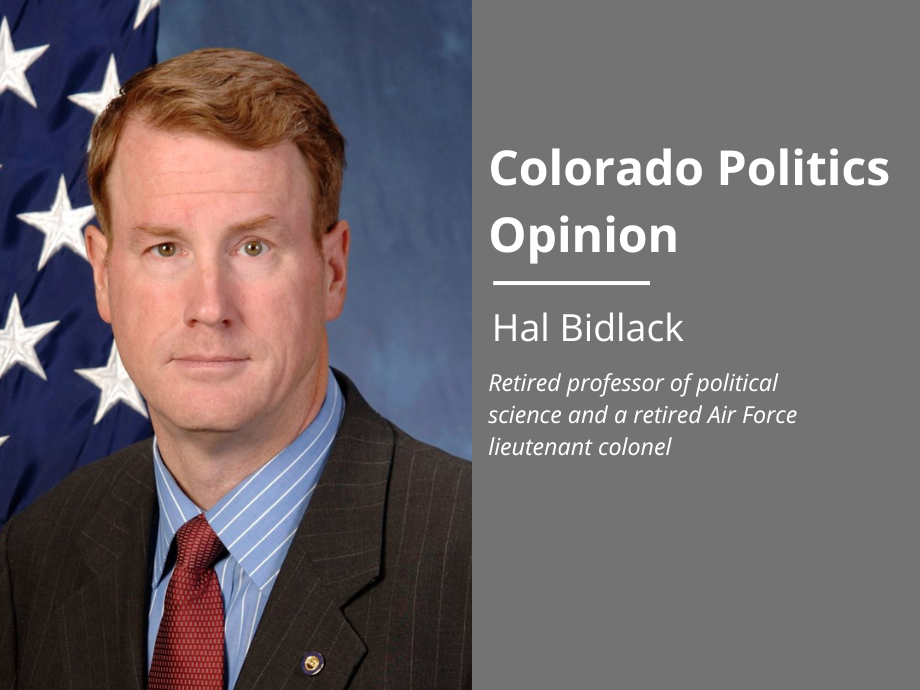
Hal Bidlack is a retired professor of political science and a retired Air Force lieutenant colonel who taught more than 17 years at the U.S. Air Force Academy in Colorado Springs.


Private equity has no place in health care | GUEST COLUMN
Colorado Politics
colorado-politics@coloradopolitics.com
Updated 9 hours ago
By Miah Ntepp Of all the financial pressures placed on working people in this country, the skyrocketing costs of health care rank near the top. As families struggle under the cuts to Medicaid made by the Trump administration, they are...
Some pointed questions for the gubernatorial hopefuls | George Brauchler
George Brauchler
george-brauchler@gazette.com
Updated 1 day ago
Earlier this month, the Republican and Democratic candidates for governor participated in a televised interview moderated by well-known, left-leaning legacy media folks. Predictably, the questions asked of the GOP candidates were more aggressive, pointed, biographical and almost entirely disconnected from...
Chaotic funding throws monkey wrench into governor’s-race money madness | Paula Noonan
Paula Noonan
paula-noonan@coloradopolitics.com
Updated 1 day ago
Chaos Monkey, Inc., gave a trifle $20,000 donation to Rocky Mountain Way (RMW), the independent expenditure committee (IEC) supporting U.S. Sen. Michael Bennet for Colorado governor. But why, Coloradans should ask, would a guy who has assigned his contributor name...

Lindsay Datko on school safety, misconduct and transparency in Jeffco schools | The OpEdge Podcast
Tony Olivero
tony.olivero@gazette.com
Updated 3 days ago
Jeffco Kids First founder Lindsay Datko joins The OpEdge to explore concerns about school safety, staff misconduct and transparency in Jefferson County Schools. Datko tells host and investigative columnist Jimmy Sengenberger why she believes Colorado’s second-largest district has too often...

Candidate’s disturbing anti-animal agriculture history | Rachel Gabel
Rachel Gabel
rachel-gabel@coloradopolitics.com
Updated 5 days ago
Rep. Manny Rutinel has busted out a cowboy hat for campaign photos and has thrown it into the ring to represent Colorado’s 8th Congressional District in D.C. He is endorsed by U.S. Sen. Cory Booker, a New Jersey democrat who serves on the Committee...

Marx, Bottoms, a primary death wish for Colorado GOP | Dick Wadhams
Dick Wadhams
dick-wadhams@coloradopolitics.com
Updated 5 days ago
Colorado Republicans stand on the brink of total irrelevance and embarrassment if they nominate one of the two nonsensical, buffoonish candidates running for governor, Victor Marx and Scott Bottoms. Republicans are already in a very defensive, tenuous position as Democrats...

Remember the grassroots reason for DEI | Miller Hudson
Miller Hudson
miller-hudson@coloradopolitics.com
Updated 4 days ago
The Trump administration’s jihad against Diversity, Equity and Inclusion (DEI) programs has metastasized into the most unexpected corners of American life. Yet, before examining this policy “incursion,” it’s worthwhile to examine the roots of DEI which reach back more than...

Why I’m voting Democrat | Jon Caldara
Jon Caldara
jon-caldara@coloradopolitics.com
Updated 1 week ago
It makes no sense to be a Republican in Colorado. Or a Democrat for that matter. On the day I turned 18, even before I bought my first legal 3.2 beer (remember 3.2 beer?), I went to the courthouse and...

A primary brings out primal instincts | SONDERMANN
Eric Sondermann
eric-sondermann@coloradopolitics.com
Updated 1 week ago
There are no Stanley Cup finals or NBA title showdowns involving local teams this June. In their place, we are inundated with primary election campaign ads. Coloradans can be excused for missing the diversion and alternate programming. But life can...

Colorado’s role in Spirit Airlines’ demise should not be ignored | GUEST COLUMN
Colorado Politics
colorado-politics@coloradopolitics.com
Updated 1 week ago
By Robin Rossenfeld At a time when Colorado families are already struggling with rising transportation costs, the collapse of Spirit Airlines could not come at a worse moment. According to the U.S. Bureau of Labor Statistics, prices in the Denver-Aurora-Lakewood...
PREV
PREVIOUS

A sign of hope for Colorado’s crime fight | Colorado Springs Gazette
Let’s applaud Gov. Jared Polis for signing a much-needed reform of Colorado’s lax laws on auto theft. Assuming other key components of the justice system do their jobs, the legislation that won the governor’s endorsement on Friday should put a dent in our state’s dubious distinction as No. 1 in the nation for the theft […]

Colorado’s radical fringe overreaches | Denver Gazette
These are heady times for Colorado’s hard left. Pumped up by their party’s back-to-back election victories, members of the ruling Democrats’ radical fringe are trying to make the most of it by fast-tracking their agenda for action. Never mind that they are attempting to claim a mandate for extremist policies in a state where nearly […]