

State Supreme Court back for arguments, new federal judge holds swearing-in ceremony | COURT CRAWL
Welcome to Court Crawl, Colorado Politics’ roundup of news from the third branch of government.
The members of the state Supreme Court are back this week to hear a brief roster of oral arguments, and Colorado’s newest federal judge held her formal swearing-in ceremony in front of friends and family on Friday.
Three cases and a hearing
? The Supreme Court has a relatively light schedule this month, with three cases scheduled to be heard on Tuesday beginning at 9 a.m. They are:
Chirinos-Raudales v. People and Orellana-Leon v. People: Both appeals involve the application of a state law that governs whether out-of-court statements from children under 15 can be used in trials for unlawful sexual behavior.
People v. Madrid: The court will review whether one of its own members, Justice Carlos A. Samour Jr., correctly handled the removal of a Black juror from a criminal trial when he was an Arapahoe County judge.
? Also, at 3:30 p.m. on Wednesday, the justices are holding a public hearing on proposed rule changes governing the unauthorized practice of law. All proceedings are live streamed here.
Newest (sort of) federal judge gets official welcome
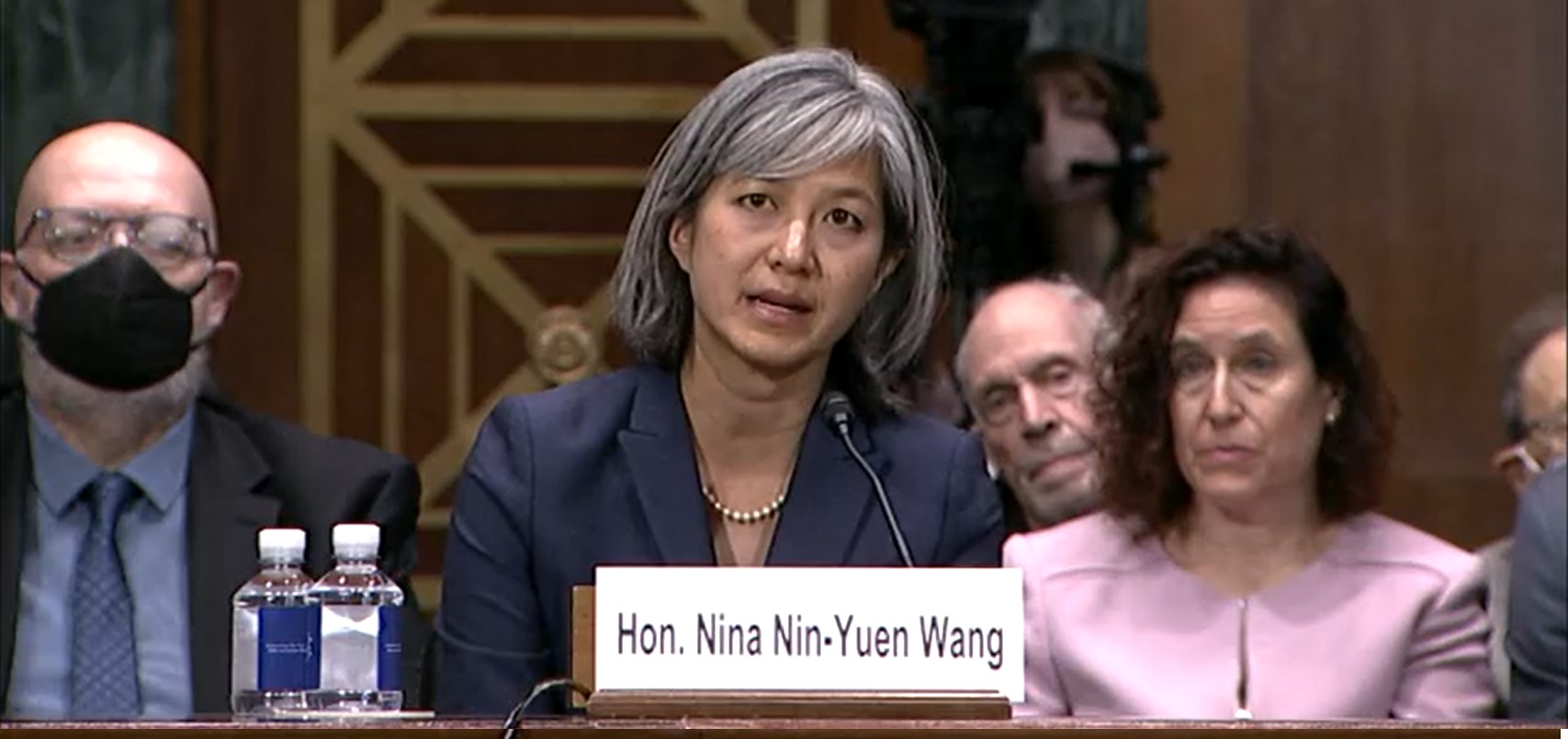
? As was the case with the two other additions to Colorado’s U.S. District Court since the Biden administration took office, Nina Y. Wang held her formal investiture ceremony in downtown Denver on Friday, where she publicly took her oath of office. Wang is the most recent appointee to the court, although she isn’t exactly “new,” having served as a magistrate judge for seven years prior to her U.S. Senate confirmation in July.
? “She doesn’t seek the spotlight. She simply works hard and dedicates her talent to others,” said Wang’s longtime friend and former coworker Natalie Hanlon Leh, now with the Colorado Attorney General’s Office.
? Wang is part of the Biden administration’s large group of women and lawyers of color appointed to the bench since 2021. Demographically, of the seven active members of Colorado’s federal trial court: three are women, four are people of color and one is openly LGBTQ. In addition, President Joe Biden has appointed as many women to the court in two years as all of his predecessors combined.
? At the end of the investiture, after all parties had been thanked, U.S. District Court Chief Judge Philip A. Brimmer, gave an additional shout-out to Wang’s husband, an engineer, for coming in during the early COVID-19 pandemic with fluorescent fluid and “trying to determine how far particles might be projected from the witness stand during testimony.”
? One more note about federal judges: There is a pending nominee for another judicial vacancy in Colorado. Given that Congress is winding down for the year, Gordon P. Gallagher will not receive a vote before January. It is possible, however, that he may appear at a hearing of the U.S. Senate Committee on the Judiciary this Tuesday. A list of nominees scheduled to testify hasn’t been announced yet.
SCOTUS hears LGBTQ discrimination case
? Last week, the U.S. Supreme Court heard oral arguments in a case arising from Colorado, 303 Creative v. Elenis. Essentially, a Christian website and graphic designer is looking to make wedding websites, but her religious beliefs preclude her from celebrating same-sex marriages. She seeks to refuse to design same-sex wedding websites because doing so would amount to “speech” violating her religious beliefs. Colorado counters that its law clearly prohibits businesses serving the public from discriminating on the basis of sexual orientation.
? Here is some of the coverage:
Colorado’s anti-discrimination law v. the First Amendment: An explainer of the 303 Creative case
Supreme Court justices spar in gay rights case involving Colorado graphic artist
? The Supreme Court’s decision could give the green light to “artists” to refuse service to some clients based on traits that are currently protected under anti-discrimination law. A decision will come before the end of the court’s term in June.
Q&A about accountability in the judicial workplace
? Following a hostile work experience with a judge, Aliza Shatzman began The Legal Accountability Project to help other law students and young attorneys acquire information that could affect their decisions about whether to clerk for a particular judge. Here is an excerpt of her interview with Colorado Politics:
Colorado Politics: In Colorado, as in every state, there are two court systems. There’s the federal one, where judges have lifetime tenure, and the state courts, where judges are subject to performance reviews and retention every few years. Should we be thinking about accountability for workplace culture in the same way for both of those systems? Or do we need to think about the federal courts completely differently from their state counterparts?
Aliza Shatzman: I think the federal judiciary perceives itself as different because judges have life tenure, but I really think all judges need to think of themselves as employers running a small workplace.
Within the larger legal community, there is a culture of deifying judges and disbelieving law clerks. It’s one of dissuading law clerks from filing complaints against judges who have mistreated them, and encouraging folks to stay silent. We need to empower more current and former clerks to demand safer workplaces.
I can say this from my personal experience, law clerks are actively dissuaded from filing complaints against their harassers. This allows both the state and federal judiciary to disclaim responsibility, to point to a lack of complaints and a dearth of data, and say these issues are not pervasive. In both state and federal misconduct investigations, judges are heavily involved and tasked with investigating and disciplining their colleagues. Telling folks they need to self-police leads to a lack of policing.

CP: Is it fair to say this data collection effort is not just intended to steer law students away from hostile workplaces, but to steer them toward places that are welcoming and where judges are good judges?
AS: Yes. But there is a distinction between a good judge and a good boss.
Heard on appeal
? An El Paso County judge dismissed the criminal charges against a defendant after a.) none of the prosecution’s witnesses showed up for trial, b.) the prosecution hadn’t even interviewed two witnesses yet and c.) COVID-19 restrictions made it unlikely the trial could be rescheduled in time. By 2-1, the state’s Court of Appeals reinstated the charges and said the trial judge should have had the witnesses arrested instead for not appearing.
? A man convicted of attempted murder in Denver will be released from incarceration and not put on trial again because a judge violated state law requiring a speedy trial within six months of a not guilty plea.
? Prosecutors in Adams County sought to dismiss a Hispanic juror from a Hispanic defendant’s trial. In doing so, they misrepresented the law, cited unverified statistics, incorrectly remembered what the juror had said, and let non-Hispanic jurors serve who had the same background they allegedly found problematic in the Hispanic juror. Nevertheless, the Court of Appeals decided no racial discrimination had occurred.
In federal news
? Even though the federal appeals court based in Colorado recently recognized the First Amendment protects the right of bystanders to record police officers, a trial judge decided an Englewood man didn’t have his constitutional rights violated when he was handcuffed after attempting to record an officer interviewing a witness from a nearby sidewalk.
? Five children were orphaned when a man murdered their parents during an in-person transaction set up over a marketplace app. A federal judge decided the children couldn’t sue the app for the murders.
? A judge declined to throw out another lawsuit against the City and County of Denver stemming from its forceful response to the racial justice protests of 2020.
? A judge clarified what type of monetary damages are valid in a lawsuit against Saguache County for the suicide death of a detainee in its jail. The plaintiff may ask for money to compensate for the decedent’s loss of “enjoyment of life,” and the request so far is up to $1.1 billion.
? The Adams County sheriff may be held liable for failing to accommodate a deaf woman detained for 16 hours in the jail, a judge ruled.

Vacancies and appointments
? There are three finalists to succeed the late Judge Joe Fennessy on the Rio Blanco County Court: Jay Edwards of Meeker, Phillip Smith of Grand Junction and Janelle Surace of Rifle.
? While not a vacancy or appointment, Court Crawl would note that the two newest members of the state’s 22-member Court of Appeals, Karl L. Schock and Katharine E. Lum, have now taken office and are hearing cases.


Federal judge green-lights civil trial against ex-Fort Collins DUI officer
Michael Karlik
michael.karlik@coloradopolitics.com
Updated 2 days ago
A federal judge ruled on Thursday that Fort Collins’ former “DUI officer” will face a civil trial for allegedly investigating a motorist for impaired driving without any reasonable suspicion to do so. In recent years, several people arrested by Officer...

Colorado Supreme Court suspends Mesa County judge pending misconduct investigation
Michael Karlik
michael.karlik@coloradopolitics.com
Updated 1 day ago
The Colorado Supreme Court suspended Mesa County Court Judge Michael J. Grattan on Thursday amid a misconduct investigation. The court’s Sept. 10 order gave Grattan 21 days to explain why his paid suspension should not continue through the end of...
Colorado Supreme Court changes course, dismisses case about special district bonds
Michael Karlik
michael.karlik@coloradopolitics.com
Updated 1 day ago
The Colorado Supreme Court declined on Friday to decide a dispute between a large-scale Commerce City development and the various districts financing it, after initially showing interest in the ongoing case. Colorado has roughly 2,800 special districts, which are local...
10th Circuit tosses GEO Group’s pretrial appeal in human trafficking lawsuit
Michael Karlik
michael.karlik@coloradopolitics.com
Updated 3 days ago
The Denver-based federal appeals court dismissed an attempt by The GEO Group on Wednesday to appeal a trial judge’s non-existent decision two months before the company is scheduled to face a civil trial over alleged trafficking violations at the Aurora...
Denver sues Trump to block armed ICE agents from polling sites
Deborah Grigsby
deborah.smith@denvergazette.com
Updated 3 days ago
The city of Denver, along with several groups, sued the Trump administration Thursday, seeking to block U.S. Immigration and Customs Enforcement officers who are armed from polling sites during the upcoming midterm elections. In fact, there are no official orders...
Federal judge takes no action against ICE in Colorado after hearing about mistakes, not ‘blatant violations’
Michael Karlik
michael.karlik@coloradopolitics.com
Updated 1 day ago
A federal judge declined to take action against U.S. Immigration and Customs Enforcement on Thursday after hearing that a pattern of alleged lawbreaking amounted to mistakes and a misunderstanding of the government’s position in court. For nearly a year, Colorado’s...
Colorado doctors, dentists challenge state law on gender‑transition services in new federal lawsuit
Marissa Ventrelli
marissa.ventrelli@coloradopolitics.com
Updated 23 hours ago
A group of Christian doctors and dentists has filed a federal lawsuit challenging a Colorado law they say requires them to provide gender‑transition services that conflict with their religious and ethical beliefs. The lawsuit, filed by the Christian Medical and...
Federal judge directs plaintiff to revise complaint alleging Denver officers’ constitutional violations
Michael Karlik
michael.karlik@coloradopolitics.com
Updated 1 day ago
A federal judge directed a plaintiff to revise his allegations on Wednesday to more precisely state what two Denver officers and the city itself allegedly did to violate his constitutional rights by facilitating his prosecution for murder until prosecutors dropped...
Lawsuit challenges Douglas County commissioners’ ballot actions
Nicholas Fogleman
nicholas.fogleman@denvergazette.com
Updated 3 days ago
A new lawsuit against Douglas County commissioners seeks to invalidate the board’s intervention in efforts to expand the commission from three members to five and restore the original ballot language approved by more than 20,000 petition signers. The suit marks...
Federal judge explores new sanctions against ex-Colorado judicial discipline director
Michael Karlik
michael.karlik@coloradopolitics.com
Updated 1 day ago
A federal judge on Wednesday directed Colorado’s former judicial discipline director, for the third time this year, to explain why she should not sanction him for his latest conduct in his litigation against the state’s judiciary. Christopher S.P. Gregory, who served...
PREV
PREVIOUS
Divided appeals court reinstates criminal charges after judge failed to order witnesses' arrest
In a divided ruling last week, Colorado’s second-highest court decided an El Paso County judge wrongly dismissed a criminal case when she should have instead issued warrants to arrest the witnesses who failed to appear. Given the circumstances in March 2021, which included COVID-19 restrictions on jury trials and the prosecution’s lack of evidence, then-District […]
State Supreme Court finds no problem with judge terminating parental rights as father struggled to log in
Colorado’s Supreme Court on Monday did not fault a Jefferson County judge for refusing to postpone a hearing in which she terminated a father’s parental rights, even as the man was unsuccessfully trying to connect to the proceedings virtually. The justices noted that Colorado law permits judges to end the legal relationship between a parent […]