

Income tax cut a promising Colorado conservative win
Voters this week cut Colorado’s income tax. It was the one bright spot in an otherwise bleak election year for conservatives in the state. It was also the second consecutive election in which voters approved an income tax cut on the ballot. If the organization behind the tax cut has its way, the measure will go down in history as just one more step on a path to zero income tax.
In 2020, Independence Institute President Jon Caldara and state Sen. Jerry Sonnenberg sponsored a citizen ballot-initiative that took Colorado’s income tax rate from 4.63% to 4.55%. This year, they sponsored Proposition 121. It won by a landslide with 65% of voters approving of the measure and slashed the rate to 4.4%.
Colorado was not the only state to cut their income tax during the last few years, but it was the only blue state where the people defied their progressive legislature and took matters into their own hands to give themselves tax relief.
There’s a nationwide movement of states moving toward more competitive tax regimes by simplifying and lowering income taxes. In 2021 and 2022 alone, nearly two dozen states reduced their income tax burdens.
These reforms are not limited to red states, and Colorado’s Gov. Jared Polis is not the only Democratic governor who has supported income tax reductions in his state. Under Governor Roy Cooper (D), North Carolina passed a law that will phase out the state’s corporate income tax during the next decade. Democratic governors in Louisiana and Kentucky also supported income tax reductions. In each of these states, however, Republicans controlled the state legislature and sent tax cuts to their governors’ desks.
In Colorado, Republicans introduced legislation to reduce the income tax during three of the last four legislative sessions. Unfortunately, the Democratic majority in the General Assembly killed the bills in committee and never gave Polis the chance to sign them.
Thanks to Coloradans’ constitutional right to place tax changes directly on the ballot, Caldara and Sonnenberg were able to circumvent the legislature and take their tax cut straight to the people of Colorado for a vote. Ultimately, Polis’s opportunity to support income tax relief came not from his Democratic colleagues in the legislature, but from a right-of-center public policy organization.
The ability to put tax cuts to a vote of the people – combined with the work of Independence Institute to make that happen – is what gave conservatives their only meaningful victory on election day. It’s also what makes Colorado stand out in the nationwide state tax relief movement.
“Since its inception in the mid 80s, Independence Institute has taken Colorado from a progressive income tax with a top rate of 8% to a single flat income tax of 4.4% with today’s victory,” said Caldara.
His organization, where I serve as director of the fiscal policy center, has been behind efforts to limit the tax burden imposed on Coloradans and push back against government overreach for decades. Its victories include taking Colorado from a progressive income tax to a single rate in 1987, helping to pass Colorado’s Taxpayer’s Bill of Rights (TABOR) in 1992, and the defeat in 2019 of Proposition CC-a measure referred to the ballot by the legislature that would have permanently abolished tax refunds under TABOR.
Proposition 121 is the latest in a long history of policy victories for the organization.
“I was honored to be the proponent on a winning tax cut two years ago, Proposition 116, and I am honored to help bring another tax cut to Coloradans again this year,” Caldara added. “We will continue to advance incremental reductions until we eliminate the income tax entirely.”
Caldara is referring to Independence Institute’s Path to Zero, a plan his organization proposed that would use TABOR surpluses to phase out Colorado’s income tax gradually without jeopardizing the state budget. Rather than needing to pass incremental tax cuts each year, the plan would use a ratchet-down mechanism to lower the rate automatically each time the state experiences a revenue surplus.
Just as the citizen ballot-initiative process facilitated a tax cut in the now deep blue state of Colorado, in the future it could enable the Centennial State to make history by eliminating its income tax entirely. If it does, Colorado would become only the third state to abolish its income tax and the first blue state ever to do so.
Ben Murrey serves as director of the Fiscal Policy Center at the Independence Institute in Denver.


Keeping Colorado’s kids’ trust online | PODIUM
Colorado Politics
colorado-politics@coloradopolitics.com
Updated 18 hours ago
By Stuart Jenkins Almost every day, the kids and teens we serve across Colorado are introduced to new generative artificial intelligence and other emerging technology, including conversational AI systems designed to simulate human conversation. These tools are no longer a...
Marx’s ‘through line’ predates Trump, connects to Maes | FEEDBACK
Colorado Politics
colorado-politics@coloradopolitics.com
Updated 18 hours ago
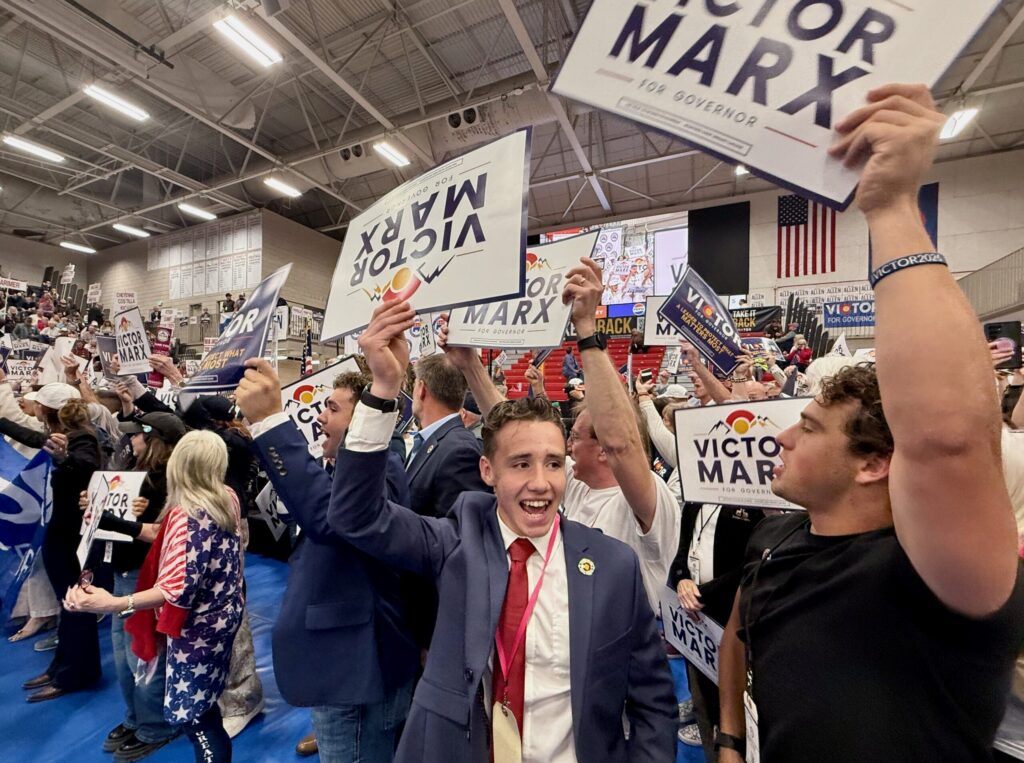
Eric Sondermann is of course correct Victor Marx is an unserious, unelectable, embarrassing Republican nominee for governor of Colorado. But I respectfully submit that the “through line,” as Mr. Sondermann describes it, is not from Trump to Marx, despite their...

Cedric Pride’s blueprint for opportunity through the trades | The OpEdge Podcast
Tony Olivero
tony.olivero@gazette.com
Updated 1 day ago
Cedric Pride, CEO of the nonprofit Pride Initiative in Denver, joins The OpEdge with a blueprint for workforce development, skilled trades, and economic opportunity. Pride tells host and investigative columnist Jimmy Sengenberger why he believes the trades offer a path...
Colorado’s No. 1 education ranking should raise our ambition | GUEST COLUMN
Colorado Politics
colorado-politics@coloradopolitics.com
Updated 1 day ago
By Scott Laband Colorado has earned the right to celebrate its new No. 1 ranking in education from U.S. News & World Report. Gov. Jared Polis called it “one of the proudest moments” of his time in office and shared the...

Colorado’s No. 1 education ranking reflects the power of school choice | GUEST COLUMN
Colorado Politics
colorado-politics@coloradopolitics.com
Updated 2 days ago
By Peter Mason Colorado is now the No. 1 state in the nation for education, according to the 2026 U.S. News & World Report Best States rankings. That is a distinction worth celebrating. It is also a distinction worth understanding....

Courageous Colorado bucks Trump’s federal stupidity | Miller Hudson
Miller Hudson
miller-hudson@coloradopolitics.com
Updated 2 days ago
There are several theories regarding the rhythm of American politics. The most frequently cited is the pendulum hypothesis — positing that episodes of liberal dominance are then interrupted by spans of conservative control. Since Ronald Reagan’s presidential election in 1980,...

A historic moment during another major drought | Rachel Gabel
Rachel Gabel
rachel-gabel@coloradopolitics.com
Updated 5 days ago
Gustav Sumnick emigrated from Germany, traveled to Oklahoma and decided rather than be a Sooner, he wanted to be a farmer. He moved north to Nebraska and married an Irish immigrant farmer’s daughter. They farmed near Fremont, Nebraska, where the...

Colorado can’t forget the lessons of COVID | Jon Caldara
Jon Caldara
jon-caldara@coloradopolitics.com
Updated 2 days ago
We are finally getting a clearer picture of what happened during COVID. Not because the people who locked us up, masked our faces and forced unproven chemicals into our bodies have suddenly become transparent, but because Anthony Fauci’s COVID-era diary...

Historic preservation supporters organize to oppose Trump changes | Bob Loevy
Tom Cronin
tom-cronin@coloradopolitics.com
Updated 5 days ago
Historic preservation organizations in Colorado Springs, the remainder of Colorado and across the nation are organizing to resist a recent effort to relax and weaken historic preservation laws in the United States. In Washington, D.C., the Advisory Council on Historic...
The primary political reform and precondition for all others | SONDERMANN
Eric Sondermann
eric-sondermann@coloradopolitics.com
Updated 1 week ago
In its current state, the American political system has no end of ailments. Far too many factors accelerate polarization and work against moderation and narrowing the differences. Media, and the way so many citizens limit themselves to agreeable, reinforcing sources,...
PREV
PREVIOUS

SLOAN | When will the GOP slide in Colorado cease?
Kelly Sloan Concerning the election that just passed, a few observations: The “red wave,” anticipated even by Democrats, did not come to pass, at least not to the magnitude expected. By any accounting, this election cycle offered everything needed for a broad and decisive Republican victory – a deeply unpopular Democratic president in Joe Biden, an […]

Denver Gazette: Set Colorado’s bar high for hallucinogens
It was only fitting that the campaign behind a statewide ballot issue recklessly legalizing hallucinogenic drugs would itself be illusory. Not only did its shadowy backers refuse to show up at public forums to defend their proposal’s obvious dangers, but their entire, multimillion-dollar bid, funded by the national legalization lobby, was deceptive to begin with. […]