

Justices asked to endorse hybrid model of calculating parole eligibility

In an unusual display of unity before the Colorado Supreme Court, both the government and inmate Nathanael E. Owens agreed that he was entitled to have his parole eligibility date calculated in a way that would move his potential release date one year earlier.
However, Owens asked the justices to go further and order the Colorado Department of Corrections to stick with its “hybrid model” of calculating parole eligibility dates, something that the department argued was unnecessary.
“It’s not going to change anything for Mr. Owens. He already has the more favorable interpretation,” First Assistant Attorney General Nicole Gellar told the court in asking it to dismiss Owens’ case.
Owens countered that the Department of Corrections had already recalculated his parole eligibility date twice in the past five years. Just as the government could give him his preferred calculation – potentially with the aim of getting the lawsuit thrown out – it could change his parole eligibility date again in the absence of a Supreme Court ruling, he argued.
“Criminal defendants plead guilty and when they do, the single overriding question they have is, when are they going to get out? What is the earliest parole eligibility date?” attorney Samuel B. Ballingrud, representing Owens, told the justices. “That is the single most important criterion for a criminal defendant who has decided to plead guilty.”
The controversy over Owens’ parole eligibility date centered around a prior Supreme Court decision in 2017 that upended, at least temporarily, the way the Department of Corrections historically applied its formula.
Owens entered guilty pleas that same year on two counts of aggravated robbery and one count of vehicular eluding. The aggravated robbery offenses each carried a sentence of ten years, with a four-year sentence for vehicular eluding. Colorado law makes inmates eligible for parole 75% of the way through sentences for certain crimes and at 50% of sentences for others.
In all, the 75% calculation applied to the two aggravated robbery counts and the 50% calculation applied to Owens’ vehicular eluding count. Applying the proper percentage to each piece of his consecutive sentences, known as the hybrid model, delivered Owens a parole eligibility date of 17 years, versus the 24 years of his entire sentence.
Then the state Supreme Court released its decision in June 2017 in the case of Executive Director of the Colorado Department of Corrections v. Fetzer. Raymond Lee Fetzer had challenged the department’s computation of his parole eligibility date with his combination of consecutive and concurrent sentences.
The court acknowledged the long and complex history of sentencing in Colorado. Before 1979, the law required judges to impose indeterminate sentences on felons, with only the minimum and maximum duration being fixed. The legislature subsequently enacted fixed-length sentences with the hybrid model for calculating parole eligibility dates.
There were further changes in 1985, 1990 and 1993, meaning that defendants who committed crimes within a short span of each other could be subject to different sentencing and parole provisions. The Supreme Court’s opinion, acknowledging the convoluted nature of sentencing law, largely deferred to the Department of Corrections in calculating inmates’ parole eligibility dates.
Then-Justice Nathan B. Coats, writing for the court, deemed the department’s interpretations of the law were “entitled to great weight.”
“(U)nless the methodology selected by the department contravenes a statute or the constitutional rights of an inmate, it will be upheld,” Coats wrote.
The result of Fetzer’s appeal was calculation of his parole eligibility date using the “single percentage model,” which treated his various sentences as one continuous sentence and applied just one percentage.
The Department of Corrections interpreted the Fetzer decision as requiring it to eschew the hybrid model and treat inmates’ multiple sentences as a continuous term of confinement. It recalculated Owens’ 24-year-sentence using only the 75% multiplier, meaning Owens would be eligible for parole in 18 years – one year later than with the hybrid model.
Owens challenged the new parole eligibility date. A three-judge panel of the state’s Court of Appeals endorsed the single percentage model and said that Fetzer “dictates” its use in lieu of the hybrid model.
Judge Michael H. Berger wrote separately to warn against giving the department too much discretion to apply the single percentage model, and believed Fetzer could still permit the hybrid model to operate with consecutive sentences.
“I respectfully suggest that either the supreme court take a second look at this or the General Assembly clarify that it meant what it said when it prescribed the percentages of sentences served to determine parole eligibility,” Berger wrote.
Owens, representing himself at that point, appealed to the state Supreme Court, which agreed to decide whether the government had to apply the hybrid model or if it had the liberty to use a single percentage.
The case attracted the support of the Office of the Alternate Defense Counsel, which defends indigent clients when the public defender’s office has a conflict. In a brief to the Supreme Court, the office pointed out that there had been 69 instances of inmates receiving later parole eligibility dates because of the government’s recalculations post-Fetzer. It noted that the postponements amounted to more than 200 years of additional incarceration at a cost of $7.6 million.
However, two months before the Supreme Court was set to hear oral arguments in Owens’ appeal, the government informed the justices that, based on Berger’s opinion, the Department of Corrections believed it could legally begin applying the hybrid model again.
“The CDOC has no plans to return to the single percentage model of calculating parole eligibility dates unless the legislature enacts a statute, or there is a Court decision,” wrote Jennifer Murphy, a departmental supervisor. She added that Owens’ parole eligibility date had reverted to 17 years under the revived hybrid model.
On Tuesday, the justices did not appear convinced that the department’s change of mind made Owens’ appeal a non-issue.
“Isn’t it the case, though, that if we were to declare this moot and not decide it, the department could change its interpretation of PED next month?” asked Justice Melissa Hart.
In large part, the arguments focused around what degree of deference courts should provide to the Department of Corrections in calculating parole eligibility dates. Ballingrud claimed that in the absence of a comprehensive rulemaking process informed by the Department of Corrections’ expertise, a simple change of heart in the middle of a lawsuit was not entitled to deference.
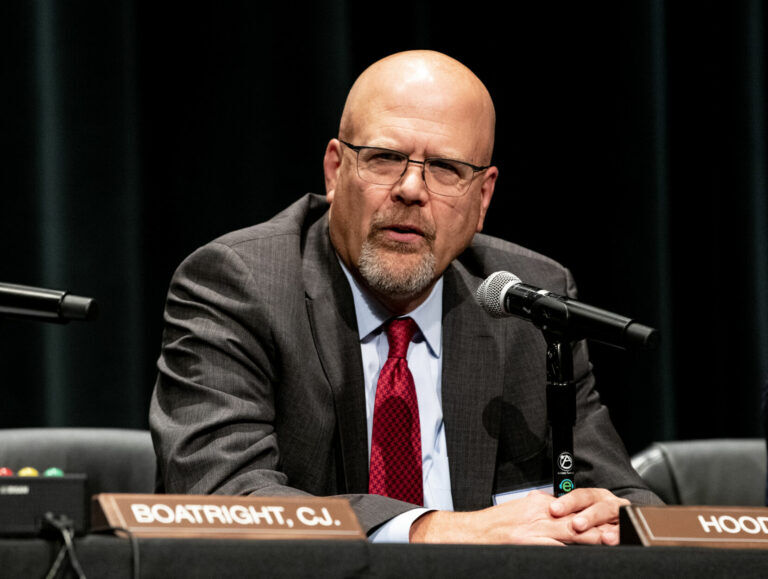
Chief Justice Brian D. Boatright was wary of that broad view. Given the complexities of sentencing law, he said, he supported “deferring to the department to allow them to do something manageable.”
Gellar reassured the court that, while she believed the single percentage model was still valid, Owens’ preferred model was once again departmental policy, as it had been for decades before Fetzer.
“Now that it has had the endorsement of a Court of Appeals judge, that the hybrid method is already acceptable, it’s returned to the status quo,” she said. “Mr. Owens can be secure in the use of the hybrid method.”
The parties did not suggest the Supreme Court needed to overrule its Fetzer decision in order to support the hybrid model. Justice Carlos A. Samour Jr. agreed, believing it would “thread the needle” for the court to stand by Fetzer’s conclusion that the Department of Corrections should have deference to calculate sentences as long as it complies with the law.
“You’re going to violate the statute unless you do the hybrid approach,” Samour observed.
The case is Owens v. Carlson et al.


Schoolchildren’s presence at child sex-related trial did not harm Arapahoe County defendant, appeals court says
Michael Karlik
michael.karlik@coloradopolitics.com
Updated 10 hours ago
Colorado’s second-highest court decided on Thursday that the presence of a group of schoolchildren on the first day of a child sexual exploitation trial did not violate an Arapahoe County defendant’s constitutional right to a fair trial. Prosecutors charged Jerry...
Appeals court cites week-old Colorado law to reinstate child neglect case at child, father’s request
Michael Karlik
michael.karlik@coloradopolitics.com
Updated 7 hours ago
Colorado’s second-highest court invoked a new state law for the first time on Thursday and reinstated a child neglect case that both the child and her father wished to reopen. House Bill 1227 took effect on Aug. 12, reversing a...
Colorado Supreme Court names William Hood as next chief justice
Michael Karlik
michael.karlik@coloradopolitics.com
Updated 1 day ago
The Colorado Supreme Court has selected Justice William W. Hood III to be the next chief justice, the judicial branch announced on Friday. Hood will succeed Chief Justice Monica M. Márquez, who took over the role in July 2024. “I...

Appeals court upholds Park County trophy hunting conviction
Michael Karlik
michael.karlik@coloradopolitics.com
Updated 1 day ago
Colorado’s second-highest court clarified on Thursday that a defendant may stand convicted under the state’s trophy hunting laws if he abandons a bear carcass but returns later to remove the meat. Under Colorado law, it is a felony to detach...

Judge grants partial injunction to GEO in fight against state health inspection law
Kyla Pearce
kyla.pearce@gazette.com
Updated 2 days ago
A judge ruled Thursday that The GEO Group does not have to follow parts of a new state law requiring more frequent health and safety inspections at the U.S. Immigration and Customs Enforcement processing center in Aurora. Under the order...

Parker man faces 20 years to life for serial sexual assaults
Nicholas Fogleman
nicholas.fogleman@denvergazette.com
Updated 3 days ago
A 25-year-old Parker man who sexually assaulted three women in 2025 pleaded guilty Wednesday and will serve 20 years to life in prison. Javier Rodriguez-Andrade pleaded guilty to charges stemming from three sexual assaults involving women ages 19 to 24. ...
Divided appeals court upholds warrantless DNA collection in Colorado cold case, cautions of government overreach
Michael Karlik
michael.karlik@coloradopolitics.com
Updated 2 days ago
Colorado’s second-highest court upheld the warrantless collection of a suspect’s DNA from a discarded soda can as constitutional on Thursday, while warning about potential abuse of DNA privacy in the absence of further guardrails. By 2-1, a three-judge Court of...

Man charged in Northglenn homicide of wife
Matt Kyle
matt.kyle@denvergazette.com
Updated 3 days ago
A man has been formally charged with murder and burglary relating to a homicide last week in Northglenn. Alexei Munive-Rodriguez, 48, was arrested Sunday after he was at large following the homicide, which occurred Friday. Police were dispatched around 10:30...

10th Circuit grants immunity to officers for fatal Manitou Springs shooting
Michael Karlik
michael.karlik@coloradopolitics.com
Updated 2 days ago
The Denver-based federal appeals court ruled on Wednesday that responding officers from Manitou Springs and El Paso County cannot be held constitutionally liable for shooting and killing a man after a 20-minute standoff. Wilford Deweese allegedly pulled out a gun...
10th Circuit rejects invitation for full-court review of tax-avoidance case
Michael Karlik
michael.karlik@coloradopolitics.com
Updated 3 days ago
The Denver-based federal appeals court declined to reconsider the standards for holding entities liable for their tax-avoidance schemes, with a majority of judges voting against full-court review on Monday. In April, a three-judge panel of the U.S. Court of Appeals...
PREV
PREVIOUS
Republican sponsor takes name off hemp bill, alleges bill was 'hijacked' by marijuana industry
A Republican senator has pulled his name from bipartisan legislation seeking to regulate hemp, alleging the bill’s Democratic co-sponsors allowed the legislation to be “hijacked” by the marijuana industry. As introduced, Senate Bill 205 would have established new definitions for adult use of cannabis products, artificially derived cannabinoid, intoxicating cannabinoid, and tetrahydrocannabinol. The measure would task the […]

Attorney general's office accuses Colorado Springs charter school board of financial, ethics violations
A Colorado Springs school is under investigation by the legislative body that governs the state’s charter schools, according to a letter from Senior Assistant Attorney General Joseph Peters. Peters issued a cease-and-desist order to the Colorado Springs Charter Academy on April 22, alleging that the school’s board committed several violations of the Colorado Charter School […]