

Judge who was victim of crime did not have to recuse herself from trial, appeals court rules
An El Paso County judge who disclosed that she was the victim of a crime similar to the one a defendant was charged with did not need to recuse herself from presiding over the trial, the state’s Court of Appeals has determined.
A three-judge appellate panel believed Khalil Jamandre Sanders had a legitimate argument that the handling of his case by then-District Court Judge Barbara L. Hughes implicated a specific provision of the Code of Judicial Conduct that requires judges to disqualify themselves if a reasonable person could question their impartiality. But Hughes’ announcement at the beginning of trial about her own status as a crime victim did not run afoul of that standard.
“Given the remoteness of the incident and the material differences between the conduct charged in this case and the conduct described by the judge, we conclude there is no appearance of partiality that would lead a reasonable observer to doubt the judge’s impartiality,” wrote Judge David J. Richman in the April 28 opinion. “Therefore, disqualification was not required.”
Sanders is serving 32 years in prison after a jury found him guilty of extreme indifference assault, illegal discharge of a firearm and menacing with a deadly weapon. In February 2017, in an apparent road rage encounter, Sanders shot and injured the driver of another car on Dublin Boulevard in Colorado Springs.
The victim had been driving aggressively and recklessly, the government admitted to the appeals court. Sanders initially could not recall driving on Dublin and denied his involvement in any altercation. Eventually he acknowledged the shooting was a “heat of the moment thing.”
After the prosecution had conducted voir dire, which is the part of jury selection in which the parties ask questions of jurors, Hughes, who had been handling the case for approximately eight months, made a disclosure outside the presence of the jury.
“I don’t think that this is anything that causes the court to recuse, but I think I would be remiss professionally if I didn’t put it on the record,” she said. “A few years ago I was driving down Nevada (Avenue) and I was shot at. Four bullets, one hit the car. There was not another person in the car, but I was going down Nevada. There were people in the middle of the road about to go into my lane. It looked like they were fighting, and I beeped my horn to get out of the way and I heard pop, pop, pop, ping, and it hit the spoiler of my car. I had to duck.”
Hughes added that there was a police report, but no criminal charges ever resulted from the incident and no one was identified as the shooter.
Sanders’ defense attorney then requested the judge to disqualify herself. Given the similarity between her encounter and Sanders’ case, Hughes could not be impartial, the defense argued, and requested a mistrial declaration.
Hughes declined to recuse, explaining that the shooting she experienced was distinct from a road rage encounter, and since then she had presided over “numerous cases involving weapons, including guns and including in cars.”
On appeal, Sanders emphasized that the standard for recusal is whether a reasonable observer could conclude a judge’s impartiality is in question. The defense had no opportunity to verify Hughes’ story or prepare additional arguments, the public defender’s office wrote.
In response, the government believed that a judge needed to have actual bias, not merely an appearance of bias, for Sanders to question the fairness of a criminal proceeding.
“(J)udges routinely deal with emotionally affecting cases as part of their daily work and yet perform their responsibilities appropriately,” wrote First Assistant Attorney General Paul Koehler.
The Court of Appeals panel did not endorse that view, finding that it is possible to reverse a defendant’s conviction if a judge had an obligation to recuse herself based on the appearance of bias. Looking to other states, the panel observed that the Iowa Supreme Court in 1994 ruled that a trial judge did not have to recuse himself from a sexual assault case, even though he had been a victim of childhood sexual abuse decades in the past. Maryland’s equivalent of the Court of Appeals reached a similar conclusion in 2014 about a trial judge who was the target of a murder-for-hire plot but later presided over an unrelated murder-for-hire case.
The appellate panel in Sanders’ case determined that there were enough key differences between Hughes’ shooting and Sanders’ road rage encounter that she did not have to recuse herself.
“Sanders has not cited, and we have not found, any Colorado precedent holding that an appearance of bias arises whenever a judge presiding over a criminal case has experienced criminal conduct similar to the conduct at issue,” Richman wrote.
The panel rejected Sanders’ other grounds for appeal, touching on claims of racial bias in jury selection and erroneous statements from the prosecution. Specifically, Sanders labeled as misconduct a statement the prosecutor made during closing arguments, after the defense observed that Sanders’ victim had not appeared during trial.
“Would you like to see the person that did this to you? Do you want to face him?” the prosecutor said hypothetically in response. “Would you want to talk to him about what happened to you that day, the feelings that you felt, the insecurities that you have now? Is it any surprise that she’s not here? No. It’s not.”
The victim had not testified, in fact, because she refused to agree that she would not bring up Sanders’ prior convictions on the witness stand, given what she had learned about him in the media. The prosecution feared she would cause a mistrial and did not call her to testify.
Sanders contended that the prosecutor knowingly made a false statement to the jury. The Court of Appeals rejected that claim, pointing out that the defense attorney at trial had also told the jury, erroneously, that it was the district attorney’s responsibility to bring the victim into the courtroom. The prosecutor was responding to those comments in explaining why the victim was absent.
The case is People v. Sanders.


Bennet, Hickenlooper to vote against Trump’s 10th Circuit nominee from Colorado
Michael Karlik
michael.karlik@coloradopolitics.com
Updated 1 day ago
Colorado’s two Democratic senators will not vote to confirm President Donald Trump’s nominee to a vacancy on the Denver-based federal appeals court. Trump has selected U.S. District Court Chief Judge Daniel D. Domenico, who he appointed as a federal trial...
U.S. government declines to oppose multiple challenges to immigration detention in Colorado
Michael Karlik
michael.karlik@coloradopolitics.com
Updated 2 days ago
Multiple federal judges in Colorado granted petitions from people challenging the lawfulness of their immigration detention this week after the government took the unusual step of declining to submit arguments in opposition. Colorado’s federal trial court is facing a flood of...
Colorado justices discuss solution to confusion from prior criminal ruling
Michael Karlik
michael.karlik@coloradopolitics.com
Updated 2 days ago
The Colorado Supreme Court pondered the fallout on Tuesday from its nearly six-year-old decision interpreting the state’s impaired driving laws, with the justices now addressing how defendants affected by the legal change must seek postconviction relief. In contrast to other...
Colorado justices suggest father entitled to appeal of custody decision
Michael Karlik
michael.karlik@coloradopolitics.com
Updated 3 days ago
Members of the Colorado Supreme Court signaled strongly on Tuesday that a father deserved some avenue for challenging a temporary child custody order that no lower court believed it could review due to the unusual circumstances of the case. Because...

Court snuffs out challenge to Denver’s flavored tobacco ban
Deborah Grigsby
deborah.smith@denvergazette.com
Updated 2 days ago
The smoke finally cleared in Denver’s battle over a citywide ban on flavored tobacco products when a Denver court dismissed a challenge from local vape shop owners seeking to declare the ordinance unconstitutional and block its enforcement. On Wednesday, Denver...
Colorado justices agree fraud claims belong in corporate dispute
Michael Karlik
michael.karlik@coloradopolitics.com
Updated 3 days ago
The Colorado Supreme Court decided on Tuesday that a corporate plaintiff validly pursued fraud claims over conduct that was not covered by a contract or by a set of interrelated business agreements leading up to the contract. Previously, the Court...
Colorado Supreme Court says intimate messages irrelevant to assault case
Michael Karlik
michael.karlik@coloradopolitics.com
Updated 3 days ago
The Colorado Supreme Court decided on Tuesday that a Douglas County judge acted reasonably by blocking evidence of a defendant’s BDSM-related conversations with the victim in his trial for assault and false imprisonment. While the Court of Appeals believed that...
Trump’s 10th Circuit nominee declines to name 2020 election winner, defends immigration decisions
Michael Karlik
michael.karlik@coloradopolitics.com
Updated 3 days ago
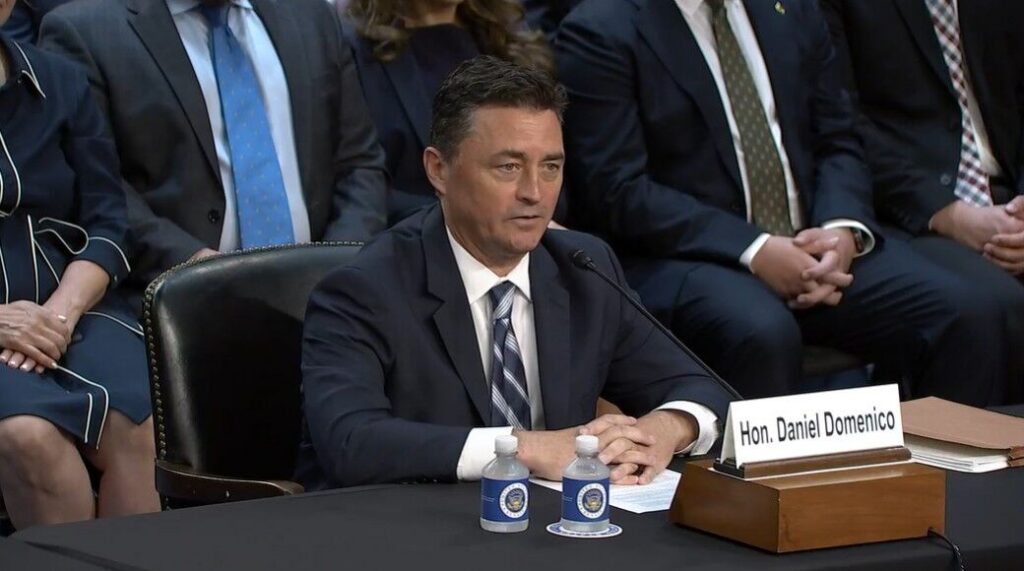
President Donald Trump’s nominee to the Denver-based federal appeals court declined to say who won the 2020 presidential election during his appearance before the U.S. Senate Judiciary Committee on Wednesday, and defended his recent rulings in immigration detention cases. U.S....
Colorado law allowing lawsuits against ‘conversion therapy’ providers takes effect July 1
Marissa Ventrelli
marissa.ventrelli@coloradopolitics.com
Updated 2 days ago
With a new law taking effect July 1, Colorado is creating a legal pathway for people to sue licensed providers of “conversion therapy,” even as debate over the practice’s constitutionality continues in the wake of a recent U.S. Supreme Court...
Colorado justices expand ability for civil defendants to avoid participating, win after trial
Michael Karlik
michael.karlik@coloradopolitics.com
Updated 3 days ago
The Colorado Supreme Court decided on Tuesday that a civil defendant, whose non-participation in the case meant that he legally admitted to the sexual assault allegations against him, could nonetheless prevail after he showed up to testify at trial. A...
PREV
PREVIOUS

Colorado House OKs expanding employment discrimination law to cover domestic workers
Legislation to protect tens of thousands of domestic workers from employment discrimination passed a major hurdle Thursday, receiving approval from the Colorado House. If enacted, House Bill 1367 would expand the Colorado Anti-Discrimination Act to cover employees who work for private households, such as cleaners, gardeners, nannies or elderly care takers. The bill would also […]
Colorado House passes bill that would help communities affected by coal plant closures
The Colorado House passed legislation Thursday that would direct $15 million from the state’s general fund to the Office of Just Transition, which was created to try to lessen the economic and social effects of the closure of coal power plants and mines across the state. House Bill 22-1394, which was approved 51-12, would transfer the funds […]