

Colorado COVID hospitalizations increase for first time in weeks as subvariants gain ground
COVID-19 hospitalizations in Colorado have increased for the first time after weeks of welcome declines, with the reversal fueled by the increased presence of sub-strains of the omicron variant.
Hospitalizations, as well as case and positivity rates, have all ticked upward in the latter half of April, state officials said Friday. The average number of new COVID-19 cases reported each day in Colorado has doubled over the past month, and the positivity rate has ticked above the 5% threshold, a sign that the virus is spreading faster.
But still, both of those metrics – along with hospitalizations – are far below what they were in mid-January or during much of the delta wave that swept through the state in the latter part of 2021.
The recent increase is primarily attributable to BA.2, a subvariant of omicron, which accounts for 80% of new infections in the state. It’s more transmissible – but not more severe – than omicron.
But it’s being shadowed now by a second subvariant, BA.2.12.1, which is more transmissible than both BA.2 and the initial omicron strain. This latest version caused 11% of the new cases in the state, and Rachel Herlihy, the state’s epidemiologist, told reporters Friday that it “probably could become the dominant here in the United States and in Colorado.”
Part of what makes omicron so disruptive is waning immunity from vaccinations and its ability to evade previous immunity from infections, like delta. But the sheer scale of infections from the omicron wave, which began in December, helped end the wave within two months and, experts have said, should give Coloradans broad immunity into the early summer.
Herlihy said BA.2.12.1 – the most recent subvariant – is still new and is being studied but that it doesn’t appear to be able to evade immunity from previous omicron infections. That’s a good sign, she said.
Cases, the positivity rate and hospitalizations are all likely to continue to increase in the coming weeks, Herlihy said. But they’re unlikely to match previous highs, according to a team of researchers who released their latest pandemic projections Wednesday.
“BA.2 could cause an increase in COVID-19 cases and hospitalizations in the next three months, but hospitalization peaks are projected to be well below prior peaks,” the researchers, led by the Colorado School of Public Health, wrote.
Herlihy told reporters that projections don’t indicate that hospitals will be strained to the degree they were just a few months ago. Hospital capacity has long been the most-watched metric of state officials, particularly given the high level of vaccination among the population.
Scott Bookman, the state’s incident commander for COVID-19, told reporters that officials were monitoring the increase and would react as necessary. The state had begun to step back from its active role in testing, vaccinating and treating COVID-19 cases, given the decline in cases, wide uptake of vaccinations and the stabilization of the health care system.
Herlihy and other officials, including the modeling team, have said Colorado’s high rate of immunity – from vaccination and from the number of infections from omicron – should give the state some protection, even if temporary, against large waves.
That could change if a new variant, which is both highly transmissible and capable of evading prior immunity, emerged. Thus far, omicron has been followed in dominance by its own progeny. But should that family tree be replaced atop the hill by a more concerning variant, officials have said, cases and hospitalizations could jerk back to levels seen during the worst peaks of the pandemic.


US Rep. Lauren Boebert’s son arrested, faces charges of sexual exploitation of child
Matt Kyle
matt.kyle@denvergazette.com
Updated 16 minutes ago
U.S. Rep. Lauren Boebert’s son Tyler Boebert has been arrested and faces charges of sexual exploitation of a child, according to court records. The case originates out of Garfield County in Western Colorado. Tyler Boebert, 21, faces five counts in...
Federal judge declines to dismiss First Amendment retaliation claim against prison official
Michael Karlik
michael.karlik@coloradopolitics.com
Updated 2 hours ago
A federal judge agreed last month that an incarcerated Native American woman may pursue her claim of First Amendment retaliation against a prison official who allegedly interfered with her religious exercise. Yvonne Peterson resided at Buena Vista Correctional Facility for...
By the students, for the students: Sierra High School represents Colorado in developing national AI framework
Eric Young
eric.young@gazette.com
Updated 1 hour ago
To many, the recent, rapid development of generative artificial intelligence and its lack of frameworks and oversight may evoke comparisons to the unrestrained Wild West in the 1800s or the economic potential of the dot-com boom in the early 2000s....

Colorado’s troubled guardianship office pursues ‘cultural reset’
Marianne Goodland
marianne.goodland@coloradopolitics.com
Updated 2 hours ago
Colorado’s guardianship program, long criticized for mismanagement and high staff attrition, is undergoing a “cultural reset,” as its new director works to repair partnerships and prepare for a major expansion under recent legislation. Created by lawmakers in 2017, the Office...
Fifty years later, women reflect on first coed class at the Air Force Academy, struggle for equality
Mary Shinn
mary-shinn@coloradopolitics.com
Updated 2 days ago
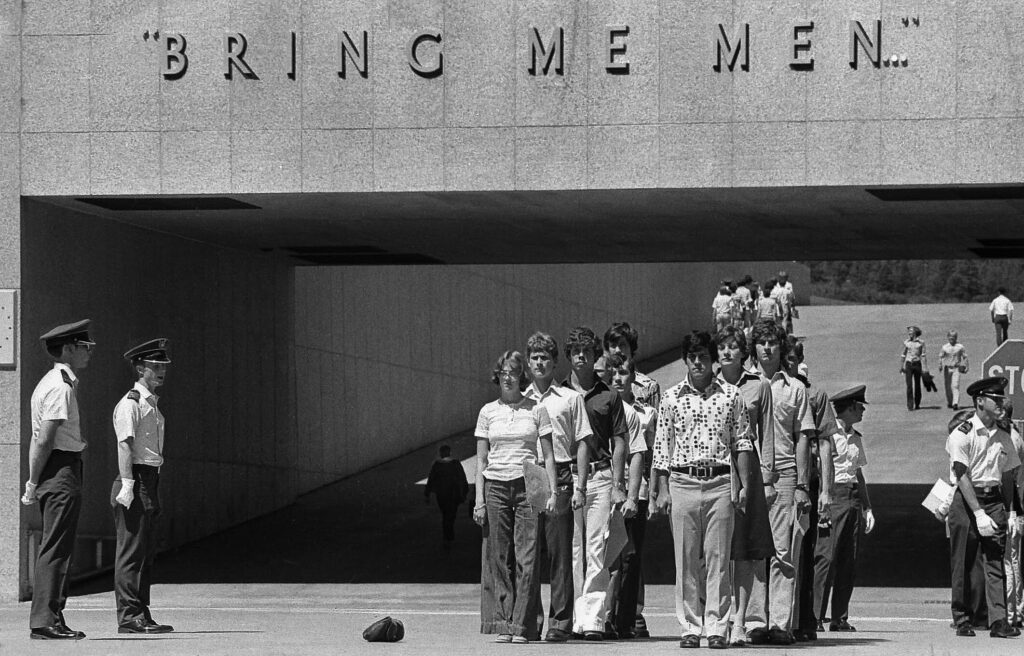
When the first female Air Force Academy cadets arrived 50 years ago this summer, they stood in front of an enormous sign on campus that read “Bring me men.” In the shadow of that sign, Kathleen Utley Kornahrens, one of...

As Lake Powell shrinks, marinas are having to adapt to dwindling water levels | OUT WEST ROUNDUP
The Associated Press
the-associated-press@coloradopolitics.com
Updated 5 days ago
ARIZONA Reservoirs near record lows PAGE — The Colorado River’s Lake Powell, the second largest reservoir in the U.S., is shrinking. A record-dry winter and extreme heat — as well as decades of overuse, chronic drought and climate change —...
U.S. Senate OKs funding bill to avoid government shutdown
Wire Services
wire-services@coloradopolitics.com
Updated 2 days ago
Hemp provision became point of contention WASHINGTON • The U.S. Senate in an overnight vote Saturday approved a short-term measure to fund federal agencies into early December and avoid a government shutdown during the middle of campaign season. The late-summer...

The relevance of Watergate more than a half-century later | SONDERMANN
By Eric Sondermann
by-eric-sondermann@coloradopolitics.com
Updated 5 days ago
It was the scandal for which all other scandals are now named. In June 1972, a small group of Cuban burglars with high-level connections broke into the headquarters of the Democratic National Committee. Those headquarters were located in the Watergate...

Wirth downplays Social Security disaster talk | A LOOK BACK
Rachael Wright, Special to Colorado Politics
rachael.wright@coloradopolitics.com
Updated 4 days ago
Forty-five years ago this week: “As time goes on,” said Democratic U.S. Rep. Tim Wirth, of the 2nd Congressional District, “we are finding that the safety net, which was proposed earlier this year, has some very large holes in it,”...

Colorado Politics Calendar Aug. 10-16
Rachael Wright, Special to Colorado Politics
rachael.wright@coloradopolitics.com
Updated 4 days ago
CoPo’s weekly political calendar will help you find political and public-policy events throughout Colorado. It includes candidate and issue campaign events, public policy meetings, court hearings, state and local party conventions, assemblies, debates, rallies, parades, speaking engagements, traveling dignitary appearances,...
PREV
PREVIOUS

Republican Brad Dempsey sues for slot in 7th CD primary, says unaffiliated voters can sign petitions
Republican congressional candidate Brad Dempsey is suing Secretary of State Jena Griswold for a spot in Colorado’s 7th Congressional District primary after her office determined his campaign didn’t submit a sufficient number of valid petition signatures. In a lawsuit filed late Wednesday in Denver District Court, Dempsey and four unaffiliated Jefferson County voters say that […]

House OKs wildfire mitigation grant program, tax credit for Colorado homeowners
As Colorado faces what experts say could be the state’s worst wildfire season in history, lawmakers are seeking to incentivize wildfire mitigation efforts. The state House passed House Bill 1007 on Friday, which would create a grant program for organizations that conduct wildfire mitigation outreach in hazard areas. The bill would also extend an existing […]