

Legislature ran afoul of constitution with marijuana law, appeals court finds

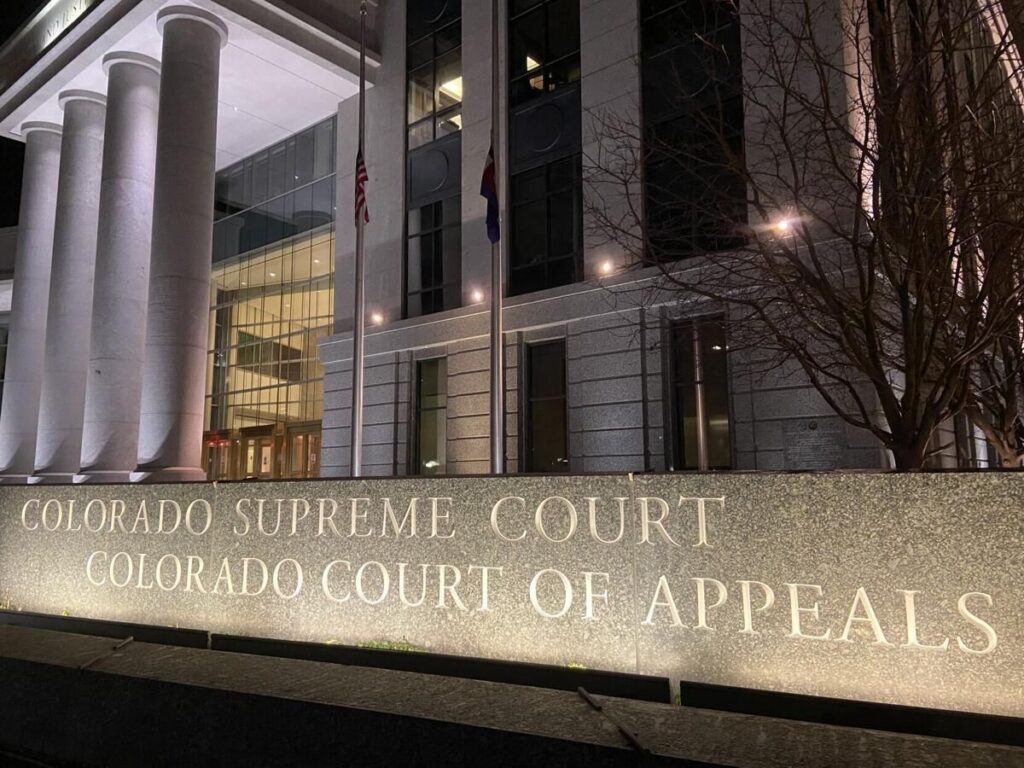
The Colorado General Assembly went beyond the state constitution in creating another condition a person must satisfy to defend themselves against medical marijuana crimes, the Court of Appeals decided on Thursday.
A three-judge panel found a Mesa County judge correctly declined to instruct a jury that a defendant’s cannabis grow was legal only if it took place in an enclosed and locked space, noting that this legislatively-added stipulation “cannot trump the constitution.”
Daniel P. Rubinstein, the Mesa County district attorney, was disappointed the Court of Appeals had not explicitly resolved the question of the law’s constitutionality, but found the opinion useful in clarifying to police officers that growing in an unenclosed or unlocked space was not a sole basis for arresting someone. However, Rubinstein believed the legislature was allowed to impose further restrictions on cannabis cultivation beyond what the text of the constitution allows.
“In the U.S. Constitution, for example, you have the right to possess firearms, but we don’t allow you to bring them into the courthouse. It’s a bad idea for people to show up to their divorce hearing with a gun,” he said. “It’s not like there isn’t some reasonable regulatory scheme.”
In 2012, voters legalized medical cannabis, inserting language into the state constitution that permitted an adult to defend themselves against charges related to medical cannabis under three conditions. First, a physician must diagnose the patient as having a debilitating medical condition. Second, there must be a determination that the patient may benefit medically from the use of cannabis. Finally, the patient or a caregiver must not possess amounts of marijuana that exceed the limits on weight or the number of plants.
In 2016, for public safety and health reasons, the General Assembly added another restriction: that the cultivation take place “in an enclosed and locked space.” There were further requirements for caregivers to maintain a list of patients and possess a registration card.
Last year, a Supreme Court committee that reviews criminal jury instructions examined whether jurors, in deciding the validity of a marijuana grower’s defense, may also find that prosecutors proved the cultivation did not happen in an enclosed and locked space. The committee said no, “because the constitutional defense applies regardless of whether the space is enclosed or locked – and because the statute cannot constitutionally narrow the breadth of this defense.”
The appellate panel agreed, with Judge Michael H. Berger concluding in the court’s May 13 opinion that “the district attorney has not cited, and we have not found, any case that authorizes the legislature to substantively dilute rights expressly granted in the constitution.”
In the case under consideration, David Lawrence Cox was growing medical cannabis in his partially-enclosed backyard, along with multiple tons of industrial hemp. Cox said he was a “primary caregiver,” which the General Assembly has defined to include people who cultivate marijuana for patients. Police searched his property in October 2017, and prosecutors charged him with multiple felony offenses and two misdemeanor child abuse counts.
“I had followed the directions clearly published on the Mesa County Sheriff’s website for a grow just like mine,” Cox told Colorado Politics.
Cox, whom 9News described as a Palisade peach grower and 9/11 conspiracy theorist, represented himself at trial and a jury acquitted him of the marijuana offenses. Mesa County District Court Judge Brian J. Flynn declined prosecutors’ request to tell the jury Cox had to prove the additional elements of his grow operation beyond the three conditions in the constitution.
Mark A. Herber, Cox’s lawyer for the appeal, said it has been unclear for some time how the three constitutional conditions for defending oneself against marijuana cultivation charges square with the legislature’s added elements.
“The biggest issue I’ve heard throughout the years is enclosed and locked space,” he said.
Prosecutors appealed the decision to the state Supreme Court, which decided against taking up the question of the law’s constitutionality. The district attorney’s office then turned to the Court of Appeals for clarity.
“There is no case law preventing a reasonable precondition on a constitutional right. To the contrary, this can and is often done, on virtually every other fundamental right. You cannot shout fire in a crowded movie theater,” argued George Alan Holley II, the senior deputy trial district attorney in Mesa County, to the appeals court. He added that the judiciary presumes laws passed by the General Assembly are constitutional.
The appellate panel countered that nothing in the constitutional provision about medical marijuana empowered the legislature to place additional restrictions on a person’s defense against criminal charges.
Stan Garnett, a former district attorney for Boulder County, said the state constitution’s built-in defense for medical marijuana offenses is fairly unusual. He explained that because the Supreme Court and Court of Appeals did not strike down the law as unconstitutional in Cox’s case, the decision served to put prosecutors on notice that they could not seek any additional restrictions on a person’s defense at trial.
Rather than a declaration of unconstitutionality, “there may be a finding that it can’t be applied or it’s not workable,” said Garnett.
Cox has also been a Republican congressional and state legislative candidate, and argued at trial that his prosecution was politically motivated.
The case is People v. Cox.
This article has been updated with Cox’s comments about his grow operation.



Denver murder conviction reversed for incomplete self-defense instruction
Michael Karlik
michael.karlik@coloradopolitics.com
Updated 11 hours ago
Colorado’s second-highest court reversed a defendant’s murder conviction last week because a Denver judge gave an incomplete instruction to the jury about the man’s right to self-defense. Donald R. Gonzales and Gary McLaughlin met up in a Capitol Hill parking...
Colorado lawmaker, House leaders named in workplace-retaliation lawsuit
Marianne Goodland
marianne.goodland@coloradopolitics.com
Updated 14 hours ago
A former legislative aide has filed a lawsuit alleging she was mistreated, illegally directed to perform campaign work and harmed by a House leadership structure she charged was fragmented, politicized and ineffective at protecting employees. The lawsuit, filed by Jennifer...
Federal judge hears arguments about Colorado’s 3-day gun purchase waiting period
Michael Karlik
michael.karlik@coloradopolitics.com
Updated 19 hours ago
A federal judge heard arguments on Monday about the constitutionality of a 2023 Colorado law that generally imposes a three-day waiting period on firearm purchases after the initiation of a background check. The test that the U.S. Supreme Court created...
Colorado Supreme Court intervenes in Weld County prosecution dismissed due to Missy Woods misconduct
Michael Karlik
michael.karlik@coloradopolitics.com
Updated 11 hours ago
The Colorado Supreme Court ordered a Weld County trial judge last week to respond to the district attorney’s claim that he improperly dismissed a criminal case because of “outrageous” conduct by the Colorado Bureau of Investigation. Daniel Lee Eatinger stood...
Schoolchildren’s presence at child sex-related trial did not harm Arapahoe County defendant, appeals court says
Michael Karlik
michael.karlik@coloradopolitics.com
Updated 3 days ago
Colorado’s second-highest court decided on Thursday that the presence of a group of schoolchildren on the first day of a child sexual exploitation trial did not violate an Arapahoe County defendant’s constitutional right to a fair trial. Prosecutors charged Jerry...
Appeals court cites week-old Colorado law to reinstate child neglect case at child, father’s request
Michael Karlik
michael.karlik@coloradopolitics.com
Updated 3 days ago
Colorado’s second-highest court invoked a new state law for the first time on Thursday and reinstated a child neglect case that both the child and her father wished to reopen. House Bill 1227 took effect on Aug. 12, reversing a...
Colorado Supreme Court names William Hood as next chief justice
Michael Karlik
michael.karlik@coloradopolitics.com
Updated 4 days ago
The Colorado Supreme Court has selected Justice William W. Hood III to be the next chief justice, the judicial branch announced on Friday. Hood will succeed Chief Justice Monica M. Márquez, who took over the role in July 2024. “I...
Family of slain Lakewood teacher releases statement as murder suspect makes first court appearance
Matt Kyle
matt.kyle@denvergazette.com
Updated 2 days ago
Patrick Theodore Barnett, the Lakewood man accused of killing his wife, a Jeffco Public Schools art teacher, made his first court appearance Friday morning as his wife’s family looked on. The status conference hearing was held before District Court Judge...
Appeals court upholds Park County trophy hunting conviction
Michael Karlik
michael.karlik@coloradopolitics.com
Updated 4 days ago
Colorado’s second-highest court clarified on Thursday that a defendant may stand convicted under the state’s trophy hunting laws if he abandons a bear carcass but returns later to remove the meat. Under Colorado law, it is a felony to detach...
Judge grants partial injunction to GEO in fight against state health inspection law
Kyla Pearce
kyla.pearce@gazette.com
Updated 5 days ago
A judge ruled Thursday that The GEO Group does not have to follow parts of a new state law requiring more frequent health and safety inspections at the U.S. Immigration and Customs Enforcement processing center in Aurora. Under the order...
PREV
PREVIOUS

Group argues Park Hill Golf Course committee facilitator has ties to redevelopment company
Save Open Space Denver sent a letter Tuesday calling for the removal of Dr. Ryan Ross as steering committee facilitator of the Park Hill Golf Course development project, alleging conflicts of interest. The letter, addressed to Mayor Michael Hancock and his administration, claims Ross works with the Five Points Development Corporation with Norman Harris. Harris […]

Bill tightening background checks on gun sales advances to final House vote
The House on Friday advanced a bill seeking to tighten background checks on firearms sales, the first of a trio of bill introduced in the aftermath of the mass shooting in Boulder to be eligible for a final vote in one of the chambers of the state legislature. House Bill 1298 would change state law […]