

Gov. Jared Polis to sign the rest of the bills from last week’s special session
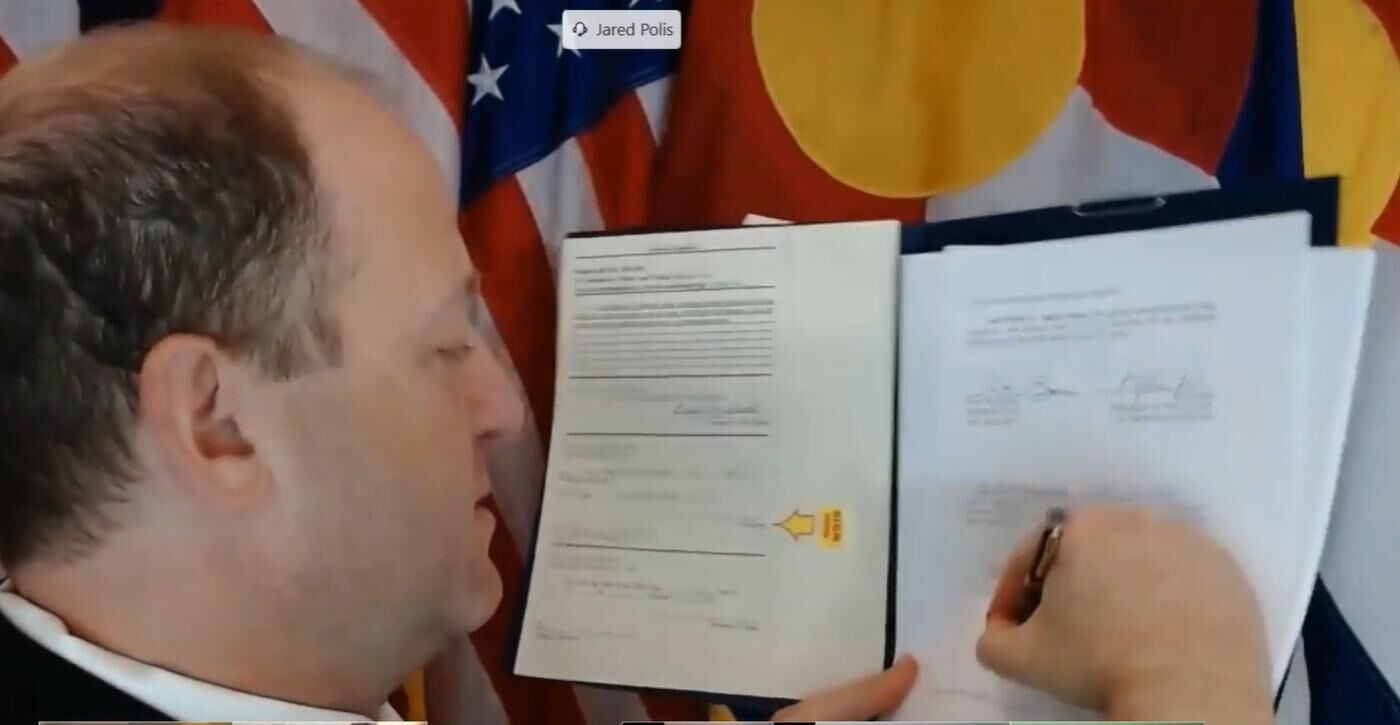
Gov. Jared Polis, who is still in quarantine from COVID-19, is signing on Monday nine of the 10 bills passed by the General Assembly from last week’s special session.
The first four were signed Monday morning, beginning at 10:30 a.m.
The General Assembly dealt with seven issues during its three-day session last week, all related to short-term COVID-19 relief for Coloradans. The bills provide funding for rental and other housing assistance, food pantry aid, direct aid to restaurants, bars, gyms, minority-owned businesses and arts organization and help with utility bills.
Monday morning, Polis signed House Bill 20B-1004, which allows restaurants, bars and food trucks impacted by capacity restrictions to retain the 2.9% state sales tax for four months, beginning with November, 2020 and lasting until the end of February. Those businesses can keep up to $2,000 per month to pay for rent and other business needs. The estimated loss of revenue to the state could reach up to $52.8 million, according to the bill’s fiscal note.
Polis also signed Senate Bill 20B-001, the direct aid bill. That comes with a price tag of $57.1 million. Of that, $37 million would go to restaurants, bars and gyms impacted by capacity restrictions. The bill also waives fees for liquor licenses for one year.
Another $7.5 million would go to cultural and arts organization, and $4 million would be available to minority-owned businesses.
The bill came with controversy, especially in the House, because businesses that want the aid must be in counties that comply with state and local public health orders. The only exception for those businesses in non-complying counites is if they are located in a municipality that is in compliance. That language addresses some of the frustration Gov. Jared Polis and others have had about Weld County, where commissioners have said they will not obey state public health orders and rely on citizens to do what they think is best.
The governor also signed two bills not contained in the special session call.
House Bill 20B-1005 grants local governments authority to limit the fees charged to restaurants by food delivery companies. The bill was backed by the Colorado Restaurant Association and could provide a boost to small restaurants that are already struggling to stay afloat on take-out business only. Some delivery services charge up to 35% of the food cost for delivery, although according to the restaurant association the break-even is at 20%. The bill also prohibits those delivery services from cutting driver pay or tips to offset the fee restrictions.
House Bill 20B-1006 is a complicated measure tied to the Colorado Loans to Increase Mainstreet Business Economic Recovery, or CLIMBER Act. That’s a bill passed in the 2020 regular session to provide recovery loans tied to the pandemic. The bill sets up the sale of premium tax credits that are due to take place later this month and which could bring in up to $250 million for those small and mid-sized businesses.
Polis was joined in the virtual signing by a several lawmakers and commissioners from Summit and Adams counties.
“This overwhelming vote of support for our small businesses in this bill we’re signing today really shows that the state understands that it is our small businesses that help define the culture of our communities and our main streets,” Polis said. “Without them, we really lose part of our identity and who we are, above and beyond the jobs, which are absolutely critical for putting food on the table for families and as our main engine of economic growth.”
Polis pledged to continue working on assistance for small businesses, but said he hoped the federal government steps up with another COVID-19 relief package in the coming months.
“This is not enough, this is not going to save every business. We just simply don’t have those resources,” said Sen. Faith Winter, D-Westminster, one of the sponsors of SB1. “But with the federal government’s continued inaction, it was important for us to come together in a bipartisan way, spend the resources we do have available” and the tools available to get relief out as soon as possible.
Rep. Leslie Herod, D-Denver, addressed the funding for arts organizations and noted the announcement Monday of the closure of longtime jazz club El Chapultepec. SB1 will take a shot at making sure the cultural venues stay open, Herod said. Herod also noted that small businesses owned by people of color have been disproportionately affected and left behind by the federal paycheck protection program.
“But it’s not enough,” Herod said, also calling on the federal government to come up with an aid package.
Polis is scheduled to sign the other five bills beginning at 3:30 p.m. Monday.
Polis last Thursday signed Senate Bill 20B-004, which puts $100 million into the state’s controlled maintenance fund, which can then be transferred to the state’s disaster emergency fund to pay for the state’s COVID-19 efforts. Polis immediately ordered the transfer of $84.3 million to the disaster emergency fund.


US service member missing after Iran shot down fighter jet has been rescued, US officials say
Associated Press
associated-press@coloradopolitics.com
Updated 15 hours ago
JERUSALEM — President Donald Trump announced early Sunday that the U.S. had rescued an aviator nearly two days after he was shot down over Iran. The extraction came after a frantic search in what appears to be a remote, mountainous region of...

Low and slow meets forever: US postage stamps honor lowrider car culture | OUT WEST ROUNDUP
The Associated Press
the-associated-press@coloradopolitics.com
Updated 5 days ago
NEW MEXICO Stamps honor lowrider culture ALBUQUERQUE — From Mexican American and Chicano barrios in the American Southwest to the halls of the Smithsonian on the National Mall and even the streets of Japan, lowrider culture has become part of...

Colorado Politics Calendar Apr. 6-12
Rachael Wright, Special to Colorado Politics
rachael.wright@coloradopolitics.com
Updated 5 days ago
CoPo’s weekly political calendar will help you find political and public-policy events throughout Colorado. It includes candidate and issue campaign events, public policy meetings, court hearings, state and local party conventions, assemblies, debates, rallies, parades, speaking engagements, traveling dignitary appearances,...

Democrats rebounding without learning necessary lessons | SONDERMANN
Eric Sondermann
eric-sondermann@coloradopolitics.com
Updated 2 days ago
“When we fight, we win!” That, reportedly, was the chant heard over and over again at the Colorado Democratic Assembly a week ago. It suggests that pugilism has been the piece missing from the Democratic toolkit. Perhaps it was just...
An April Fool’s Day to remember | Capitol M | Week of April 4, 2026
Marianne Goodland
marianne.goodland@coloradopolitics.com
Updated 3 days ago
The lighter side of the Capitol, and if light were weight, the Capitol would have lifted off better than the Artemis II rocket on April Fool’s Day. There was a plethora of Fools at the Capitol for April Fool’s Day...

Federal judge sides with Mesa County school district in ex-student’s First Amendment claims
Michael Karlik
michael.karlik@coloradopolitics.com
Updated 2 days ago
A federal judge concluded last week that Mesa County Valley School District 51 and three of its administrators did not violate the First Amendment rights of a former student when they imposed minor discipline in response to disruptive behavior. In...

Colorado Supreme Court intervenes in 4 ongoing cases
Michael Karlik
michael.karlik@coloradopolitics.com
Updated 2 days ago
The Colorado Supreme Court recently moved to intervene in four ongoing cases, including two criminal prosecutions, a civil lawsuit, and a child welfare proceeding. At least four of the court’s seven members must agree to hear a case outside of...
Colorado ski resorts announce early closures amid historic snowpack lows, high temperatures
Kyla Pearce
kyla.pearce@gazette.com
Updated 2 days ago
Vail Resorts is the latest area to announce season closure Wednesday As Colorado’s historically low snowpack year comes to a close and spring conditions take over the mountains, the state’s major ski resorts are announcing closing dates — some of...

Kentucky Gov. Andy Beshear set to headline Colorado Democrats’ annual fundraising dinner
Ernest Luning
ernest.luning@coloradopolitics.com
Updated 2 days ago
Kentucky Gov. Andy Beshear, one of the Democrats’ top 2028 presidential prospects, is scheduled to deliver the keynote address at the Colorado Democratic Party’s annual fundraising dinner in June in Denver, the party said Friday. Serving his second term as...
Gov. Polis names new leaders for Colorado health agencies in wake of Medicaid turmoil
Marianne Goodland
marianne.goodland@coloradopolitics.com
Updated 2 days ago
Gov. Jared Polis, on Thursday, announced he was appointing Gretchen Hammer to serve as acting executive director of the Colorado Department of Health Care Policy and Financing, and deputy executive director Stephanie Beasley to become the next commissioner of the...
PREV
PREVIOUS
Snowpack dwindles in Colorado, as widespread drought continues
Though Colorado previously rose above the median to-date snowpack in early November, the dry weeks that followed have caused the state’s snowpack to lag behind what is typically expected for this time of the year. According to the United States Department of Agriculture and the Natural Resources Conservation Service, Colorado is currently at just 76 […]

Specialty courts work, but fairness of access questioned
District attorneys tout specialty courts and diversion programs, designed to rehabilitate rather than incarcerate, as a success story. The worth of these programs is a rare topic both Republican and Democratic district attorneys often agree on. In Colorado, specialty courts – also known as problem-solving courts – include drug courts, mental health courts, veterans’ treatment […]