

As House GOP took aim at pandemic restrictions, Democrats’ exasperation surfaced
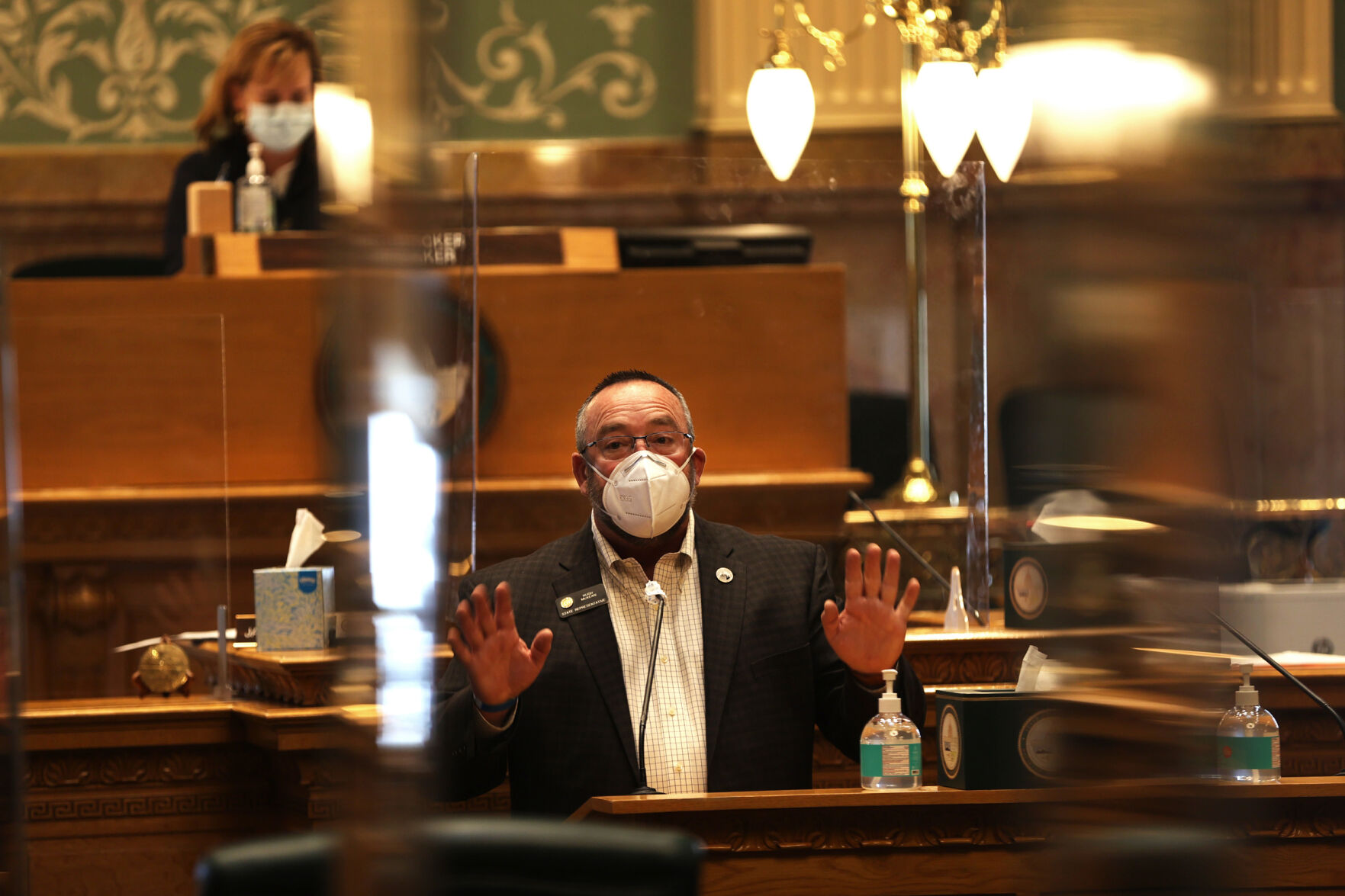
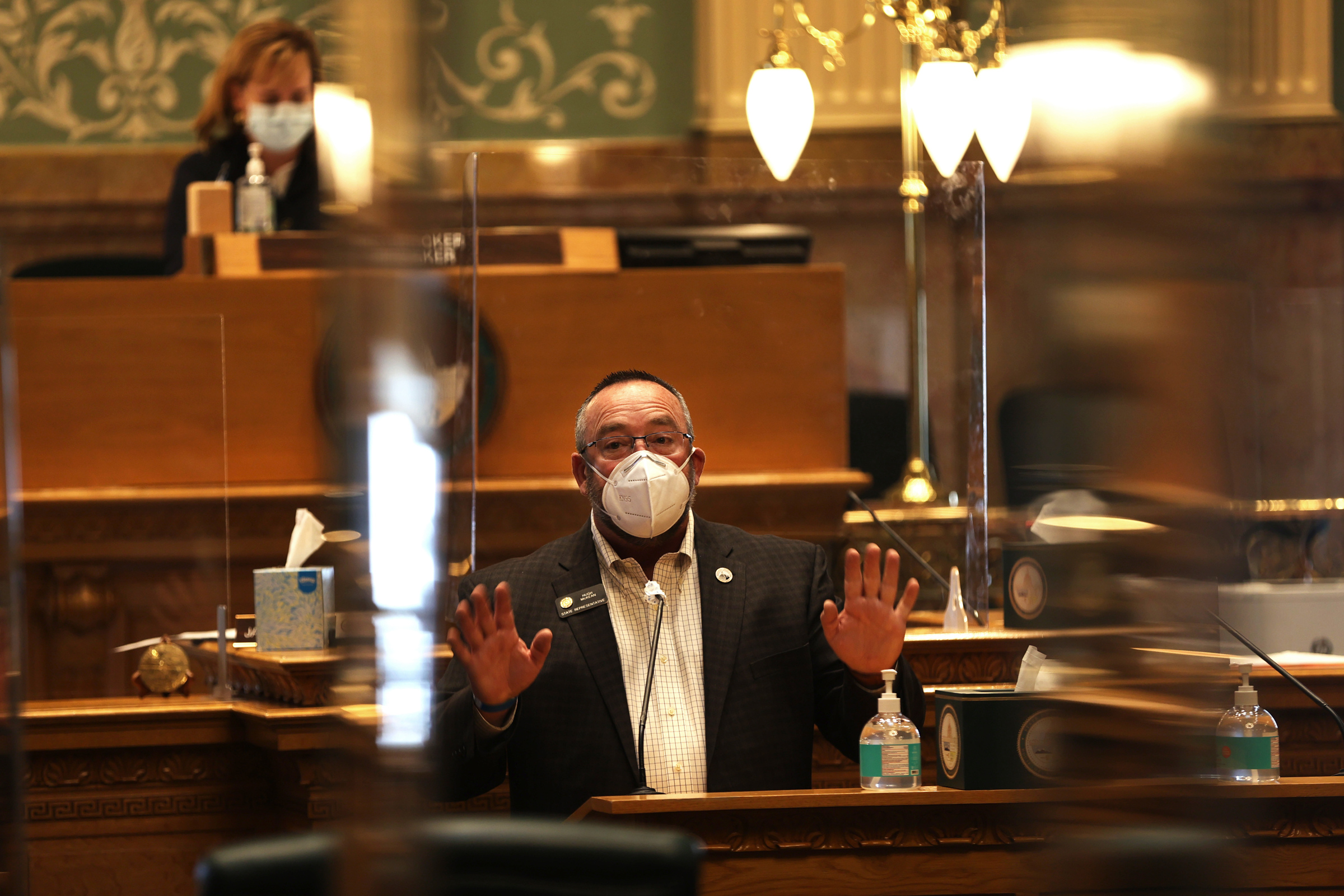
If Colorado’s House Republicans had annoyed Democrats during the three-day special session by repeated attempts to undermine COVID-19 health orders and going maskless at the Capitol, the frustration boiled over on the final day.
“In this chamber, some people have chosen not to wear face masks, and to come over and talk to their colleagues without face masks,” said Rep. Cathy Kipp, D-Fort Collins, standing at the microphone with her voice shaking and her Democratic colleagues standing in solidarity. “I find that offensive. I am not going to tolerate people encouraging the kind of civil disobedience that will cost lives. That is not OK.”
Kipp was also the lawmaker who tweeted a photo on Monday of Rep. Larry Liston, R-Colorado Springs, wearing his mask over the top of his head instead of over his face. Liston denied any wrongdoing, saying critics were being “way too sensitive.”
After several members of the majority party had voiced concerns about their own safety attending a large public gathering at a time when one in 41 Coloradans has COVID-19, they were relieved Kipp had finally said what they felt.
“Rep. Kipp doesn’t say much at the mic, so when she talks, it’s important and from the heart,” observed Rep. Jonathan Singer, D-Longmont.
With a husband who is a cancer survivor and a diabetic, Rep. Julie McCluskie, D-Dillon, said she struggled with the responsibility to her constituents and avoidance of unnecessary risk.
“I am angered that members of this body use mask-wearing and non-compliance with public health guidance as political show. I am grateful for Rep. Kipp’s words,” she said.
Republicans who did honor mask-wearing and distancing guidelines were nonetheless disinclined to criticize their colleagues who chose to do otherwise.
“I see it as a courtesy, whether I agree or disagree with it. To me it’s a courtesy and a respect thing,” said Rep. Jim Wilson, R-Salida, who attended the session remotely because he did not want to bring home a potentially fatal virus to his wife and family.
Most members of his caucus, said Rep. Richard Holtorf, R-Akron, did not, in his opinion, see mask-wearing as an issue of respect. Although Holtorf did cover his face, he also suggested that it is detrimental to “live in fear” of the virus.
He did agree that Kipp was right to be offended – to a point.
“She should have said, ‘please stay back 6 feet. I’m concerned about the COVID threat,’ and she should have stated that to whomever she was dialoguing with,” Holtorf said. “And she should have further said, ‘would you please put on a mask so we can have a professional dialogue and I am comfortable we’re both protected?'”
If the person refused, “then she had every right to come forward and make the claim she made.”
However, seeing mask-wearing only as a courtesy to be invited was not the diagnosis of some Democrats.
“It seems that putting one’s health at risk is a strange protest behavior passed down from the nation’s worst and most unintelligent president ever,” observed Rep. Alex Valdez, D-Denver. “It’s a sad state of things.”
But conflict over personal health choices was not the only subtext to the extraordinary session.
What prompted Kipp’s remarks was a speech from maskless Rep. Dave Williams, R-Colorado Springs, announcing his opposition to a bill covering $57 million in aid and associated costs to small businesses, minority-owned companies, and arts and cultural organizations. In doing so, Williams incited businesses to disregard COVID-19 restrictions that adversely affect their operations.
“I think it’s time that more businesses rise up and engage in civil disobedience. I encourage it and I encourage all of you to encourage it,” Williams said.
Kipp added in her rebuke that such rhetoric was irresponsible. “You are encouraging your local businesses to have their license revoked by the state,” she warned.
On Tuesday, Republicans in the House of Representatives attempted to attach several amendments to relief legislation to curb Gov. Jared Polis’s emergency powers and overturn public health orders. Williams himself offered several: one to exempt faith houses from restrictions; another to retain legislative control over spending.
Along with Liston, he introduced amendments to restore 100% capacity to businesses that were otherwise following health orders. Then, when that failed, 75%. Then 73%. Then 50%.
“When we continue on in the state of emergency and then have emergency orders numbering over 230,” argued Rep. Mark Baisley, R-Roxborough Park, “we’re no longer living under a constitutional republic. We’re living under the imagination, the preference, of one particular person.”
McCluskie, one of the sponsors of the relief legislation, pushed back on attempts to micromanage the work of the Colorado Department of Public Health and Environment.
“Any other focus on public health guidance that has been coming from CDPHE or the governor’s office should remain outside of this bill,” she warned.
Holtorf had been a critic of Republicans’ treatment during the special session and of the pandemic directives on rural Colorado generally but sided at first against his party.
“I hate to inform my colleagues, but this bill has nothing to do with your freedoms. This bill has nothing to do with your constitutional rights,” he said during the floor debate. “If Gov. Polis needs funds, then we are here and have been directed to give him the money.”
Although he ultimately reversed course and voted for the amendment about faith houses, Holtorf said on Wednesday that he did it to keep harmony in the caucus, and he stood by his comments.
“There is a very strong sentiment among constituents that the Republican legislators need to make statements and need to try to correct and realign constitutional rights with the governor’s authorities,” Holtorf said. “And truly many Republicans believe that the constitutional rights are not diminished during war or times or crisis or times of pandemic.”
While Democrats argued government assistance was needed to mitigate the effects of the pandemic, Republicans, in turn, saw the public health restrictions as the cause of pain and suffering.
“We’ve created this monster,” said Wilson. He acknowledged, however, that if Polis had lifted all restrictions months ago, businesses would likely still need economic relief.
By the end of the session, Republican efforts to curb the governor’s power had failed, while Polis will now get to sign legislation in each of the areas he identified for calling the session in the first place.
“The Governor’s grateful for the trust the people of Colorado have bestowed upon him to manage this pandemic,” said Conor Cahill, a spokesperson for Polis. “The Governor is proud of legislators of both parties for coming together to help solve problems.”


Trump lowers flags to half-staff for Dolly Parton: ‘The World loves you’
Naomi Lim
naomi-lim@coloradopolitics.com
Updated 16 hours ago
President Donald Trump is honoring the life of country music legend and philanthropist Dolly Parton by ordering federal buildings across the country to lower flags to half-staff for a week. “Very sad to report that Dolly Parton, one of the...
Ted Cruz suggests GOP realignment coming after Trump leaves office
Emily Hallas
emily-hallas@coloradopolitics.com
Updated 16 hours ago
Sen. Ted Cruz (R-TX) on Monday suggested the Republican Party could embrace a directional shift after President Donald Trump leaves office, a transition that promises to leave a gaping hole in the GOP. Cruz is known as a critical ally...
2 Colorado State troopers shot near Woodland Park; suspect killed
DEBBIE KELLEY
debbie-kelley@coloradopolitics.com
Updated 15 hours ago
Two Colorado State Patrol troopers were hospitalized, and a suspect is dead after a shooting during a traffic stop Tuesday. The initial incident happened at about 7:15 a.m., when a resident reported suspicious activity in the area near milepost 286...

Aurora moves forward with data center regulations
Kyla Pearce
kyla.pearce@gazette.com
Updated 15 hours ago
The Aurora City Council approved moving forward with two new regulations on data centers and directed staff to come back at the next study session with others. At a council meeting in early August, council members directed city management to...

Aurora City Council considers stricter food truck regulations
Kyla Pearce
kyla.pearce@gazette.com
Updated 15 hours ago
The Aurora City Council is considering passing laws to limit the number of food trucks on properties in the city and how and when they operate. Councilmember Angela Lawson, who sponsored the ordinance, said she understands the importance of food...
Denver murder conviction reversed for incomplete self-defense instruction
Michael Karlik
michael.karlik@coloradopolitics.com
Updated 13 hours ago
Colorado’s second-highest court reversed a defendant’s murder conviction last week because a Denver judge gave an incomplete instruction to the jury about the man’s right to self-defense. Donald R. Gonzales and Gary McLaughlin met up in a Capitol Hill parking...
Colorado lawmaker, House leaders named in workplace-retaliation lawsuit
Marianne Goodland
marianne.goodland@coloradopolitics.com
Updated 16 hours ago
A former legislative aide has filed a lawsuit alleging she was mistreated, illegally directed to perform campaign work and harmed by a House leadership structure she charged was fragmented, politicized and ineffective at protecting employees. The lawsuit, filed by Jennifer...

Secret Service confirms awareness of Iranian state media video threatening Barron Trump’s life
The Associated Press
the-associated-press@coloradopolitics.com
Updated 21 hours ago
WASHINGTON (AP) — The U.S. Secret Service has confirmed it is aware that Iranian state media has aired a video that appears to threaten the life of Barron Trump, President Donald Trump’s youngest son. “The U.S. Secret Service is aware...
Federal judge hears arguments about Colorado’s 3-day gun purchase waiting period
Michael Karlik
michael.karlik@coloradopolitics.com
Updated 21 hours ago
A federal judge heard arguments on Monday about the constitutionality of a 2023 Colorado law that generally imposes a three-day waiting period on firearm purchases after the initiation of a background check. The test that the U.S. Supreme Court created...

Denver auditor finds oversight failures in $175.6M 16th Street project
Nico Brambila
nico.brambila@denvergazette.com
Updated 15 hours ago
Surprise historic sewer discovery delayed completion a year, cost $18M The Denver Auditor recently found significant oversight and contracting problems with the $175.6 million 16th Street Improvement Project, including an $18 million contract increase and a nearly one-year extension that...
PREV
PREVIOUS
Special session ends with 10 bills heading to governor
The General Assembly approved a COVID-19 relief package of 10 bills on Wednesday, ending a three-day extraordinary session that Gov. Jared Polis called just two weeks prior. The assistance measures, which ranged from providing support to child care operators and food pantries to capping fees charged for food delivery, amounting to approximately $280 million in […]

INSIGHTS | A spirited fight when everyone agrees at the Colorado Capitol
Imagine, if you will, a place where everyone has the same goal and fundamentally has the same solution, yet they can’t stop bickering long enough to hear one another. That place was the Colorado Capitol this week. There you had Democrats and Republicans going at it in a special session to distribute $280 million in […]