

Judge improperly excluded evidence of clean drug tests, court rules in reversing convictions

Because an El Paso County judge excluded two witnesses who could speak to the defendant’s 30 clean drug tests, a man convicted of possessing methamphetamine will receive a new trial, the Court of Appeals ruled on Thursday.
“As a basic principle, we believe a jury is more likely to credit testimony of other independent witnesses than a defendant denying a ‘knowing’ possession of unlawful substances,” wrote Judge John Daniel Dailey.
Jacob Raynaldo Pineda was shopping for bicycle locks at Walmart in April 2019 when an off-duty Colorado Springs police officer and store security guard saw him put the merchandise in his pocket. They handcuffed Pineda and brought him to the security office, where they searched his backpack. Inside were methamphetamine and three glass pipes.
El Paso County prosecutors changed Pineda with theft as well as possessing a controlled substance and possessing drug paraphernalia.
Pineda defended himself by arguing he was unaware of the contents of his backpack. He had received a previous drug conviction but since underwent treatment and had not used methamphetamine since. Pineda insisted he overlooked the items in the backpack when ridding himself of old narcotics.
“My heart’s pumping,” Pineda testified about the moment when the search revealed the methamphetamine. “Initially I was confused, but then realized what he was showing me. I couldn’t believe it. It’s just the last thing I was expecting.”
A jury convicted Pineda, but he appealed, arguing the trial court should have admitted evidence showing one year of negative drug test results that corroborated his defense.
At the beginning of the trial, the prosecution attempted to block two witnesses who could speak to Pineda’s drug tests, saying that such testimony was irrelevant and would confuse the jury. The district court judge agreed, explaining that “lack of use doesn’t show that he didn’t possess.”
During oral argument before the appeals court, Heather Wong, representing Pineda, argued that even though Pineda himself testified to his lack of use, “the jury would have heard independent evidence where the strength of the evidence did not depend on Mr. Pineda’s credibility as a witness.”
The three-member panel of the Court of Appeals observed that the prosecution’s charges against Pineda did not require proof he used drugs. But they were sympathetic to Pineda’s contention that the fact he did not use was relevant to proving whether he knowingly possessed.
“Significantly, only 1.73 grams of methamphetamine were found in the backpack,” wrote Dailey in the court’s opinion. “This amount is consistent with possession of the drug for personal use, not possession of the drug with intent to distribute it to others.”
The judges agreed the evidence from Pineda’s drug tests would lend itself toward the defendant’s version of events. Dailey dismissed the prosecution’s argument that jurors may have been confused into thinking they could not convict Pineda unless he was an active drug user.
Further, the panel concluded that because the evidence against Pineda was not “overwhelming in nature,” the trial court’s error likely affected the jury’s verdict. The exclusion of the clean drug tests also gave rise to another error, in which the prosecution characterized Pineda as a “drug addict,” even though the tests showed otherwise.
“Despite knowing of independent evidence corroborating Pineda’s testimony of successful drug rehabilitation that went unconsidered by the jury,” wrote Dailey, “the prosecution improperly summed up its theory of Pineda’s guilt by saying Pineda’s ‘a drug addict. Drug addicts carry drugs with them, and that’s what happened here.’”
At oral argument, Judge Craig R. Welling quizzed the representative from the attorney general’s office about about why Pineda’s drug tests were irrelevant at the same time the prosecutor made “the argument in closing that ‘this is what we expect of a drug addict.'”
“I think the prosecutor’s statement at closing was certainly inartful,” conceded attorney Daniel Rheiner.
“The problem I have is this,” continued Judge Matthew D. Grove, the third member of the panel. If Pineda’s own testimony about his nonuse was permissible at trial, “I have trouble seeing how evidence that corroborated that testimony would be irrelevant.”
Rheiner believed the trial court judge was simply giving leeway to Pineda in telling his story.
The appellate court reversed Pineda’s two drug-related convictions. A spokesperson for the Fourth Judicial District Attorney’s Office indicated it was possible, but not likely, that prosecutors would seek to retry Pineda on the drug crimes.
The case is People v. Pineda.


Boulder police investigate sexual assault, ‘drugging’ at bar near CU
Matt Kyle
matt.kyle@denvergazette.com
Updated 1 hour ago
The Boulder Police Department is investigating reports of sexual assault and “suspected drugging” involving underage girls at a bar. There may be additional victims who have not yet come forward, the department said in a news release. The bar, Scrooge...
Appeals court finds no illegal sentence when defendants forfeit time-served credit
Michael Karlik
michael.karlik@coloradopolitics.com
Updated 3 hours ago
Colorado’s second-highest court ruled on Thursday that criminal defendants may agree to relinquish the credits they earned while incarcerated pending trial, despite a state law guaranteeing that such time “shall be deducted” from a person’s sentence. Kerry Ellis Endsley pleaded...
Appeals court reinstates Garfield County arson charge
Michael Karlik
michael.karlik@coloradopolitics.com
Updated 21 hours ago
Colorado’s second-highest court reinstated a Garfield County defendant’s arson charge on Thursday, concluding a trial judge improperly credited a witness’s claim that she alone was responsible for starting the fire. A sheriff’s deputy responded to a brush fire near Parachute...

Democratic US Sen. John Hickenlooper qualifies for Colorado primary by petition, will skip assembly
Ernest Luning
ernest.luning@coloradopolitics.com
Updated 19 hours ago
U.S. Sen. John Hickenlooper has qualified for Colorado’s Democratic primary after the first-term incumbent submitted enough valid petition signatures to make the ballot, state officials said. Hickenlooper is facing primary challenges from state Sen. Julie Gonzales, D-Denver, and university professor...
Federal judges rebuke ex-Colorado judicial discipline director for conduct in lawsuit
Michael Karlik
michael.karlik@coloradopolitics.com
Updated 22 hours ago
A pair of federal judges expressed a desire on Thursday to break the logjam on a lawsuit by Colorado’s former judicial discipline director against the state Supreme Court and related entities, while simultaneously showing little tolerance for the plaintiff’s scorched-earth...
Democratic bill would let recipients of ‘conversion therapy’ sue Colorado providers with no statute of limitations
Marissa Ventrelli
marissa.ventrelli@coloradopolitics.com
Updated 20 hours ago
Colorado lawmakers have advanced a proposal that would allow people who underwent conversion therapy to sue licensed providers for damages, moving the measure forward on a party-line vote in the House Judiciary Committee. House Bill 1322, proposed by Democratic Reps....
Pinnacol separation bill delayed as Colorado budget remains in flux due to $1.5B deficit
Marianne Goodland
marianne.goodland@coloradopolitics.com
Updated 19 hours ago
A bill that would allow Pinnacol Assurance to formally sever its remaining ties with the state appears unlikely to emerge anytime soon, as House leaders juggle a massive budget shortfall, unresolved negotiations with key stakeholders, and growing doubts about whether...

100 days until America250: Five host cities unveiled for July 4 celebrations
Emily Hallas, Washington Examiner
emily.hallas.washington.examiner@gazetteedit.wpenginepowered.com
Updated 1 day ago
America250, the entity tasked by Congress with marking the United States’ semiquincentennial, on Thursday revealed further details about its sweeping plans to celebrate the milestone. America250 chairwoman Rosie Rios launched the official 100-day countdown to July 4, and said the...
U.S. Sen. Michael Bennet qualifies by petition for Colorado’s Democratic gubernatorial primary
Ernest Luning
ernest.luning@coloradopolitics.com
Updated 20 hours ago
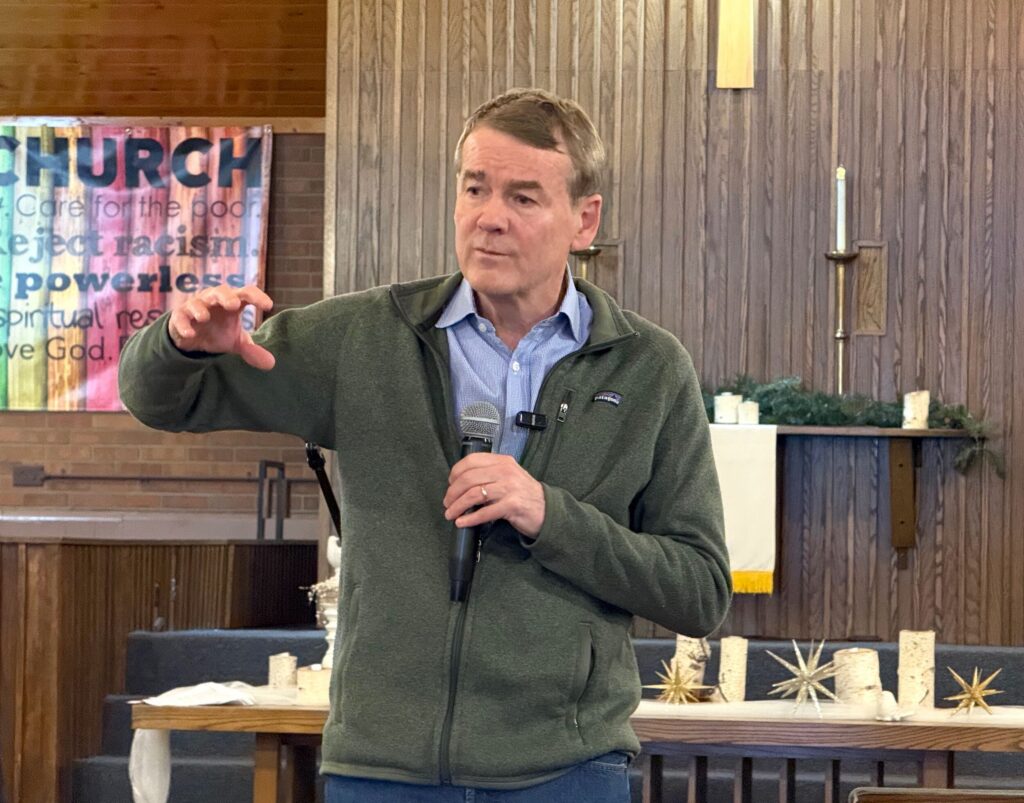
U.S. Sen. Michael Bennet on Tuesday became the first gubernatorial candidate to qualify for Colorado’s June primary ballot after state election officials determined the three-term Democrat’s campaign submitted enough valid petition signatures. Bennet is running against Attorney General Phil Weiser...

Thornton police investigating homicide
Matt Kyle
matt.kyle@denvergazette.com
Updated 21 hours ago
Police in Thornton are investigating a homicide that happened late Wednesday night. Thornton Police Department officers responded just before 11 p.m. near the intersection of East 88th Avenue and Grant Street after a 911 caller reported someone bleeding. Upon arrival,...
PREV
PREVIOUS

Court interprets arson statute, permits multiple charges for single fire
Colorado’s arson statute permits charges for each building, piece of property or individual endangered, and not for the number of fires, the Colorado Court of Appeals clarified for the first time on Thursday. “If the unit of prosecution were, in fact, tethered to the number of fires set, then one would expect one arson charge […]
BALLOT WATCH | Colorado turnout surpasses one-third of registered voters
More than one in three Colorado voters has already cast their ballot as of Wednesday night. Election officials have processed nearly 1.3 million votes to date, a little more than 1% of which have been in person. Democratic women continue to lead in returns, representing nearly one-quarter of the electorate to date. They are trailed […]