

SLOAN | Our polarized politics shapes views of the pandemic
The sense of unity which permeated our national life after the attacks of Sept. 11, 2001, lasted, by some estimates, roughly two months, which is about 59 days longer than it has in the current crisis.
The country is now polarizing around the question of whether continued societal lockdown is necessary to prevent an even larger medical crisis, and the competing sense that trying to sustain the unsustainable is doing more harm than good. The poles are aligned generally – but not exclusively – along political lines.
Conservatives, who place their trust in individuals and private institutions, tend to argue that people and businesses can be trusted to resume their lives with a few precautions, and that the long-term social and economic consequences of a prolonged government-mandated shutdown are starting to outstrip the medical benefits. Liberals, who place their trust in government and collectivist hegemony, are generally more comfortable with a statist approach and authoritarian edicts.
This divide has boiled over in recent days with protests of various forms sprouting up around the country, including in Denver and Grand Junction, opposing the continued imposition of solitary confinement as offensive to inalienable rights and freedoms, equatable to fascism, and appealing for the removal of the government boot from the throat of the economy. On the other hand, one finds increased sneering and derision leveled at those who question, and in some cases openly flout, the new conventional wisdom of enforced social distancing, mask-wearing, and other new standards as selfish and uninformed rubes who would willingly fill mass graves in exchange for their right to get a haircut.
If anything is flourishing at this time, it is the art of vilification.
Earlier in the crisis government officials – from mayors, to governors, to the president – deserved, and generally received, some latitude. The word “unprecedented” is being used almost like a comma nowadays, but it’s true that there was not much in the way of a playbook for responding to this particular threat. For the most part, government officials based their reactions on worst-case scenarios and the fear of what would happen if they guessed wrong, erring therefore on the side of extreme caution. And they could hardly be blamed for that.
Now, as the situation evolves and the picture becomes a little less opaque every day, criticism is both more prevalent and more warranted. The measures employed have evidently worked as initially intended – the infection rate flattened sufficiently to avert an inundation of the hospital system – but it is just as obvious that there were some clear instances of government going too far. The arrest of a father playing with his daughter in Brighton made national headlines, as did Michigan Gov. Whitmer’s absurd excesses.
There is now the brewing question of how, and how-quickly, to re-open society. It is interesting to see the divergence of reporting, especially at the national level, between the proposals of, for instance, Colorado and Georgia. Both are among states that are beginning the process, and while there are differences in the respective approaches, they are not wide enough to justify the painting we have seen of Georgia Gov. Brian Kemp as a reckless troglodyte, a charge Gov. Jared Polis has managed to avoid, mostly by being a member of the right party.
Differences in approach, incidentally, are a good thing; when we look back on this in the months and years ahead, we will digest the various avenues taken. Was Sweden’s approach the better one? Germany’s? South Dakota’s? Those analyses, too, will be undoubtedly colored by one’s prevailing ideology, which is unfortunate because objective exegesis would be valuable in organizing a blueprint for responding to any future similar occurrence.
My own view of things is that the initial explanation for lockdown was valid – flatten the curve to alleviate strain on the health system, which could otherwise reach levels of existential threat. Having done that, we have bought sufficient time and accumulated enough data that now even a statistically significant increase in cases would not overload the system, therefore it is necessary now to prioritize other considerations, the economy, debt, etc.
For the time being, a proposition: may we concede that the actions taken by government, even those ultimately proven to be unwise or unnecessarily authoritarian, were done so with good intentions, and not malicious or evil aims? And in return that those who place a real value on individual liberties and economic life are not a bunch of misanthropes callously indifferent to other people’s lives? Fair enough?
Kelly Sloan is a political and public affairs consultant and a recovering journalist based in Denver.


Private equity has no place in health care | GUEST COLUMN
Colorado Politics
colorado-politics@coloradopolitics.com
Updated 8 hours ago
By Miah Ntepp Of all the financial pressures placed on working people in this country, the skyrocketing costs of health care rank near the top. As families struggle under the cuts to Medicaid made by the Trump administration, they are...
Some pointed questions for the gubernatorial hopefuls | George Brauchler
George Brauchler
george-brauchler@gazette.com
Updated 1 day ago
Earlier this month, the Republican and Democratic candidates for governor participated in a televised interview moderated by well-known, left-leaning legacy media folks. Predictably, the questions asked of the GOP candidates were more aggressive, pointed, biographical and almost entirely disconnected from...
Chaotic funding throws monkey wrench into governor’s-race money madness | Paula Noonan
Paula Noonan
paula-noonan@coloradopolitics.com
Updated 1 day ago
Chaos Monkey, Inc., gave a trifle $20,000 donation to Rocky Mountain Way (RMW), the independent expenditure committee (IEC) supporting U.S. Sen. Michael Bennet for Colorado governor. But why, Coloradans should ask, would a guy who has assigned his contributor name...
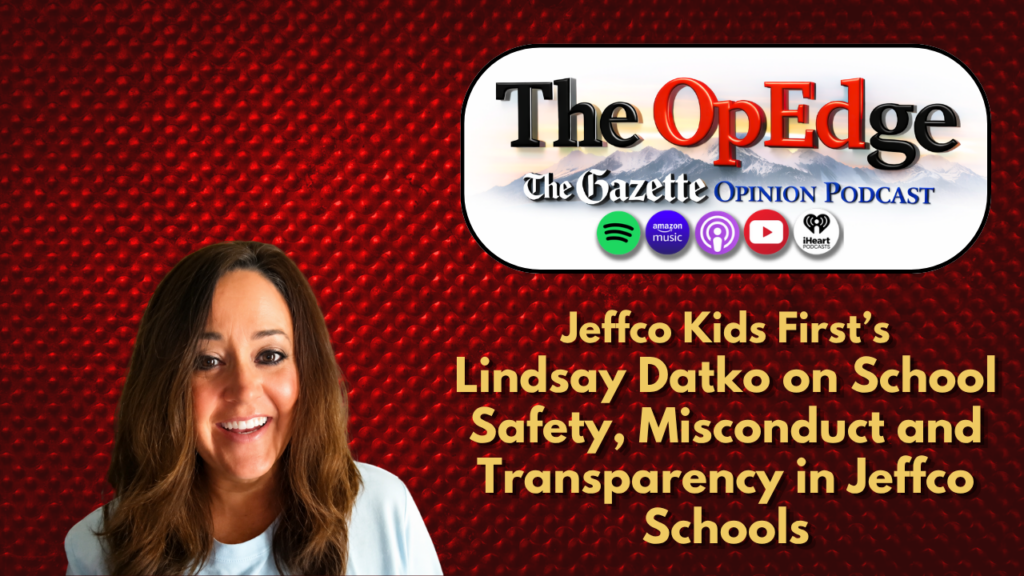
Lindsay Datko on school safety, misconduct and transparency in Jeffco schools | The OpEdge Podcast
Tony Olivero
tony.olivero@gazette.com
Updated 3 days ago
Jeffco Kids First founder Lindsay Datko joins The OpEdge to explore concerns about school safety, staff misconduct and transparency in Jefferson County Schools. Datko tells host and investigative columnist Jimmy Sengenberger why she believes Colorado’s second-largest district has too often...

Candidate’s disturbing anti-animal agriculture history | Rachel Gabel
Rachel Gabel
rachel-gabel@coloradopolitics.com
Updated 5 days ago
Rep. Manny Rutinel has busted out a cowboy hat for campaign photos and has thrown it into the ring to represent Colorado’s 8th Congressional District in D.C. He is endorsed by U.S. Sen. Cory Booker, a New Jersey democrat who serves on the Committee...
Marx, Bottoms, a primary death wish for Colorado GOP | Dick Wadhams
Dick Wadhams
dick-wadhams@coloradopolitics.com
Updated 5 days ago
Colorado Republicans stand on the brink of total irrelevance and embarrassment if they nominate one of the two nonsensical, buffoonish candidates running for governor, Victor Marx and Scott Bottoms. Republicans are already in a very defensive, tenuous position as Democrats...

Remember the grassroots reason for DEI | Miller Hudson
Miller Hudson
miller-hudson@coloradopolitics.com
Updated 4 days ago
The Trump administration’s jihad against Diversity, Equity and Inclusion (DEI) programs has metastasized into the most unexpected corners of American life. Yet, before examining this policy “incursion,” it’s worthwhile to examine the roots of DEI which reach back more than...

Why I’m voting Democrat | Jon Caldara
Jon Caldara
jon-caldara@coloradopolitics.com
Updated 1 week ago
It makes no sense to be a Republican in Colorado. Or a Democrat for that matter. On the day I turned 18, even before I bought my first legal 3.2 beer (remember 3.2 beer?), I went to the courthouse and...

A primary brings out primal instincts | SONDERMANN
Eric Sondermann
eric-sondermann@coloradopolitics.com
Updated 1 week ago
There are no Stanley Cup finals or NBA title showdowns involving local teams this June. In their place, we are inundated with primary election campaign ads. Coloradans can be excused for missing the diversion and alternate programming. But life can...
Colorado’s role in Spirit Airlines’ demise should not be ignored | GUEST COLUMN
Colorado Politics
colorado-politics@coloradopolitics.com
Updated 1 week ago
By Robin Rossenfeld At a time when Colorado families are already struggling with rising transportation costs, the collapse of Spirit Airlines could not come at a worse moment. According to the U.S. Bureau of Labor Statistics, prices in the Denver-Aurora-Lakewood...
PREV
PREVIOUS
NOONAN | Plot thickens — along with the methane — in firing of a CU prof and a reporter
Paula Noonan Every day under shelter-in-place gives Coloradans a vision of the Front Range without haze obscuring the mountains. If the state could keep on this path of clear air due to reduced car and industrial emissions, it might get out from under its EPA air quality violation status, which would be a good thing […]
IN RESPONSE | Big Tobacco targets minorities
Terri Richardson A recent opinion piece by Jon Caldara of the Independence Institute attempts to highlight the inequalities smoke shops are facing with the governor’s stay-at-home order, as they have not been deemed “critical businesses” (“CALDARA | Smoke shops shuttered, pot gets a free pass, under cockeyed COVID crackdown,” April 19). He asks us to […]