

Insights: If Republicans win the statehouse, expect a new way of budgeting
House Republican Leader Patrick Neville says if voters put Republicans in charge of the legislature and the governor’s office next year, you can expect big changes on how the bills get paid in Colorado.
The state budget, $28.5 billion, is the most important thing the legislature does. It pays for everything from schools to prisons, and healthcare to highways, but does a lot better job of covering some bills than it does others. How people vote might or might not be reflected in state’s spending decisions.
The duly elected legislators from 65 districts in the House and 35 in the Senate tinker on the budget with a screwdriver when they need a toolbox, from Neville’s point of view.
The real work is done by the Joint Budget Committee, six members from the House and Senate – three Republicans and three Democrats – who sit through mind-numbing sessions of budget requests to write the annual spending plan. It’s called the long bill, but it’s short on direct input of members outside the JBC. Lobbyists love it, because six is a smaller number than 100.
The budget that comes out of the JBC is pretty much the budget the governor signs, because it usually aligns with what he requested. When it lands on the floors of the House and Senate in April, each chamber spends a few days rattling sabers, running symbolic amendments and shedding crocodile tears.
That’s especially true in Colorado these days, where Republicans hold a one-seat majority in the Senate and Democrats have a nine-seat edge in House.
“There’s an almost unwritten rule that it doesn’t get touched,” Neville told me about the budget. “We’ve got 94 other legislators that all represent different constituencies with different interests around the state, so why can’t they get more involved from the beginning?”
It makes more sense to have the committees that deal with issues such as agriculture, energy, insurance or human services do that work, he said. The committees have a deeper history with the respective issues, as well as some level of institutional knowledge about how department’s really spend their money.
Sometimes the members of the JBC have that background, but often they don’t.
For the committees of reference to take on the chore, it means more meetings for lawmakers during the eight months out of the year that they’re not in session. But Neville thinks the state would be better served with writing two-year budgets every other year. That would provide more time for hearings and, yes, politics.
The Joint Budget Committee wouldn’t go away, but it would become a performance-measurement panel to tie together the work of the committees and help ensure taxpayers are getting their money’s worth, Neville said.
He pointed to the last session, when his caucus members took the budget and looked for things they could cut without killing any essential services. They found about $593 million in savings and ran amendments for those cuts, in vain, against the House Democratic majority. Half that amount could have paid back the $3.5 billion bond issue that represented the largest failure in the last session.
Lawmakers were considering borrowing the money to fund a statewide transportation plan, including more money for transit and to widen portions of Interstate 70 and Interstate 25.
But when the budget landed this year, it didn’t carve out anything to pay for those high-priority projects. House Speaker Crisanta Duran, a Denver Democrat, and Senate President Kevin Grantham, a Republican from Canon City, instead put forth House Bill 1242, which would have asked Coloradans this November to vote on a sales tax to raise about $300 million a year to repay the loan.
The state already has the SMART Government Act. The acronym stands for state measurement for accountable, responsive and transparent. And while it’s good for departments to explain themselves, it isn’t effectively tied to their budgets. The committees would make that connection.
“We should be talking about efficiency in government and making sure departments are accountable in the budget,” said Rep. Cole Wist, the assistant minority leader in the House. “Where the rubber meets the road in government is what gets funded and what’s not going to get funded. Are you as a department willing to be accountable in your budget for what you said you would do two years ago?”
Wist says the process is flawed, summing up appearances before the JBC as department heads saying, “Things are going great. We need more money.” Throw in more numbers than a Chicago street lottery, and that’s pretty much a day’s worth of headaches for a fiscal conservative. It’s next meeting is at 9 a.m. on Sept. 20 at the Capitol, so listen in online and hear for yourself. Make coffee. Its last meeting on June 20 went for five hours.
The budgeting overhaul is a message Republicans are going to run on next year.
And there’s a good reason for that. When more politicians are involved in something, it always means more politics.
Republicans can cry about reform and cuts until they’re, ahem, blue in the face, but parties aren’t held accountable, especially in Colorado. When the two chambers are controlled by different parties or a governor who’s not in your camp, there’s an easy foil to blame your losses on.
You can bet nobody is saying, “It’s my party’s fault you’re stuck in traffic.”
But regardless of which party wins at the ballot, the Joint Budget Committee will remain evenly split. Elections have consequences, but not so much in the Colorado budget.


Wyoming governor sues state board, asks court to enforce property tax cap | OUT WEST ROUNDUP
The Associated Press
the-associated-press@coloradopolitics.com
Updated 4 days ago
WYOMING Governor sues over property tax cap Gov. Mark Gordon filed a lawsuit on June 16 to force the State Board of Equalization to certify residential property tax values after the panel concluded it could not do so due to...
Democratic Colorado rural congressman threatens to caucus with GOP to preserve PILT | A LOOK BACK
Rachael Wright, Special to Colorado Politics
rachael.wright@coloradopolitics.com
Updated 3 days ago
Forty-Five Years Ago This Week: “It’s sometimes like talking to a brick wall,” said Colorado Congressional District 3 U.S. Rep. Ray Kogovsek. Kogovsek was frustrated at the lack of support from congressional representatives from the East Coast and the Midwest...

25 lessons and wishes to celebrate America’s 250th | SONDERMANN
By Eric Sondermann
by-eric-sondermann@coloradopolitics.com
Updated 4 days ago
The 250th celebration of America’s birth is upon us. There is undoubtedly much to salute. Despite plenty of strife and discontent at home, America remains a beacon to much of the world. The wisdom of our founders has largely withstood...

Colorado Politics Calendar July 6-12
Rachael Wright, Special to Colorado Politics
rachael.wright@coloradopolitics.com
Updated 4 days ago
CoPo’s weekly political calendar helps you find political and public policy events throughout Colorado. It includes candidate and issue campaign events, public policy meetings, court hearings, state and local party conventions, assemblies, debates, rallies, parades, speaking engagements, traveling dignitary appearances,...

Victor Marx holds a steady lead over Barbara Kirkmeyer in Colorado Republican governor contest
Thelma Grimes
thelma.grimes@coloradopolitics.com
Updated 2 days ago
Victor Marx overtook state Sen. Barbara Kirkmeyer in the Republican primary for governor on Wednesday evening, seizing a narrow lead after trailing her since polls closed. Kirkmeyer, one of three candidates, opened the night with a clear advantage, at one...

Democrats confront shift as socialist-aligned candidates win races in Colorado
Thelma Grimes
thelma.grimes@coloradopolitics.com
Updated 1 day ago
Democratic socialists’ recent electoral gains — punctuated by Melat Kiros’ victory on Tuesday over U.S. Rep. Diana DeGette, the dean of Colorado’s congressional delegation — are the result of a movement that has been taking shape in metro Denver for...
Trump’s judicial nominee orders bond in wave of cases after 10th Circuit rejects government’s position
Michael Karlik
michael.karlik@coloradopolitics.com
Updated 3 days ago
Within 24 hours of the Denver-based federal appeals court rejecting the government’s expansive view of its immigration detention authority, the lone judge in Colorado to embrace that view ordered bond hearings for detainees in at least 20 cases. U.S. District...
Cherry Creek spent $65K on investigation, but invoices remain secret, records show
Nico Brambila
nico.brambila@denvergazette.com
Updated 3 days ago
After previously refusing to disclose the cost associated with the investigation into the former superintendent and his wife, the former human resources chief, Cherry Creek School District officials partially released records showing the cost to taxpayers: $65,054.85. The Denver Gazette...
Colorado governor fires clemency board members who opposed Tina Peters commutation
Marissa Ventrelli
marissa.ventrelli@coloradopolitics.com
Updated 3 days ago
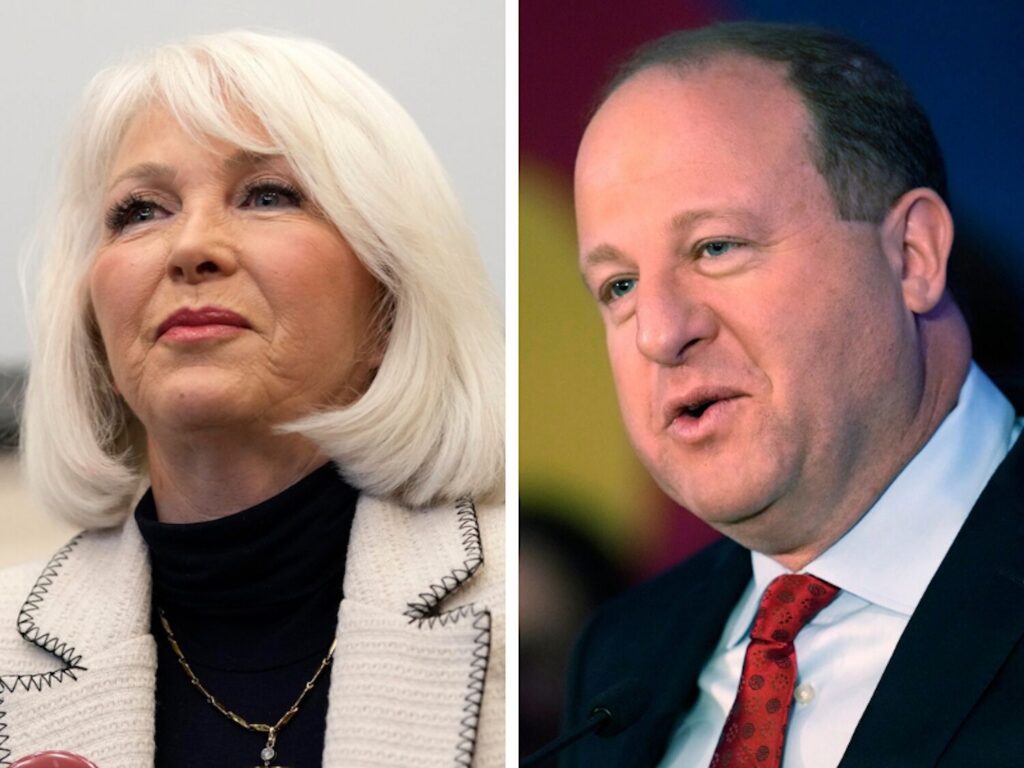
Gov. Jared Polis has fired two members of his clemency board who opposed his commutation of Tina Peters’ sentence, according to Colorado Politics news partner 9News. In firing Azra Taslimi and Hannah Seigel Proff, Gov. Jared Polis said they had...
Democrats supercharge court fight after campaign finance ruling
James A. Downs
james.a..downs@washingtonexaminer.com
Updated 3 days ago
Democrats are hoping to dampen the GOP’s midterm cash advantage after Republicans scored a major win allowing unlimited coordination between political parties and candidates. Republican campaign arms say they can access discounted TV ad rates after the Supreme Court lifted...