

Hickenlooper, state lawmakers continue to push Congress for Good Samaritan bill

Lawmakers at the federal level may not be much help, but the EPA and Colorado officials are working well together to fix the century-old mining mess above Silverton that continues to leak waste water into local streams, according to the town administrator.
“That [Aug. 5] accident is going to allow this problem to be properly addressed,” Silverton administrator Bill Gardner told The Colorado Statesman this week. “I think we can be grateful for that. Again, it’s awful that it had to happen, but the good news is we’re not allowing that to hinder us from taking ownership of this legacy mine problem and resolving it.”
Eight months after EPA contractors accidentally released 3 million gallons of acid mine drainage into a tributary of the Animas River that turned it a bright orange, the federal agency on Wednesday announced it will propose adding the Bonita Peak Mining District to the National Priorities List, making it eligible for resources under EPA’s Superfund program.
The Superfund listing, which could be finalized and published on the Federal Register as soon as this summer, is proceeding quite rapidly and marks a major reversal for Silverton and the surrounding San Juan County community, which for years had resisted the listing. But in February, local officials voted to pursue the listing and Gov. John Hickenlooper backed them.
“This is a crucial next step in making the region eligible for necessary resources and comprehensive cleanup efforts under EPA’s Superfund program, but our work is not done,” Hickenlooper said of Wednesday’s decision. “We are working with the EPA to ensure that adequate funding for this site is provided, including immediate interim measures and options to mitigate any further water-quality deterioration.”
The EPA has been operating a temporary wastewater treatment facility above Silverton since last fall at an estimated cost of $16,000 a week. Before and after the Aug. 5 release of 3 million gallons of wastewater from the mine, Gold King has been producing 500 to 770 gallons of wastewater per minute, or more than 720,000 gallons a day.
Gardner was part of a negotiating team that included his administrator counterpart at San Juan County, both the town and county attorneys, a town council member and a county commissioner. He said they worked hard with officials from both the EPA and the Colorado Department of Public Health and Environment over the last several months.
“As much as is humanly and politically possible, this is going to be a positive,” Gardner said of the listing. “First of all the naming [of the Bonita Peak Mining District] – making sure it had absolutely nothing to do with Silverton and San Juan County – that’s an important victory.”
Much of the resistance to listing the last couple of decades came from businesses leaders and residents concerned about stigmatizing the tourism-dependent region. Local officials also fought to make the listing geographically specific so it would not include the entire northern half of San Juan County.
“The other step forward is that we’re working cooperatively with the EPA and we’re not going to be getting headlines that we’re fighting or that we’re doing anything to obstruct what really needs to be done,” Gardner added. “And the biggest thing we accomplished is we feel confident that we have a seat at the table, that we have a voice and that the EPA and the CDPHE will work with us before they make their decisions.”
At the national level, Congress remains gridlocked on a decades-long push to absolve nonprofit groups, local governments and modern mining companies of some degree of legal liability in order for them to clean up leaky abandoned mines all over the West under what’s been dubbed “Good Samaritan” legislation.
“We continue to support efforts by our congressional delegation to reach consensus around ‘Good Samaritan’ legislation, which is one of the most significant tools at our disposal to allow for voluntary cleanups of draining and abandoned mines,” Hickenlooper said.
U.S. Sens. Cory Gardner and Michael Bennet, along with U.S. Rep. Scott Tipton, have been pushing bipartisan Good Samaritan legislation with the support of state lawmakers who late last month passed a bipartisan joint memorial:
“We, the members of the Colorado General Assembly, urge Congress to pass legislation establishing a Good Samaritan exemption from liability under the CWA [Clean Water Act] and CERCLA [Comprehensive Environmental Response, Compensation, and Liability Act] as an important step toward preventing another disaster like the Gold King Mine spill and remediating all other draining abandoned hard rock mines in Colorado,” the memorial reads.
The Colorado Division of Mining Reclamation and Safety estimates there are more than 22,000 abandoned mines in Colorado, and that at least 500 are polluting streams. EPA official say it would cost $35 billion to clean up the estimated 500,000 abandoned hard rock mines across the United States.
“For public safety reasons, as well as environmental quality reasons, we really need to get a handle on how many abandoned mines we have, what are the actions we’re going to take, and we have to prioritize that very lengthy list,” said state Sen. Ellen Roberts, a Republican who represents Durango and the surrounding area. Roberts sponsored the Good Samaritan resolution.
“For us, the Gold King Mine, it was just a matter of time,” Roberts added. “It wasn’t whether it would happen; it was when it would happen – whether it was specifically that mine or another Silverton-area mine.”
Roberts this session also successfully sponsored SB63, a state law already signed by Hickenlooper that’s designed to make it easier for local governments to work across borders in emergency situations. In other words, downstream communities in New Mexico or Utah.
“We found with the mine spill obviously that contaminated rivers don’t necessarily follow state boundaries, so we need quicker response times, whether its wildfires, contaminated rivers or other emergency management,” Roberts said.
Silverton administrator Gardner appreciates the efforts of state lawmakers, but he said what really works is for local communities to engage federal and state government officials, and he reserved high praise for Hickenlooper’s efforts. As for the U.S. Congress, he’s not holding his breath.
“They’re still working on [Good Samaritan], and from my seat here in Silverton it just appears that Congress is really unable to work on solutions to problems like this, and so from what we can tell there’s nothing that’s really hopeful that’s going to be forthcoming,” Gardner said.

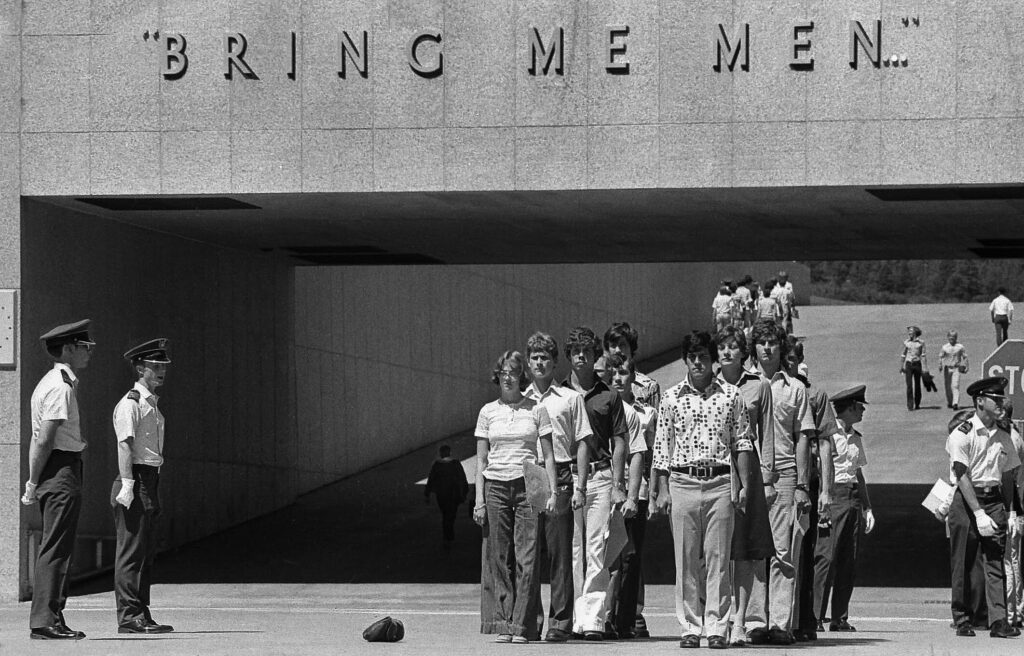
Fifty years later, women reflect on first coed class at the Air Force Academy, struggle for equality
Mary Shinn
mary-shinn@coloradopolitics.com
Updated 2 days ago
When the first female Air Force Academy cadets arrived 50 years ago this summer, they stood in front of an enormous sign on campus that read “Bring me men.” In the shadow of that sign, Kathleen Utley Kornahrens, one of...
As Lake Powell shrinks, marinas are having to adapt to dwindling water levels | OUT WEST ROUNDUP
The Associated Press
the-associated-press@coloradopolitics.com
Updated 5 days ago
ARIZONA Reservoirs near record lows PAGE — The Colorado River’s Lake Powell, the second largest reservoir in the U.S., is shrinking. A record-dry winter and extreme heat — as well as decades of overuse, chronic drought and climate change —...

A new day? Colorado’s troubled guardianship office pursues ‘cultural reset’
Marianne Goodland
marianne.goodland@coloradopolitics.com
Updated 4 days ago
Colorado’s guardianship program, long criticized for mismanagement and high staff attrition, is undergoing a “cultural reset,” as its new director works to repair partnerships and prepare for a major expansion under recent legislation. Created by lawmakers in 2017, the Office...
U.S. Senate OKs funding bill to avoid government shutdown
Wire Services
wire-services@coloradopolitics.com
Updated 2 days ago
Hemp provision became point of contention WASHINGTON • The U.S. Senate in an overnight vote Saturday approved a short-term measure to fund federal agencies into early December and avoid a government shutdown during the middle of campaign season. The late-summer...

The relevance of Watergate more than a half-century later | SONDERMANN
By Eric Sondermann
by-eric-sondermann@coloradopolitics.com
Updated 5 days ago
It was the scandal for which all other scandals are now named. In June 1972, a small group of Cuban burglars with high-level connections broke into the headquarters of the Democratic National Committee. Those headquarters were located in the Watergate...

Wirth downplays Social Security disaster talk | A LOOK BACK
Rachael Wright, Special to Colorado Politics
rachael.wright@coloradopolitics.com
Updated 4 days ago
Forty-five years ago this week: “As time goes on,” said Democratic U.S. Rep. Tim Wirth, of the 2nd Congressional District, “we are finding that the safety net, which was proposed earlier this year, has some very large holes in it,”...
Colorado Politics Calendar Aug. 10-16
Rachael Wright, Special to Colorado Politics
rachael.wright@coloradopolitics.com
Updated 4 days ago
CoPo’s weekly political calendar will help you find political and public-policy events throughout Colorado. It includes candidate and issue campaign events, public policy meetings, court hearings, state and local party conventions, assemblies, debates, rallies, parades, speaking engagements, traveling dignitary appearances,...

Democratic group aims Spanish-language TV ad at Gabe Evans in Colorado’s battleground 8th CD
Ernest Luning
ernest.luning@coloradopolitics.com
Updated 2 days ago
A national group tied to House Democratic leadership launched a six-figure Spanish-language TV ad in Colorado this week targeting Republican U.S. Rep. Gabe Evans and the GOP’s signature budget legislation. The 30-second spot is part of $15 million in new...
Colorado School of Mines lands major share in Trump’s $100M mining-education plan
Thelma Grimes
thelma.grimes@coloradopolitics.com
Updated 3 days ago
President Donald Trump on Friday named the Colorado School of Mines among roughly a dozen institutions that will share in a $100 million commitment “to train the next generation of American miners.” Paul Johnson, the university’s president, said he is...
Local party leaders, incoming judge among members of judicial performance commission that violated law
Michael Karlik
michael.karlik@coloradopolitics.com
Updated 2 days ago
A local Democratic leader and 2024 presidential elector. A legislative aide and leader in the Young Republicans. An incoming county court judge freshly appointed by the governor. They are among the eight members of the northeastern Colorado judicial performance commission...
PREV
PREVIOUS

Crowder wants to be really clear about how he sees the hospital provider fee, you follow?
“The thing I’m trying to impress on people is we got to come out and have to have an adult conversation in this state about what direction we want to go,” said state Sen. Larry Crowder, standing on the steps of the Capitol last week. Crowder was talking about his support for House Bill 1420, […]

Hickenlooper, Senate GOP in message battle over move to 'defund' Clean Power Plan implementation
Patience is wearing thin at the Capitol around the budget battle being waged over the state’s air quality division, which Republicans have targeted as the main office prepping the ground for implementation the Obama administration’s carbon-slashing Clean Power Plan. Gov. John Hickenlooper has argued that the division’s work is vital to state businesses and he […]