

Rain barrel bill may be coming back
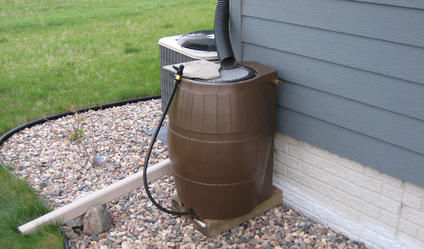
Coloradans may yet get the chance to use those rain barrels for something other than enormous flowerpots.
The General Assembly’s Water Resources Review Committee on Tuesday considered a bill that would allow Colorado residents to collect and use rainwater that comes off their roofs. Colorado is the only state that forbids collecting rainwater.
It’s a revival of an effort from the last legislative session, but the proposal has a very different look than a bill that died on the session’s next-to-last day. The House version of the 2015 legislation would have allowed residents to set up two 55-gallon rain barrels to collect rainwater that comes off their roofs.
State Sen. Jerry Sonnenberg, R-Sterling, who refused to allow the 2015 rain barrel bill to come up for a final vote in May, is proposing a different approach. His bill would address the biggest concern of farmers, ranchers and others who fear that allowing rainwater collection will threaten their water rights.
Sonnenberg’s draft bill starts with the same two 55-gallon rain barrels as the 2015 House version but goes on to set out a number of new requirements and restrictions, including a requirement that consumers would have to install rain barrels above ground and keep the barrels sanitary and free of mosquitoes and other pests. In addition, water utilities would have to grant permission to install the barrels and then would be responsible for replacing the water diverted into them. The draft bill would also limit use of the barrels to buildings with four or fewer units, meaning most apartment buildings and condo complexes couldn’t collect rain.
Drew Beckwith of Western Resource Advocates told the water committee that his organization estimates about 200,000 people would set up rain barrels in Colorado, diverting an estimated 40 acre-feet of water annually. (An acre-foot is about 325,000 gallons.)
Also under the draft bill, water providers would have to make it easy for consumers to register their rain barrels so the state and utilities could track how much water is being diverted.
The state’s doctrine of prior appropriation, embedded in the state Constitution, lies at the heart of many of the provisions in Sonnenberg’s draft legislation. The doctrine establishes that whoever first lays claim to water in a river or stream is designated the senior water-rights holder and gets first crack at the water. Whoever else holds rights to the water, so-called junior water-rights holders, get whatever is left over.
Under the bill, water providers that allow rainwater collection would have to file something called an augmentation plan — an agreement approved by the state’s Water Court that lets junior rights holders diver water “out of priority” without harming senior rights holders.) The bill includes options for replacing the water, including via a substitute water supply plan that would have to be approved by the state engineer.
But water-rights holders get nervous when talk turns to augmentation plans.
Still, Sonnenberg pointed out that most water districts already have augmentation plans in place and would just have to adjust them. “The intent is to make this simple and cost effective and to keep the prior appropriation system whole,” he said.
It involves a trip before the Water Court to change or establish a new augmentation plan, and that’s not an easy process. According to discussion at the committee hearing, a water district that wants to adjust its plan to allow for rain barrel collection will first have to figure out just how much water will be diverted before allowing customers to collect rainwater, a sort of cart-before-the-horse proposition.
It can also be something of a risk to re-open an augmentation plan, said Doug Kemper of the Colorado Water Congress, opening it up to more changes than those related to rainwater collection.
The water committee decided to order Sonnenberg’s proposal into formal drafting. The committee plans to vote next month whether to sponsor the bill although, if members decide against that course, Sonnenberg could carry the bill on his own next session.

Ron Hanks, Scott Bottoms sue to stop Colorado’s unaffiliated voters from participating in GOP primary
Ernest Luning
ernest.luning@coloradopolitics.com
Updated 2 hours ago
Three Republican candidates in Colorado filed a lawsuit in Denver District Court this week seeking to prevent unaffiliated voters from participating in next month’s GOP primary, arguing that the state’s semi-open primary system violates their constitutional rights by forcing Republicans...
Colorado needs a sane, viable opposition party | SONDERMANN
By Eric Sondermann
by-eric-sondermann@coloradopolitics.com
Updated 4 days ago
If you are upset with the increasing regulatory burden in Colorado, the exodus of too many large employers, accelerating property taxes, the condition of the roads, and all of the funding for transit schemes with low demand, of course, you...

Colorado Politics Calendar May 11-17
Rachael Wright, Special to Colorado Politics
rachael.wright@coloradopolitics.com
Updated 3 days ago
CoPo’s weekly political calendar will help you find political and public-policy events throughout Colorado. It includes candidate and issue campaign events, public policy meetings, court hearings, state and local party conventions, assemblies, debates, rallies, parades, speaking engagements, traveling dignitary appearances,...

NRA carves out early success story battling 1981 Colorado gun legislation | A LOOK BACK
Rachael Wright, Special to Colorado Politics
rachael.wright@coloradopolitics.com
Updated 2 days ago
Forty-Five Years Ago This Week: After House Bill 81-1542, which would have mandated detention for juveniles carrying concealed weapons, cleared the Senate Judiciary Committee, Sen. Paul Powers, R-Denver, said he had received 45 letters per day denouncing the legislation. And...
It’s almost Sine Die and it can’t come soon enough | Capitol M | Week of May 9, 2026
Marianne Goodland
marianne.goodland@coloradopolitics.com
Updated 2 days ago
The lighter side of the state Capitol, usually. At first, May the Fourth might have been a bit of a disappointment. Usually, there’s a lot of Star Wars foolishness on this particular day, but early on, it was low-key. The...

TABOR showdown: Senate moves bill forward, Advance Colorado prepares for legal action
Marianne Goodland
marianne.goodland@coloradopolitics.com
Updated 17 hours ago
Despite objections from legislative staff and Republican opposition, Senate Democrats on Friday moved forward with a proposal to reroute $306 million in taxpayer refunds. Already, critics are preparing to sue over the proposal that seeks to take $300 million in Taxpayer’s...
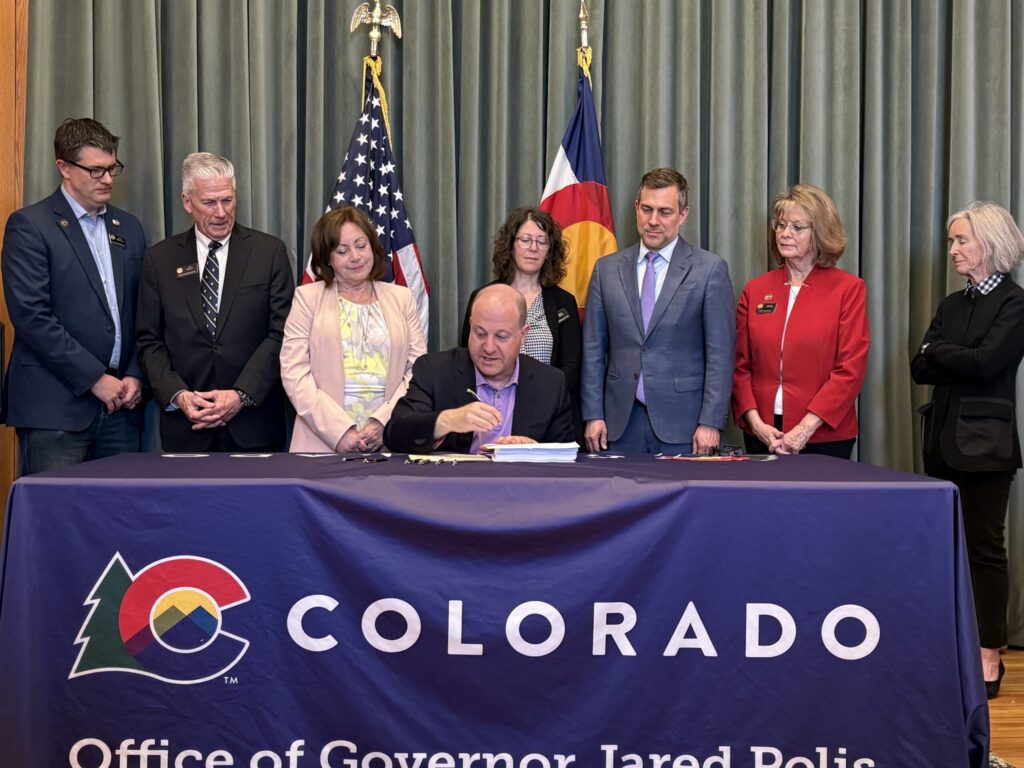
Colorado governor signs $47 billion budget in which ‘nobody won’
Marianne Goodland
marianne.goodland@coloradopolitics.com
Updated 17 hours ago
Gov. Jared Polis on Friday officially signed a $46.87 billion spending plan for the Colorado state government in the next fiscal year. His signature is the culmination of months of work by legislators, who resorted to cuts, transfers and other...
Latest Pinnacol proposal shifts sponsors, cuts state benefits and triggers union standoff
Marianne Goodland
marianne.goodland@coloradopolitics.com
Updated 21 hours ago
Colorado’s long‑running bid to let Pinnacol Assurance break away from state control is suddenly in jeopardy, as a newly revised bill — stripped of the payouts and structural changes once central to the deal — has triggered fresh tensions among...

Denver could be back in DNC spotlight 20 years later
Deborah Grigsby
deborah.smith@denvergazette.com
Updated 22 hours ago
It’s been nearly two decades since Denver shared the spotlight as host to the 2008 Democratic National Convention — and a lot has happened in the city since then. But not major party conventions. In fact, before 2008, Denver hadn’t...

Bill permitting lawsuits against ICE agents reaches Gov. Jared Polis’ desk
Marissa Ventrelli
marissa.ventrelli@coloradopolitics.com
Updated 16 hours ago
Colorado lawmakers advanced two high‑profile measures Thursday — one seeks to reshape how the state manages its strained prison population and another allows Coloradans to sue federal immigration agents for alleged constitutional violations. The state policymakers sent both bills to...
PREV
PREVIOUS

Water storage a major concern heard by resource review panel
Storage! And storage, and, just maybe, more storage. If there was a single message that emerged from the final two hearings on the state water plan, it’s that the East Slope needs more water storage. It’s a message the interim Water Resources Review Committee heard and acknowledged during the hearings, held Monday in Greeley and […]

Strode: ZIP Code matters as much as genetic code
Where you live, what you do for a living, and how much you make could determine your long-term health outlook. This concept, commonly termed “social determinants,” is gaining equal importance with healthy behaviors as a predictor of an individual’s future health outcomes. Alan Weil, editor in chief of Health Affairs, the nation’s leading journal on […]