

Hickenlooper lauds bipartisanship session at state of the state to business community

If you’ve been watching the current reprise of Fargo on FX from the inimitable Coen brothers, you have witnessed several victims tossed into car trunks who later crawled out to find their captors either unconscious, dead or vanished. Governor John Hickenlooper emerged the day after the 2014 legislative session adjourned last week to deliver State of the State remarks before the Denver Metro Chamber of Commerce in a similar daze of slightly mystified elation. Democratic majorities unceremoniously kidnapped him for a rough ride during the 2013 session that ended by galvanizing three Senate recall elections, 11 secessionist rebellions in rural counties, and a cesspool of festering personal and political resentments. He was quick to point out that 15 of the 17 issues he identified during his state-of-the-state speech in January had been favorably enacted by the Legislature.

Asked whether he planned, unlike last year, to veto any pending legislation he indicated his phone has been ringing with multiple appeals for vetoes. Yet, he didn’t sound like a man in eager pursuit of bills to kill. Echoing the back patting rhetoric of Senate President Morgan Carroll and House Speaker Mark Ferrandino he pointed out that 90 percent of the approved bills had received bipartisan support. This is one of those truths that hides more than it reveals. Yes, the resolutions recognizing victorious high school athletic teams and honoring former members recently departed for the Assembly in the sky enjoyed generous bi-partisan majorities, but hidden among the 10 percent that split along party lines you can find much of the real work of the session. Nonetheless, collaboration was the watchword of the day.
While Republicans may be aggrieved that they were unable to funnel more dollars to Colorado’s job creators, it is hard to compete against an administration that has established a business climate where 100 percent of income growth following the recession of 2009 has been captured by the top 1 percent of earners. Unbelievably, the Economic Policy Institute reports that 16 other states managed the same trick. The Governor moved into a recounting of what is sure to become a percussive refrain during the election ahead, pointing out that Colorado has moved from 40th to 4th in job creation during the past four years — that Colorado is now ranked among the top 10 places to locate a business with five of the nation’s 20 best start-up communities. Flood relief and CDOT’s swift roadway restoration, broadband expansion and a reliable climate for economic growth all received a deserving nod. Then he launched into a mind numbing recitation of positive statistics and economic indicators, which he began to stumble over — eventually blaming his budget director, Henry Sobanet, for this pedantic focus on numbers.
No argument was advanced claiming these improvements were produced as the direct consequence of intentional policies. It seemed enough that they had occurred on his watch. Surprisingly, neither did the Governor advance a blueprint for the next four years, even one as modest as “…we can do better.” Before turning the program over to two of his predecessors to grapple with the imminent fracking war, he reflected on Colorado’s good fortune in having “…the most responsible oil and gas industry in the country.” His estimate was that no better than a 50/50 chance existed of finding a compromise for the Legislature to consider in a special session.
Old timers at bat
Former governors Bill Owens and Roy Romer may seem like an unlikely dance team, but they share an appreciation for the crucial role that oil and gas extraction plays within Colorado’s economy and in support of the state’s budget. Kelly Brough, president and CEO of the Chamber, is reactivating its political arm this year in order to fend off an expected ballot initiative(s) that would advance local control over fracking regulations. She moderated a political conversation with the former governors. Owens was cerebral and wonky with his discussion of “state primacy” and the importance of keeping more “stupid stuff” like TABOR and Amendment 41 out of the Colorado Constitution. Romer was his usual high octane self, railing against the supporters of local control as stalking horses for an openly anti-fracking agenda. “This is about shutting down our oil and gas industry,” he charged. Romer singled out Congressman Jared Polis as “well intentioned” but just plain dumb on the fracking question.
The former Democratic governor advanced natural gas as a transition fuel that will be required for an adequate response to global warming. He also pointed out that lifestyle compromises would be necessary as we move towards a more sustainable and permanent renewable energy infrastructure. He even advocated the wisdom of a phased-in national carbon tax. Almost everyone in the room was astounded at the seemingly infinite reservoir of personal energy he still commands well into his ninth decade. The Chamber could do far worse than to put “Uncle Roy” back on the statewide oatmeal circuit he so deftly navigated in support of the DIA election in Adams County. He explains facts in a way that voters grasp: fracking technology is improving each year, shale oil and gas are limited resources but they can hold down Colorado energy costs for decades and, therefore, cannot be properly regulated at the local level.
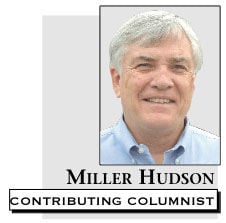
Miller Hudson is a political affairs consultant. He served in the Colorado legislature and is the former executive director of the Colorado Association of Public Employees.
Colorado Politics Must-Reads:


The Denver Broncos are on the ballot this fall | Jon Caldara
Jon Caldara
jon-caldara@coloradopolitics.com
Updated 3 days ago
Do you want the Broncos to win the Super Bowl? Then you’d better hope Amendment 87 — which brings back Colorado’s economy-strangling “graduated” income tax — loses at the ballot box this fall. Seriously. Forget Republicans and Democrats. Forget tax...

Was there ever a Colorado city that required racial segregation by law? | BOB LOEVY
Bob Loevy
bob-loevy@coloradopolitics.com
Updated 2 days ago
The answer is “yes.” The Black Racial Equity Study Commission, led by Colorado Senate President James Coleman, has learned the city of Fruita had laws forbidding black people from being on the city streets at night and from being buried...
The African roots of three Colorado leaders | SONDERMANN
Eric Sondermann
eric-sondermann@coloradopolitics.com
Updated 3 days ago
Colorado’s political transformation is measured in many ways. A once reliably red state (with asterisks) became purple and is now a rather deep blue. For better or worse, probably the latter, power is ever more consolidated along the Front Range...

Fighting for every Colorado rural hospital on the eastern plains | GUEST COLUMN
Colorado Politics
colorado-politics@coloradopolitics.com
Updated 3 days ago
By Lauren Boebert After touring Melissa Memorial Hospital in Holyoke and Wray Community District Hospital — two of more than a dozen rural hospitals in my district — I was again reminded why I fight for them in Washington. The...

Fix Colorado without shortchanging taxpayers | GUEST COLUMN
Colorado Politics
colorado-politics@coloradopolitics.com
Updated 2 days ago
By Lisa Frizell If we truly want to fix Colorado, we must respect taxpayers, demand accountability and prioritize classroom results. Proposition NN fails the test. The far left put forth this measure, presenting it as the only way to fund public...

New anti-gun legislation is about preventing firearm ownership, not safety | GUEST COLUMN
Colorado Politics
colorado-politics@coloradopolitics.com
Updated 3 days ago
By Ava Flanell It’s been a little more than a month since the most radical anti-gun legislation went into effect in Colorado history: Senate Bill 25-003. Originally intended as an “assault weapons ban,” Colorado Democrat sponsors settled for a complicated...
Colorado ed department must up its competence to prevent waste, fraud, abuse | Paula Noonan
Paula Noonan
paula-noonan@coloradopolitics.com
Updated 3 days ago
The Colorado Department of Education let $24 million fly from its checking accounts from January 2017 through June 2026 to CHE, aka Colorado Homeschool Enrichment. The details show how easily CHE and Education Re-Envisioned BOCES re-envisioned how to convert public...
Remember the injustice of forced unionism | GUEST COLUMN
Colorado Politics
colorado-politics@coloradopolitics.com
Updated 3 days ago
By Mark Mix This Labor Day we celebrated the men and women whose hard work keeps the country running. But in Colorado, many of those same workers face a real threat: pay union dues or lose their job. That’s because...

Should we always blame voters for low civic participation in elections? | GUEST COLUMN
Roland Halpern
roland-halpern@coloradopolitics.com
Updated 4 days ago
This year, like every election cycle, we hear the same complaints — enough citizens don’t vote. Voter turnout is too low. People are disengaged. Citizens are shirking their civic responsibility. If only voters cared more, democracy would work better. Fair...

Lori Gimelshteyn on 3 ballot measures to ‘let kids be kids’ | The OpEdge Podcast
Tony Olivero
tony.olivero@gazette.com
Updated 3 days ago
Lori Gimelshteyn — board member of Protect Kids Colorado and executive director of the Colorado Parent Advocacy Network — joins The OpEdge to discuss three measures headed to Colorado voters this November. Gimelshteyn tells host and investigative columnist Jimmy Sengenberger...
PREV
PREVIOUS

Influential lobbyist Wally Stealey is a much beloved figure in Colorado’s political world
I wanted to invite you and Julie to his 80th birthday party. There will be lots of people there you know… It will be a SURPRISE,” wrote Sharon, Wally Stealey’s wife of 57 years. Well, it was a surprise, a wonderful one. For me, as well as for Wally, the legendary lobbyist from Pueblo who […]

Tell me, what’s with the ‘silent running’ on the part of Colorado Democrats?
During the first few weeks following each legislative session, Colorado’s public policy institutes convene their supporters to either brag about their successes or bemoan their failures. For nearly a decade progressive and liberal lobbying shops have had a lot to be happy about (not so much at CACI and the Independence Institute). Once Democrats figured […]