The African roots of three Colorado leaders | SONDERMANN
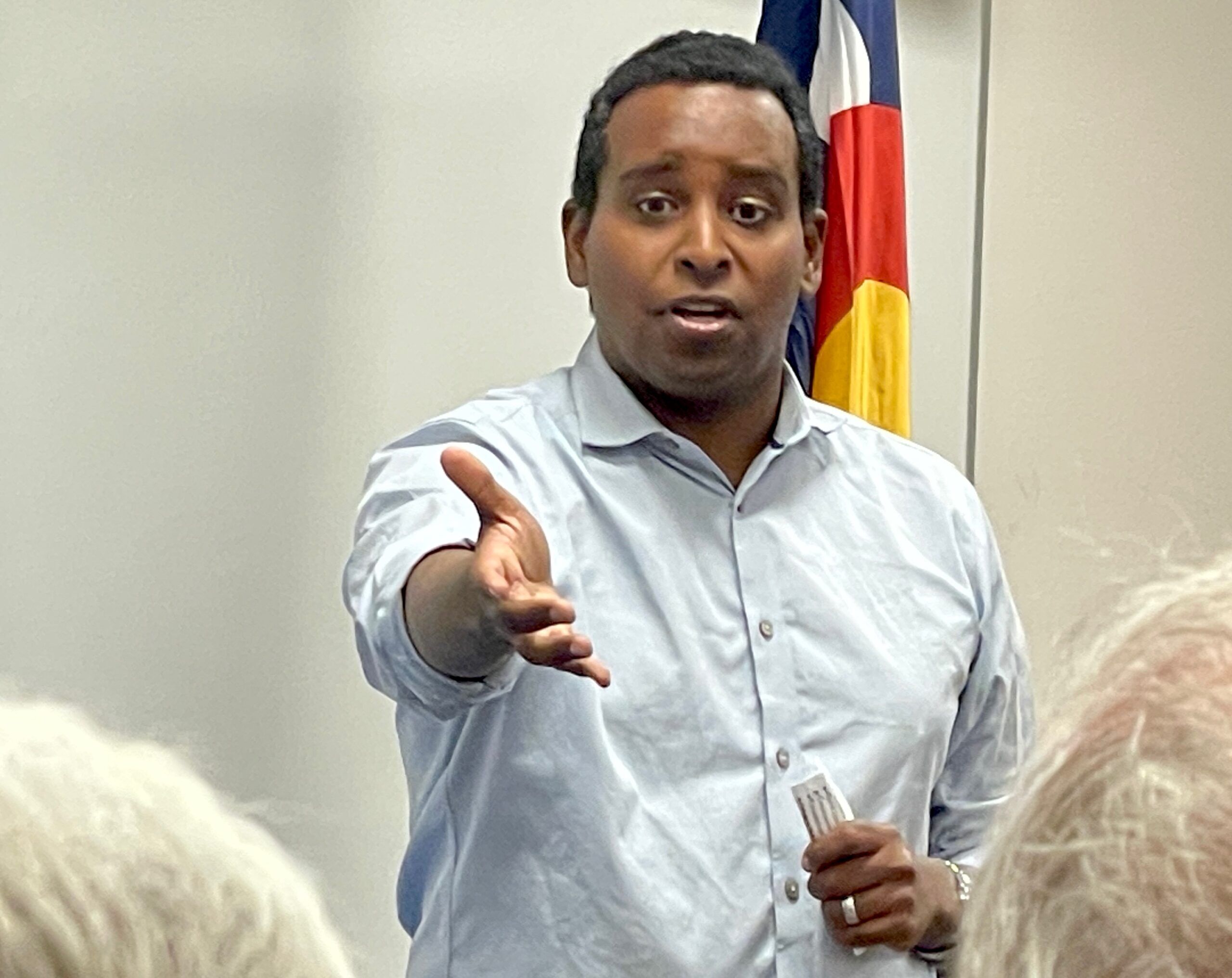
Colorado’s political transformation is measured in many ways.
A once reliably red state (with asterisks) became purple and is now a rather deep blue. For better or worse, probably the latter, power is ever more consolidated along the Front Range corridor. Counties such as Arapahoe, Jefferson, and Larimer, once Republican strongholds, are now at the heart of the Democratic coalition.
That said, let me pose one other sign of this wholesale change. Put yourself back in time a decade or two and imagine that one-quarter — two out of eight — of Colorado’s members of Congress would be recent African immigrants. To go along with the mayor of the state’s second-largest city.
That is a striking metamorphosis. Joe Neguse, the son of Eritrean immigrants who had moved to California just a couple of years before his birth, will soon begin his fifth term in Congress. Barring something unforeseen, he will be joined there by Melat Kiros, who immigrated from Ethiopia in 1998 at roughly 11 months of age.
Yemi Mobolade, Colorado Springs’s mayor for the last three years, is a native of Nigeria who came to America 30 years ago last month.
Like any three immigrants, or any three people for that matter, each has their own story and their own perspective. Together, they represent a recasting of Colorado politics and the American story.
Mobolade landed at Chicago’s O’Hare airport in August 1996, in his emotional words, “as a shy, timid, unsure, lost teenager” heading to nearby South Bend to study at Bethel University. A loving family sent him here, seeking an opportunity that was simply nonexistent in Nigeria.
Neguse, whose parents left their homeland in 1980 to escape a war for Eritrean independence from Ethiopia, moved to Aurora at age 6, then to Highlands Ranch, before heading to Boulder for college and law school.
Hailing from the other side of that conflict in Ethiopia, Kiros’s father won a diversity immigration lottery and moved here with his wife and baby Melat in 1998. A veterinarian in Ethiopia, her father ultimately became a pharmacist in his new country.
“Here by the stroke of luck,” per Kiros, the family settled among the growing Ethiopian community in east Denver and Aurora.
These three individuals shared that sentiment. Neguse referred to his path as “the story of the American dream.” Mobolade attributed his success to “America’s extremely low barrier to opportunity.”
All three are clearly driven, a trait common among many immigrants. Kiros cited “the responsibility that goes hand in hand with the privilege I’ve been given.” Mobolade spoke of “knowing the value of hard work and having no other choice.”
For Neguse, America means “an equality of opportunity, not of outcomes.” Parenthetically, some other Democrats might take note of the distinction.
Moreover, all three are keenly aware of how fate could have dealt them a very different hand. All acknowledged thinking — sometimes more, sometimes less — of what their life might be like had they not received an entry pass to the United States.
Put powerfully by Kiros, “Life is a collection of choices and non-choices.” She went on to mention the recent “genocide” in Tigray, her parents’ tribal affiliation and the region of Ethiopia from which they departed.
Given the centrality of immigration to current political debates, I was curious how their own experiences shaped their thinking. Unsurprisingly, all are advocates for immigrants though none are unrestrained in their thinking. Even Kiros has taken exception to the call by her Democratic Socialists of America supporters for open borders.
Neguse claimed “a deep reservoir of empathy for newcomers” while Mobolade talked of most immigrants coming, “not to take back but to give back.”
Mobolade engaged the issue of African tribalism as the biggest impediment to progress on that continent and the tribalism that increasingly defines American politics. As a political independent and the elected head of a more conservative city, he disdains thinking in red and blue, focusing instead on “quality of life” issues that bridge the divide.
True to form, Kiros, while acknowledging the ills of excessive tribalism, more stridently traced its origins to “centuries of exploitation, wealth inequality and a fight over resources and security.”
While all three lived it, Mobolade spoke openly of the pressures and conflicts of being a “third culture kid,” not fully African but also not yet fully American. In his words, “If that was a disadvantage, it also contributed to my strength.”
Befitting their career choices and ambitions, all gave voice to how their immigrant upbringing fed a fierce commitment to giving back. “My reverence for this country is bone-deep,” said Neguse. “That was borne of my parents’ experience. It is now my obligation to pay it forward.”
Far too much is often made of racial and ethnic identity. But however you assess these three political leaders, and this hardly constitutes any kind of endorsement, it bears note that their paths are only recently possible.
Colorado and our nation are better off with Joe Neguse, Melat Kiros, and Yemi Mobolade in the spotlight.
Eric Sondermann is a Colorado-based independent political commentator. He writes regularly for ColoradoPolitics and the Gazette newspapers. Reach him at EWS@EricSondermann.com; follow him at @EricSondermannSondermann.com; follow him at @EricSondermann.

Colorado ed department must up its competence to prevent waste, fraud, abuse | Paula Noonan
Paula Noonan
paula-noonan@coloradopolitics.com
Updated 2 days ago
The Colorado Department of Education let $24 million fly from its checking accounts from January 2017 through June 2026 to CHE, aka Colorado Homeschool Enrichment. The details show how easily CHE and Education Re-Envisioned BOCES re-envisioned how to convert public...
Trumpicans thumb their nose at the Constitution | Hal Bidlack
Hal Bidlack
hal-bidlack@coloradopolitics.com
Updated 5 days ago
As is all too often the case, there are again too many interesting things appearing in Colorado Politics for me to comment on all of them. So let me tell you what I won’t be talking about before I get...

CoComandering? | Miller Hudson
Miller Hudson
miller-hudson@coloradopolitics.com
Updated 2 days ago
At 8 a.m., Friday morning, Aug. 28, 70 or 80 mostly bleary-eyed visitors to the Transportation Technology Center outside Pueblo packed a conference room to attend the Front Range Passenger Rail District’s (FRPRD) Board meeting. With the exception of those...

Even Dem court couldn’t abide theft of GOP seats | Dick Wadhams
Dick Wadhams
dick-wadhams@coloradopolitics.com
Updated 2 days ago
Thanks to the Colorado Supreme Court, Colorado voters will be able to reaffirm their support for the Independent Congressional Redistricting Commission after the court struck down the Democratic scheme to steal three Republican congressional seats. Billionaire-funded national Democratic groups from...
Chaotic meeting began with attempt to squelch public comment | Rachel Gabel
Rachel Gabel
rachel-gabel@coloradopolitics.com
Updated 6 days ago
When Attorney General Phil Weiser takes the governor’s office in January, he must immediately address the chaos of the latest round of appointees to the Colorado Parks and Wildlife Commission to assure stakeholders he’s willing to put pressure on the...

Graduated income tax proposal is a flat tax in disguise | Jon Caldara
Jon Caldara
jon-caldara@coloradopolitics.com
Updated 1 week ago
“Youth is wasted on all the wrong people.” That’s one of my favorite lines from “It’s a Wonderful Life.” The older I get, the less it sounds like a joke. Every generation inherits victories it did not win. Young Americans...
AI optimism vs. anxiety — podcasters debate this every night | Tom Cronin
Tom Cronin
tom-cronin@coloradopolitics.com
Updated 7 days ago
President Donald Trump, CNBC’s “Mad Money” host Jim Cramer and entrepreneurial “accelerationists” celebrate the AI revolution and the infrastructure data-center build-out. Cramer recently gushed, “I like data centers so much that I wish I lived in one.” Trump criticized any community...

The dissonance of an American Jew thinking about Israel | SONDERMANN
Eric Sondermann
eric-sondermann@coloradopolitics.com
Updated 1 week ago
The Jewish High Holidays will soon be upon us. The third anniversary of Oct. 7 will then quickly follow. Three weeks later, Israeli voters will head to the polls to elect all 120 members of its parliament, the Knesset and...
Gong-Show Griswold’s latest data dump a disaster | George Brauchler
George Brauchler
george-brauchler@gazette.com
Updated 1 week ago
Last week, Colorado Secretary of State Jena Griswold’s office discovered they exposed for weeks the addresses of more than 130,000 “confidential voters” — including victims of sexual assault, domestic violence — and her political opponent in the attorney general’s race,...
Colorado’s education paradigm déja-vu | Paula Noonan
Paula Noonan
paula-noonan@coloradopolitics.com
Updated 1 week ago
Déja-vu for 10 years. In 2015-2016, state standardized testing was fully integrated into teacher performance evaluation. The tests comprised 50% of teacher “performance.” The idea was to follow the General Electric “rank-and-yank” human resources model. At GE, the model went...