

Colorado primary election voters shake things up | Cronin & Loevy

Every election has its surprises, but last Tuesday’s Colorado primary election results gave us several unexpected outcomes. U.S. Sen. Michael Bennett lost his bid to switch from the U.S. Senate and become Colorado’s next governor. Meanwhile, progressive Democratic U.S. Rep. Diana DeGette, from Denver, who had served 30 years in the U.S. House of Representatives, was defeated by a 29-year-old Democratic Socialist who’s never held elective office.
The new Democratic nominee in Denver, Melat Kiros, called for generational change and an end to military aid to Israel. She won using the Bernie Sanders-Zohran Mandani-AOC playbook, and it worked in Colorado’s bluest congressional district.
Both DeGette and Bennet had plenty of money and name recognition, but they were long-term members of what the public considers a “do nothing Congress.” That proved to be a liability for each. They both underestimated that anti-Washington mood.
Voters were saying they don’t like President Donald Trump, they don’t like Congress, and they believe the country is going in the wrong direction.
U.S. Sen. John Hickenlooper won renomination against a left-leaning state legislator, but Hickenlooper’s 8-to-1 fundraising advantage yielded only a modest victory margin, whereas he was expected to crush his opponent in this race.
No one in Colorado knew what would happen in the race for the Republican nomination for governor. We did know two MAGA- embracing conservative candidates were pitted against a veteran state legislator, who had the almost unanimous backing of the Colorado Republican political establishment.
Victor Marx, founder of All Things Possible Ministries in Colorado Springs, ran and it seems will win the Republican nomination by running on conservative MAGA issues and casting himself as a maverick outsider who is needed to shake things up, put limits on government and enhance public safety. Marx, a former Marine, is an author and public speaker. His Republican opponents indicated they could not support him if he won the nomination.
This will be intriguing to follow. Marx has a colorful and complex personal history — which will doubtlessly be probed soon.
Here again, holding office and being a Republican Party insider probably hurt the centrist Republican Kirkmeyer.
What explains these surprising results from last Tuesday’s election? And what does it mean for Colorado politics going forward?
Colorado Attorney General Phil Weiser will be the Democratic Party nominee for governor in the November general election. He was a decided underdog in the Democratic gubernatorial primary, but he and his campaign team ran a disciplined and high-energy campaign.
Weiser cleverly positioned himself as more anti-Trump and slightly more to the left than Michael Bennet.
Bennet’s negative attacks on Phil Weiser did not work for two reasons. They were way too negative, and they were wholly out of character for the mild-mannered and mainstream Bennet.
Bennet hurt himself with this unnecessary mudslinging. It was true Weiser also ran some negative ads against Bennet, and they were also unbecoming to Weiser. But Bennet had much more money to spend on negative ads
Melat Kiros’ defeat of U.S. Rep. DeGette was the biggest surprise last Tuesday. The upset received extensive coverage in the national media.
DeGette had a respected voting record, and she had held a variety of leadership responsibilities for the Democratic Party in the U.S. House of Representatives.
But any member of Congress who has been there for 30 years becomes vulnerable. DeGette doubtlessly understood that, yet also probably underestimated her chances of being defeated by an Ethiopian-born newcomer who had never been in an elected office.
Kiros benefited from an endorsement from U.S. Sen. Bernie Sanders, who has always played well in metropolitan Denver in his various presidential races.
Left-leaning Democrats are having their best time in years in many places across the country, from Maine to Seattle, and in Los Angeles and New York City.
Kiros came to Denver as a young girl and was raised in the Denver area. She attended Washington College, a small liberal arts college on the eastern shore of Maryland. She then earned a law degree from Notre Dame.
She worked briefly as a corporate lawyer in New York before returning to Denver just a few years ago. She is “young, energetic, savvy, and whip smart,” according to those who know her.
She is an example of the new “Mamdani model” in American politics, one that is having an extended honeymoon with left-leaning voters.
Republicans in Colorado consider Kiros’ victory in a Denver U.S. House of Representatives district to be a political gift to them.
Republicans will try to paint leading Democrats such as Weiser and Hickenlooper, and others, as far left-leaning Democrats like she is and try to use that to win crucial unaffiliated voters over to the Republican side.
In a similar way, Marx’s likely nomination for governor will be seen as a gift to the Democratic candidates in Colorado this year.
Democrats will try to portray Republican candidates up and down the ballot as being like Marx and as too extreme on a number of issues.
The 2026 elections are occurring in the “sixth year” of Donald Trump’s presidency. Traditionally, elections in the sixth year of a presidency go poorly for the president’s political party — in this case the Republicans.
Sixth-year elections tend to produce unexpected upsets and see unknown newcomers elected to office. That likely will happen this year. We have already seen incumbents in both parties defeated, including in the Colorado state legislature.
Weiser and Hickenlooper are expected to win on Nov. 3. A few other statewide races, such as for Attorney General, are likely to be more contested. Kiros should win in Denver, but her primary victory is unlikely to become a model for the rest of Colorado. If you drop Denver off the Colorado geographical map — Colorado becomes a purple state — as it was several years ago.
Colorado’s overall primary-election results suggest a Democratic Party moving leftward, especially in Denver, and a Republican Party fractured with a controversial candidate for governor and a largely unknown candidate for the U.S. senate.
But Nov. 3 is a long way away — and both major political parties will have a challenge trying to be unified.
Tom Cronin and Bob Loevy are news commentators who write about Colorado and national politics.


Democratic gubernatorial candidate Phil Weiser promises to appoint rural outreach director, water adviser
Marianne Goodland
marianne.goodland@coloradopolitics.com
Updated 7 hours ago
Democratic gubernatorial candidate and current Attorney General Phil Weiser told the Colorado Water Congress Thursday he intends to appoint a rural outreach director and a water policy adviser should he win the election in November. Weiser’s speech at the Steamboat...
Attorney General candidates present priorities at Colorado Water Congress
Marianne Goodland
marianne.goodland@coloradopolitics.com
Updated 8 hours ago
The two major-party candidates for attorney general — Republican Michael Allen, the district attorney for Teller and El Paso counties, and Democratic Secretary of State Jena Griswold — on Thursday outlined their priorities at the Colorado Water Congress. Griswold attended...
State money diversion scheme the unsurprising downfall of ERBOCES scam | Paula Noonan
Paula Noonan
paula-noonan@coloradopolitics.com
Updated 11 hours ago
Falcon School District 49, aka El Paso County School District 49, has finally cut bait, thrown the fishing pole into the lake and sunk the canoe. The longtime enabler of the Education Reenvisioned BOCES’ (ERBOCES) schemes to fund private Christian...
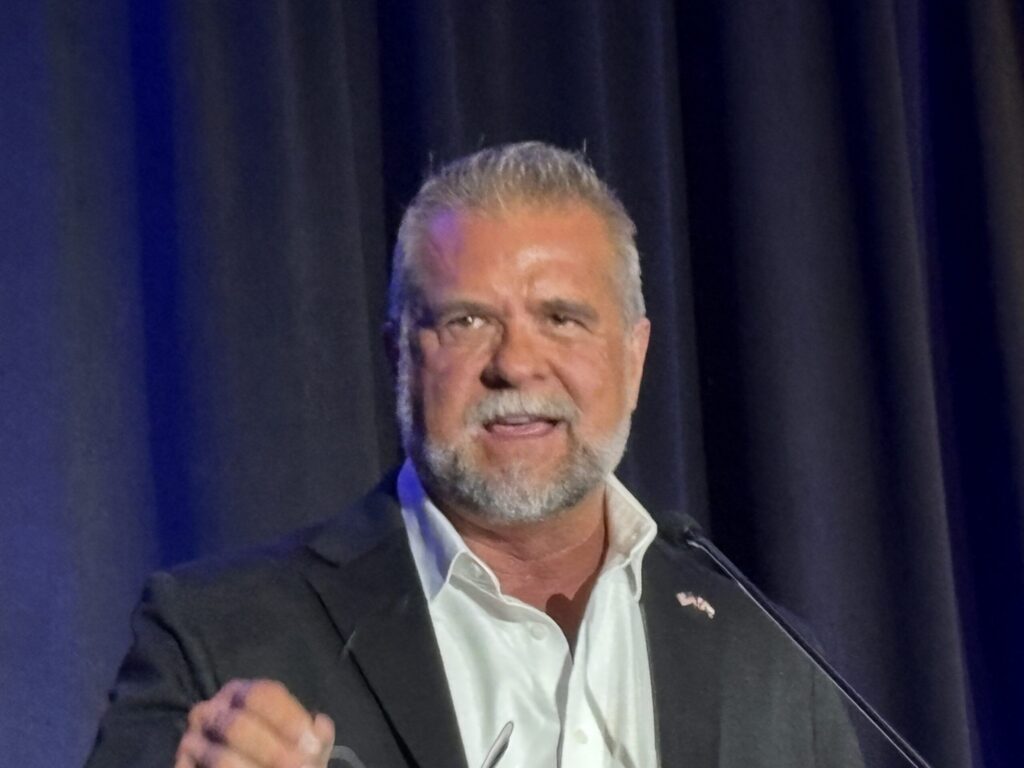
GOP gubernatorial candidate Victor Marx pushes aggressive water-storage expansion at Colorado Water Congress
Marianne Goodland
marianne.goodland@coloradopolitics.com
Updated 16 hours ago
Victor Marx, the Republican nominee for governor, took the spotlight Wednesday during the opening day of the Colorado Water Congress, laying out how he says the state should approach its water future. Marx told the standing-room-only audience in Steamboat Springs...

U.S. Rep. Lauren Boebert stresses storage, forest health and Upper Basin rights at Colorado Water Congress
Marianne Goodland
marianne.goodland@coloradopolitics.com
Updated 7 hours ago
Republican U.S. Rep. Lauren Boebert used her brief Wednesday appearance at Colorado Water Congress to tout her record on delivering water projects for the state and her district. Boebert, who is running for her second term representing the 4th Congressional...

Steve Schuck on the ‘magic’ of school choice | The OpEdge Podcast
Tony Olivero
tony.olivero@gazette.com
Updated 1 day ago
Parents Challenge co-founder and longtime school choice advocate Steve Schuck joins The OpEdge to discuss expanding educational opportunities and ensuring parents are in charge of their kids’ education. Schuck tells investigative columnist and host Jimmy Sengenberger why he believes Colorado...
Do lobbyists add value to policymaking? | PODIUM
Colorado Politics
colorado-politics@coloradopolitics.com
Updated 1 day ago
By Corky Kyle I was recently asked a straightforward question: are lobbyists a valuable component in the development of public policy? After more than four decades working with the Colorado General Assembly, state agencies, local governments, associations and businesses, my...
Ain’t Polis’ Peters commutation a pity? | Hal Bidlack
Hal Bidlack
hal-bidlack@coloradopolitics.com
Updated 3 days ago
I am hoping that, yet again, my long-suffering and very forgiving editor will pardon my rambling thoughts today, as there are too many open tabs on my computer that deal with issues I want to talk about (Ed: pretty used...
Colorado House Democrats’ caucus finances under scrutiny as ethics case against leader advances
Marianne Goodland
marianne.goodland@coloradopolitics.com
Updated 2 days ago
Democratic lawmakers told a legislative ethics panel that a leader’s management of caucus finances left them with unanswered questions, disputed reimbursements and a breakdown in communication that ultimately triggered a formal complaint. The House Ethics Committee is examining a complaint...

Colorado River crisis: Lake Mead, Lake Powell inch closer to ‘dead pool’
Marianne Goodland
marianne.goodland@coloradopolitics.com
Updated 3 days ago
In the past 10 days, both Lake Mead on the Arizona-Nevada border and Lake Powell roughly 300 miles northeast on the Utah-Arizona line have recorded their lowest water levels since the reservoirs were first filled. Lake Mead, the nation’s largest...
PREV
PREVIOUS

25 lessons and wishes to celebrate America’s 250th | SONDERMANN
The 250th celebration of America’s birth is upon us. There is undoubtedly much to salute. Despite plenty of strife and discontent at home, America remains a beacon to much of the world. The wisdom of our founders has largely withstood the test of time. That said, we are living through a tumultuous period, certainly not […]

Colorado needs an Independence Day | Jon Caldara
Happy 250th Birthday, America! You look fabulous. As all the cool countries are saying, “250 is the new 230.” The Declaration of Independence wasn’t merely an announcement of war against a tyrant. It was the most revolutionary political document ever written. The Declaration was a landmark in human development, perhaps the landmark of all human […]