

Court snuffs out challenge to Denver’s flavored tobacco ban

The smoke finally cleared in Denver’s battle over a citywide ban on flavored tobacco products when a Denver court dismissed a challenge from local vape shop owners seeking to declare the ordinance unconstitutional and block its enforcement.
On Wednesday, Denver District Court Judge Erica F.H. Englert dismissed a lawsuit filed by the Rocky Mountain Smoke-Free Alliance, which argued that the City and County of Denver’s ordinance banning the sale of flavored tobacco products is unconstitutionally vague and violates multiple aspects of both the Colorado and U.S. Constitutions, including free speech.
“This decision sends a clear message that communities have the authority to stand up to the tobacco industry and protect public health,” Jodi Radke, regional director of the Campaign for Tobacco-Free Kids, said in a statement. “We look forward to building on this momentum across Colorado by advancing more local flavored tobacco policies and, ultimately, a statewide law that protects every Colorado kid from the harms of flavored tobacco and the tobacco industry’s relentless efforts to addict a new generation of customers.”
The lawsuit did not seek monetary damages.
The court granted the city’s March 25 motion to dismiss all five claims, finding that the plaintiffs had not made a legally sufficient case to move forward.
“The court rejected each of the tobacco industry’s claims and upheld Denver’s authority to protect public health,” Radke added. “In its ruling, the court recognized Denver’s legitimate interests in promoting public health, reducing youth tobacco use and combating tobacco sales to kids.”
Radke noted that the case was supported by 26 other national, state and local public health, medical and community organizations that joined the amicus brief supporting the city’s motion to dismiss.
John-Paul Willett, a spokesperson for the Rocky Mountain Smoke Free Alliance, asserts that the Campaign for Tobacco-Free Kids targeted flavored tobacco sold by locally owned vape shops instead of cigarettes.
“Rather than banning cigarettes and fighting the tobacco companies, they eliminated what many adult smokers use as one of the most effective off-ramps to stop smoking cigarettes: vaping,” Willett said in a statement. “To date, 21 million Americans have left cigarette smoking for better alternatives.”
The court’s decision, Willett asserts, will affect many locally owned vape stores, with some forced to close their doors.
“The court decision didn’t go our way, but it does not mean that this is the end of the fight,” local vape store owner Philip Gueirn told The Denver Gazette.
Guerin, who stepped down several months ago as the president of the Rocky Mountain Smoke-Free Alliance, added: “Small businesses in Denver are being unfairly burdened with short-sighted solutions for long-term problems that the Denver government should be managing.”
The court ruling comes at the end of a long and expensive journey for local vape shop owners.
After the Denver City Council voted to adopt the flavored tobacco ban in late December 2024, a grassroots effort gained traction when it set out to take the matter to the voters.
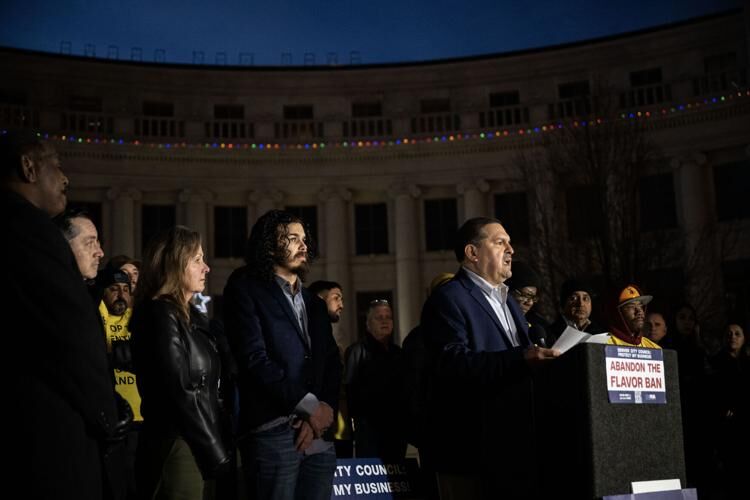
In March 2025, a group of vape shop owners — Guerin, Ellen Rochelle, Shanna Finch, Kristen Hensel and Russel Hensel — pushed back by turning in 17,000 signatures to the city, almost twice the 9,500 needed, to put Referendum 310 on the Nov. 4 ballot. The referendum sought to repeal the ban.
More than 70% of Denver voters opted to keep the city’s ban on flavored tobacco in place.
Guerin, then-president of the Rocky Mountain Smoke-Free Alliance Board of Directors and owner of Myxed Up vape stores, said getting Referendum 310 on the ballot was expensive — it cost his group more than $240,000, most of which went to pay the firm that collected and verified the signatures.
Michael Bloomberg, former mayor of New York City, waded into the fight over Denver’s flavored tobacco ban, contributing more than $5 million to Denver Kids vs Big Tobacco, according to Denver Searchlight, the city’s online database for campaign and finance disclosure.
“Unfortunately, the voice of a New York billionaire was more influential than that of a real Denverite,” Guerin told The Denver Gazette in November 2025. “It’s really scary that there’s no limit to the amount of outside money that can be brought in on issues.”
The blowback over the city’s ban on flavored tobacco stems from arguments that the product’s sweet and candylike flavors target youth in particular and serve as a gateway to further substance abuse.
City documents claim that the economic impact of flavored tobacco products in Colorado amounts to $2.2 billion in annual healthcare costs, $4.4 billion in smoking-caused productivity losses and $415 million in estimated Medicaid costs, for a total tax burden of $772 per household.
Enforcement of Denver’s flavored tobacco ban, which prohibits the sale of any flavored tobacco or nicotine product, including menthol, within the city of Denver, began on Jan. 1.
City officials said that while education efforts will continue, retailers can expect both public-facing and undercover investigations to ensure compliance.
This story was updated to include a statement from the Rocky Mountain Smoke-Free Alliance, which did not respond to The Denver Gazette’s request for comment regarding the court’s ruling by the time this story was originally published.


Denver companies shine in Vail festival’s ‘Colorado Dances’ | NONPROFIT REGISTER
Joanne Davidson Special to Colorado Politics
joanne-davidson-special-to-colorado-politics@coloradopolitics.com
Updated 1 hour ago
COLORADO BALLET CLEO PARKER ROBINSON DANCE Denver News: The 2026 Vail Dance Festival, an 11-day “Celebration of creativity, collaboration and world-class artistry,” closed on Aug. 10 with a program of world premieres and new works created for the festival. But on Aug. 9...
Denver City Council committee looks to ease affordable housing metrics
Deborah Grigsby
deborah.smith@denvergazette.com
Updated 2 days ago
Denver’s Department of Housing Stability is asking the city to rewrite some of the key performance metrics in the city’s agreement with the Denver Housing Authority to deliver affordable housing. HOST is asking the city to amend parts of a...
Denver City Council committee looks to ease affordable housing metrics
Deborah Grigsby
deborah.smith@denvergazette.com
Updated 2 days ago
Denver’s Department of Housing Stability is asking the city to rewrite some of the key performance metrics in the city’s agreement with the Denver Housing Authority to deliver affordable housing. HOST is asking the city to amend parts of a...

Signals mixed for Colorado economy halfway through 2026
Bernadette Berdychowski
bernadette.berdychowski@denvergazette.com
Updated 24 hours ago
Colorado’s economy faced a mix of headwinds and tailwinds through the first half of the year. Inflation is up again, job growth is slowing and geopolitical turmoil has added the effects of high oil prices to the state’s economy. Yet,...

Colorado students push AI task force as schools navigate new tech era
Marissa Ventrelli
marissa.ventrelli@coloradopolitics.com
Updated 4 hours ago
A group of students is urging lawmakers to establish a task force on artificial intelligence in education to advise districts on how to ensure that pupils and educators use the technology effectively without becoming overly reliant on it. The students...

Colorado audit finds $175K wasted on unused state-issued cellphones
Marissa Ventrelli
marissa.ventrelli@coloradopolitics.com
Updated 2 days ago
Colorado spent nearly $175,000 on government issued cellphones for employees of various departments that went unused last year, according to a recent state audit. About 400 of the 6,688 cellphones issued to state employees received no calls or texts and...

Polis administration relaunches Colorado e-bike rebates with $3 million
Scott Weiser
scott.weiser@gazette.com
Updated 6 days ago
Gov. Jared Polis and the Colorado Energy Office announced Thursday the return of the state’s popular e-bike rebate program, with registration set to open later this month. The office plans to provide point-of-sale rebates totaling $3 million from the Community...

Right-to-natural-gas proposal in Colorado qualifies for ballot
Marissa Ventrelli
marissa.ventrelli@coloradopolitics.com
Updated 7 days ago
A citizen initiative that seeks to enshrine the right to natural gas has qualified for the November ballot, Colorado’s election office confirmed on Thursday. Petitions containing signatures for Initiative No. 177 were turned in to the Secretary of State’s Office for review...

Colorado AG urges Supreme Court to let Boulder climate lawsuit proceed
Marissa Ventrelli
marissa.ventrelli@coloradopolitics.com
Updated 7 days ago
Colorado Attorney General Phil Weiser has filed a court brief with the U.S. Supreme Court in a lawsuit brought by Boulder city officials seeking to hold oil companies liable for their environmental impact. The case began in 2018, when the...

New Colorado laws going into effect cover AI disclosures, medical marijuana access and gambling limits
Marissa Ventrelli
marissa.ventrelli@coloradopolitics.com
Updated 1 week ago
More than 100 new Colorado laws take effect Aug. 12, bringing changes to chatbot safety rules, psychedelic research, campus wellness checks and sports betting restrictions. Here is a look at some of those laws set to take effect. The law:...
PREV
PREVIOUS

Colorado justices agree fraud claims belong in corporate dispute
The Colorado Supreme Court decided on Tuesday that a corporate plaintiff validly pursued fraud claims over conduct that was not covered by a contract or by a set of interrelated business agreements leading up to the contract. Previously, the Court of Appeals found that Veolia Water Technologies, Inc. had a duty, independent from any contract, […]

Colorado justices suggest father entitled to appeal of custody decision
Members of the Colorado Supreme Court signaled strongly on Tuesday that a father deserved some avenue for challenging a temporary child custody order that no lower court believed it could review due to the unusual circumstances of the case. Because the appeal involved a child welfare matter, neither the underlying filings describing the case nor […]