

DPS names panel to shape $43M tax hike
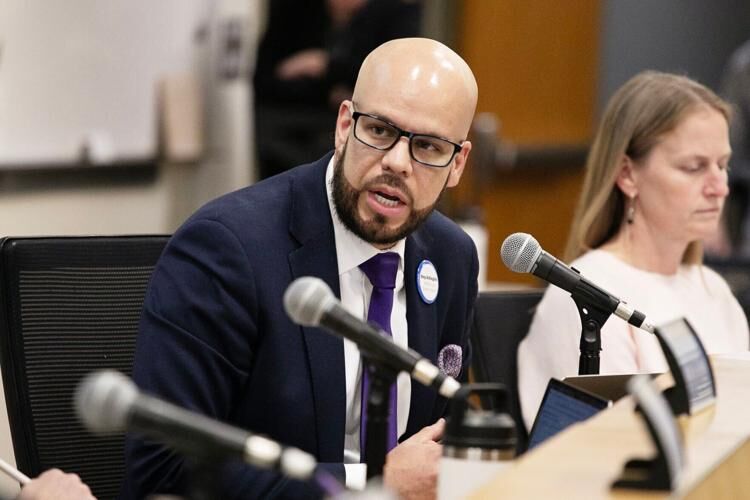
A newly appointed Mill Levy Override Advisory Committee has been tasked with deciding how Denver Public Schools should spend more than $40 million in additional revenue, should voters approve the tax hike in November.
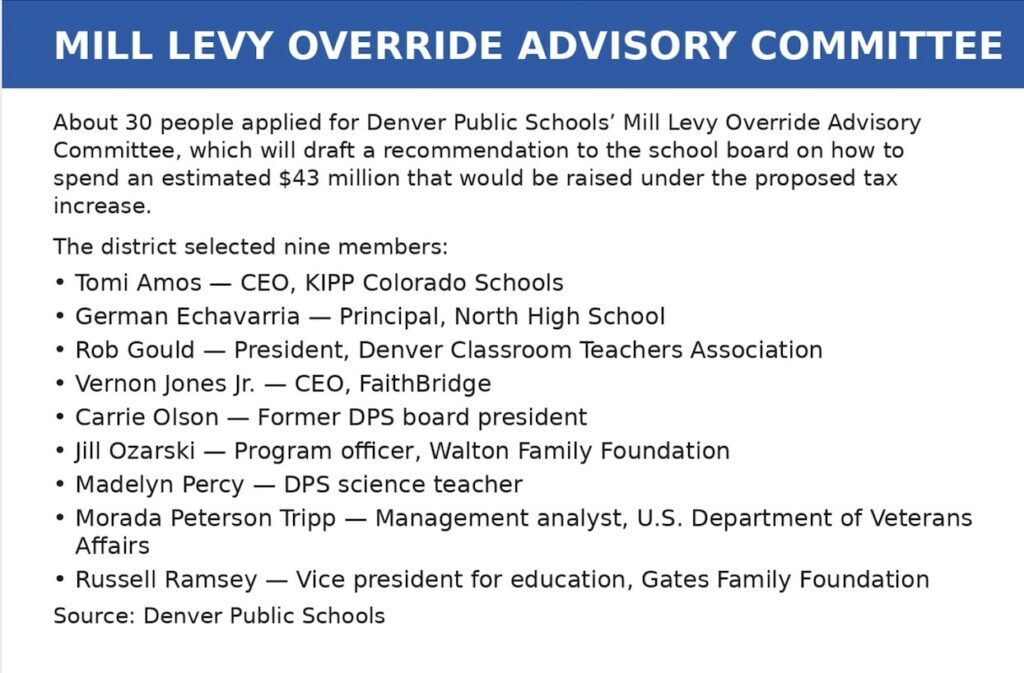
The district received about 30 applications and accepted nine for the committee, said Scott Pribble, a DPS spokesperson. The group represents a cross-section of education stakeholders, with notable representation from philanthropy and system leadership.
Members will hold six public meetings starting next week to gather input from the community.
The committee is expected to draft a recommendation that will be presented to the board of education in June.
DPS currently collects $288.6 million annually in mill levy override revenue, according to the district. If voters approve the measure in November, the override would increase the tax rate in Denver from 29% to 30%, resulting in the average homeowner paying an additional $71 annually, according to DPS.
This would raise the total collected from voter-approved overrides to $332.6 million.
Of the roughly $43.9 million raised, $33.7 million would benefit district-run schools and $10.2 million would go to charters, officials said.
Needs identified by the district include: staff incentives for hard-to-fill roles and a “cost of living” gap. Last year, the teachers’ union reached an agreement with the district to seek an increase in educator pay through a ballot measure after being denied their full cost-of-living (COLA) increase in 2024.
Officials also pointed to a familiar financial challenge: declining enrollment and the subsequent loss of funding.
As previously reported, a Denver Gazette analysis of the district’s audits found DPS has operated with a negative unrestricted net position for at least two decades, reflecting long-term liabilities that limit the district’s financial flexibility. The district increasingly relies on local taxpayers for its funding, with state support having declined over that period.
Local property taxes are not tied to enrollment. But the district has made enrollment a central issue in its growing financial woes.
Superintendent Alex Marrero has repeatedly warned that enrollment losses — which reduce state funding — are outpacing what school closures alone can address, adding pressure to the district’s already tight budget.
‘Support is expensive’
The mill levy override discussion comes 18 months after district officials promised voters that passing a nearly $1 billion bond would not raise taxes.
Denver voters overwhelmingly approved the largest bond measure in Denver’s history: $975 million in 2024. The bond package included $83 million for safety and technology; $240 million to equip 29 schools with air conditioning; and $301 million for “critical maintenance.”
Had Denver voters rejected the bond measure, the taxpayers would have saved about $20 million a year as previous bonds mature, DPS Chief Financial Officer Chuck Carpenter has said.
DPS already generates more than 25% of its core funding through voter-approved tax overrides.
State law caps the amount a district can raise through an operating mill levy override — up to 25% of its total program funding.
Revenue from this voter-approved override can support teacher pay and school programs but cannot be used for capital construction, which is funded through bonds.
The proposed tax increase comes as the district faces mounting financial pressures.
Denver voters have approved three overrides since 2012, with the latest in 2020, a $32 million mill levy to help hire more school nurses and pay for teacher pay raises and hourly workers like bus drivers and custodians.
Denver homeowners will already pay more in school taxes next year, even though DPS slightly lowered its overall tax rate. This is being driven by rising assessed home values
The district can adjust only a small portion of its total tax rate each year. In practice, the changes in a property’s assessed value are what most often determine whether a homeowner’s tax bill goes up or down.
Some people spoke in support of a mill levy override at Wednesday’s board of education meeting during public comment.
Michelle Horowitz was one of them.
A speech language pathologist, Horowitz said students returning from the COVID-19 pandemic are showing up with more complex needs.
“They’re not fitting into the box and they need more support,” said Horowitz. “That support is expensive.”
Horowitz is a former bargaining co-chair for the Denver Classroom Teachers Association, which represents about 4,000 educators across the district.
The earlier commitment to not raise taxes remains a point of tension as the district returns to voters.
“I think that we’re so underinvested that they should have never committed to that,” Horowitz said.


Douglas County schools to consolidate administrative offices into $29M headquarters to cut costs
Nicholas Fogleman
nicholas.fogleman@denvergazette.com
Updated 3 days ago
The Douglas County School Board is moving forward with a $29 million plan to consolidate district administrative operations into a new headquarters. It’s part of an effort to reduce annual costs as the district faces ongoing budget pressures. In June,...
Jeffco taxpayers could be on the hook for a possible child sex assault settlement
Matt Kyle
matt.kyle@denvergazette.com
Updated 3 days ago
Taxpayers may end up on the hook for a child sexual assault settlement, possibly worth up to $15 million, after Jeffco Public Schools failed to notify its insurance company in a timely manner about the case. The incident stems from...

Colorado Springs D-11 may present voters with $775 million bond measure
Eric Young
eric.young@gazette.com
Updated 4 days ago
Colorado Springs’ oldest school district could see new capital funding for the first time in over 20 years. Colorado Springs District 11’s Board of Education will decide whether to present a new, districtwide bond totaling $775 million to voters this...

Jeffco Public Schools sues Trump administration to protect funding after alleged transgender policies violation
Matt Kyle
matt.kyle@denvergazette.com
Updated 4 days ago
In the wake of several threats by the Trump administration to revoke federal funding, Jeffco Public Schools filed a lawsuit against the Department of Education seeking to protect that badly needed money. Jeffco has been under investigation by the DOE’s...
Q&A with Jeffco Public Schools’ interim superintendent on budget deficit, federal investigation
Matt Kyle
matt.kyle@denvergazette.com
Updated 14 hours ago
For the upcoming school year, Robert Stein will serve as Jeffco Public Schools’ superintendent. The 66-year-old Denver native has been semi-retired for the last few years. He spent 40 years in education, as both a teacher and administrator. Most recently,...

Gov. Polis celebrates Colorado’s first-place education ranking by U.S. News
Marianne Goodland
marianne.goodland@coloradopolitics.com
Updated 4 days ago
Colorado officials said they have something to celebrate this week, in addition to the state’s sesquicentennial birthday on Saturday. U.S. News & World Report on Tuesday gave Colorado its top ranking for education efforts from pre-K to postsecondary, though it...

Colorado schools receive $24 million for free meals program
Marissa Ventrelli
marissa.ventrelli@coloradopolitics.com
Updated 6 days ago
The Colorado Department of Education is providing Colorado schools with nearly $24 million in grant funding to implement a free lunch program. Approved by voters in 2022, the Healthy School Meals for All provides free breakfast and lunch to all...

Colorado districts prepare for school year amid mental health worries — will fewer cellphone distractions help?
Marissa Ventrelli
marissa.ventrelli@coloradopolitics.com
Updated 7 hours ago
The signs of a new school year are everywhere — buses in the shop, teachers unpacking boxes, families ticking through supply lists — and behind the familiar rituals, Colorado districts are preparing for a year defined less by routine than...

UNC opens College of Osteopathic Medicine
Marissa Ventrelli
marissa.ventrelli@coloradopolitics.com
Updated 6 days ago
The University of Northern Colorado held a grand opening for its new College of Osteopathic Medicine on Friday, with Gov. Jared Polis in attendance to celebrate the culmination of a two-year, $127.5 million project. The project was funded through legislation...

DOJ sues Colorado to overturn in‑state tuition for students living in the country illegally
Marianne Goodland
marianne.goodland@coloradopolitics.com
Updated 1 week ago
The U.S. Department of Justice has sued Colorado to dismantle a decade‑old law that grants in‑state tuition to students living illegally in the United States, setting up a high‑stakes clash over immigration policy. In 2013, after more than six tries...
PREV
PREVIOUS

Colorado awards $26M in tax incentives to keep aerospace company in state
A technology company in the aerospace and defense industry is looking to expand and could bring 1,250 jobs to Colorado if it chooses to continue growing in the state. The Colorado Economic Development Commission approved $26 million in job growth incentive tax credits on Thursday for an unnamed company called “Project Hera.” (The commission often […]

Aurora seeks public input on City Council decorum rules
Aurora residents can help shape how City Council meetings are conducted by giving input on council rules through the end of April. The Council Rules Ad Hoc Committee is reviewing the Aurora City Council’s Rules of Order and Procedure and inviting residents to share their input through April 30 at EngageAurora.org/Decorum. The committee will also […]