

Denver promised every school funding from $1B bond — but campuses later closed received far less | Analysis
Denver voters overwhelmingly approved the largest bond measure in Denver Public Schools history on the promise that every school — including charter campuses — would receive something.
And they did.
But the nearly $1 billion bond was not distributed evenly. Schools that remained open were allocated about 57% more bond funding on average than campuses later identified for closure or restructuring, a Denver Gazette analysis of district planning records shows.
Campuses marked for closure received about $2.6 million on average, compared with roughly $4.1 million for schools that remained open.
That disparity has led some to surmise that how the bond was sold to the public was misleading — by telling voters each school would get money without disclosing that several would receive way less. That knowledge, those critics said, could have swayed the election in a different direction.
“It is true that we indicated and plan for all buildings to receive something from the bond package, but we never said that the amounts would be equal,” district spokesperson Scott Pribble said.
Pribble said need is what dictated the choices.
Some buildings, he said, required more critical maintenance, while maintenance at smaller buildings also does not cost the same as larger facilities.
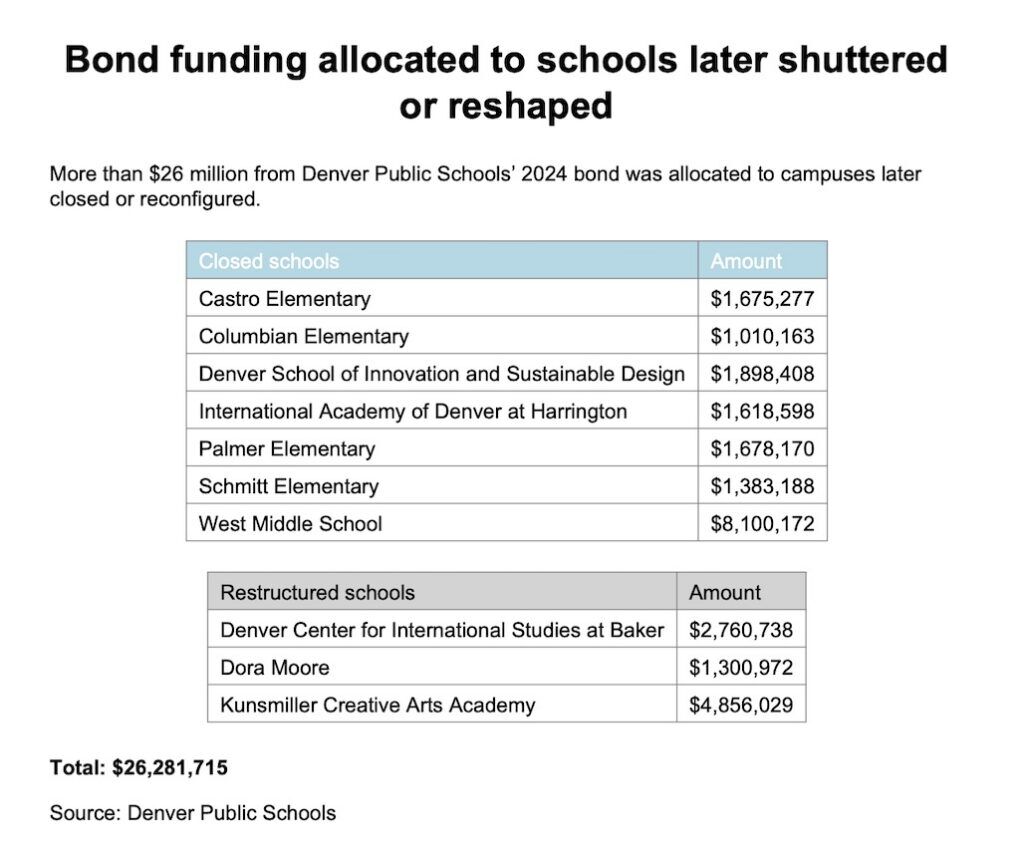
District officials said critical maintenance projects will still be carried out at closed and restructured schools. A Denver Gazette analysis found that about $8.1 million of the funding for those 10 campuses is tied to maintenance-related projects. The remaining funds — roughly $18 million — were allocated to other projects, raising questions about how those dollars would be used.
‘A hard pill to swallow’
An analysis of district planning records found significant disparities across campuses.
Among the findings:
- The allocations for closed or restructured campuses totaled $26.2 million
- Across the district, campus spending ranged from as little as $15,120 at Rocky Mountain Prep Sunnyside to $24 million at the Paul Sandoval campus, which is shared by Northfield High School and DSST-Conservatory Green High School.
- Roughly three out of four campuses received an allocation of $1 million or more
- About a dozen schools received less than $100,000 in bond funding
- Twenty properties got more than $10 million
Capital improvements are planned and funded at the campus level. But because multiple schools or programs may operate at a single site, the Denver Gazette analyzed allocations by physical campus.
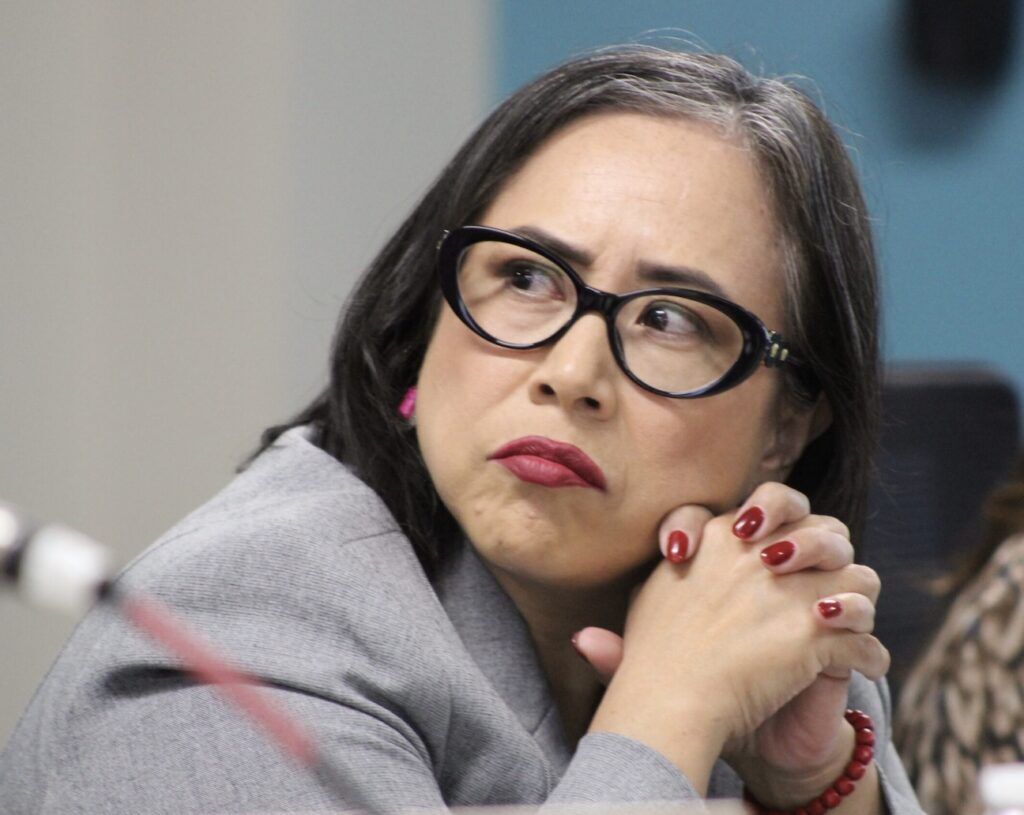
Board President Xóchitl Gaytán declined to comment about the disparities. Instead, she directed The Denver Gazette to comments she made 17 months ago on the day of the school closure vote.
District officials have justified the closures, warning more are likely to come because of the declining enrollment spurred by lower birth rates, rising housing costs and gentrification.
After peaking in the 2019-2020 school year with 92,112 students, district enrollment has dipped roughly 3% to 89,210, state data shows.
“I do believe the numbers that DPS has represented,” Gaytán said before the vote. “They’re a hard pill to swallow.”
Gaytán represents southwest Denver, which bore the brunt of school closures in 2024 and is expected to continue experiencing a decline in school-age students.
Since 2019, Southwest Denver has lost roughly 20% of its students, the most profound decline in the district. The northwest region is down 9%, while in the central region, it’s down 7%.
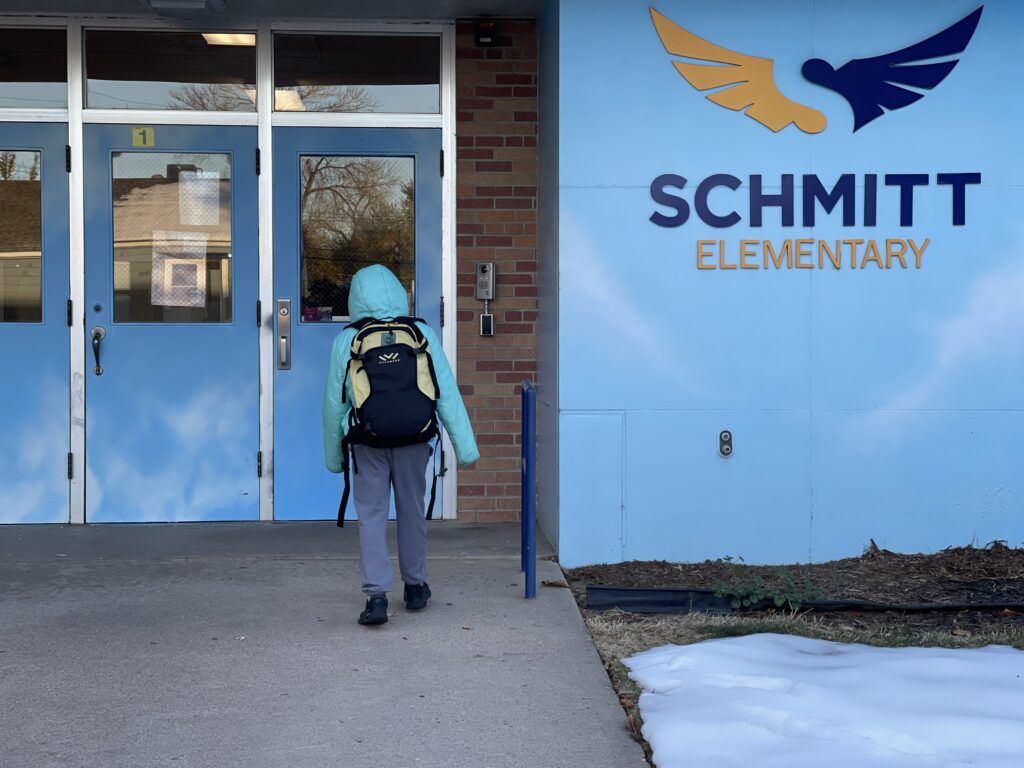
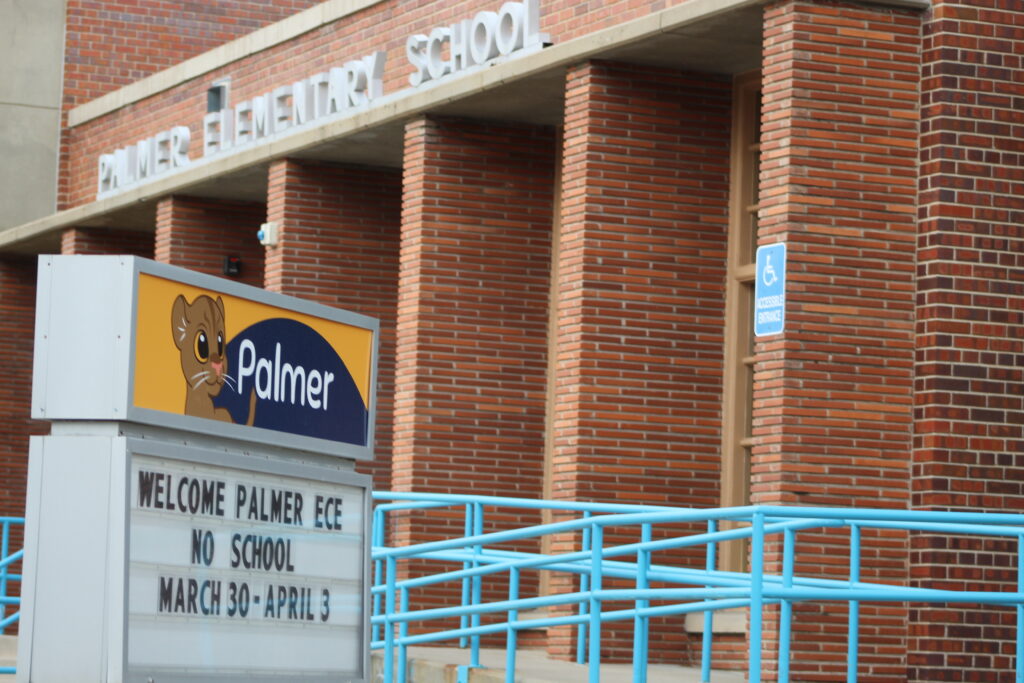
The board unanimously voted to shutter Columbian Elementary, Castro Elementary, Schmitt Elementary, International Academy of Denver at Harrington, Palmer Elementary, West Middle School and Denver School of Innovation and Sustainable Design.
They also approved restructuring Kunsmiller Creative Arts Academy, Dora Moore and the Denver Center for International Studies at Baker.
Collectively, these schools were allocated $26.2 million from the 2024 bond, planning documents obtained under the Colorado Open Records Act show.
‘The process has been a sham’
Voters overwhelmingly approved the $975 million bond package in November 2024. Two days later, Superintendent Alex Marrero released a closure list — without a boundary or impact study — that included schools already slated to receive millions.
The closure list was expected in October.
But Marrero requested a one-time extension, citing the need for the October Count enrollment data for his team to complete the analysis. As previously reported by The Denver Gazette, Marrero’s team actually used September enrollment data, district documents show.
The timing carried added weight because district leaders were simultaneously asking voters to approve the largest bond package in its history — with assurances it would not increase taxes.
Those concerns were voiced in real time.
“We find that the process has been a sham,” State Rep. Tim Hernandez, D-Denver, said at the time.
A former DPS teacher, Hernandez urged board members not to support closures.
District officials and the board have defended Marrero, saying his actions were not nefarious.
While both conditions were met at the time, district officials have since signaled a mill levy override could be needed to address ongoing financial pressures.
The October Count — which the district cited as the reason for the delay — is a key benchmark used to determine state school funding.
Every year on Oct. 1, school districts across the state conduct what’s called the “October Count,” which is used to determine school funding.
The financial pressure driving those decisions is rooted in how schools are funded.
In Colorado, enrollment is tied to state funding, which in Denver accounts for about 17 cents on the dollar.
The state share in Denver has been shrinking over the past two decades from 35% to 17%, while the portion coming from property taxes increased from about 58% to roughly three-quarters today, district audits show.
That shift has left district like Denver more dependent on local funding, which is not tied to enrollment.
Because fewer students mean less money for the district, DPS officials have looked to school closures to trim costs.
Since 2023, the district has closed 10 schools and reconfigured three others. Seven of these closures were first targeted in 2022, when Marrero’s list faced intense community pushback prompting the district to abandon the plan.
‘Misleading’
Kate Grimm voted for the 2024 bond.
And then when the board closed Palmer Elementary, where her son attended kindergarten, Grimm said she visited half a dozen schools before landing on Carson Elementary.
Grimm wasn’t surprised allocations differed across the district. But what shocked her was the gap between similar schools.
“I would have expected spending to be similar for comparable buildings,” Grimm said.
Having a fuller picture now, Grimm said the bond measure was “misleading.”
“Who knows if the outcome would have been exactly the same, but it certainly would have been a different conversation,” she said.
Marrero was prohibited from recommending school closures solely on enrollment, as was done in shuttering Denver Discovery, Mathematics and Science Leadership Academy and Fairview Elementary three years ago. So, his team used “building utilization rates.”
Education finance experts say disparities like those Grimm observed are not uncommon in systems driven by enrollment and competition.
“What you have is a circular relationship,” said Mark Weber, an education policy analyst at New Jersey Policy Perspective. “You then have a school in a death spiral.”
Schools with fewer resources may struggle to attract students, which can further reduce enrollment — and funding.
“At the end of the day, what winds up happening is you get winners and by default you also get losers,” Weber said.
But others say the district’s allocations reflect the realities of those dynamics.
“If they already knew which schools were going to close — behind closed doors — then wouldn’t it make sense that they would spend less at those schools,” said David Knight, an education finance expert and fellow at the National Education Policy Center in Boulder.
In that kind of system, experts say, declining enrollment isn’t just a cause of closures — it can also be the result of earlier decisions.
“It’s not surprising that people don’t want to send their kids to the worst funded schools,” Weber said.

DOJ official decries ‘nonsense’ in Jeffco schools at fundraising gala
Matt Kyle
matt.kyle@denvergazette.com
Updated 14 hours ago
Amid a legal battle between Jeffco Public Schools and the federal government, a Department of Justice official spoke at a fundraising gala and decried “crazy stuff” and “nonsense” in the school district. The gala was for Jeffco Kids First, an...
Former VP Mike Pence joining Colorado Christian University faculty
Marissa Ventrelli
marissa.ventrelli@coloradopolitics.com
Updated 1 day ago
Former Vice President Mike Pence has been hired as a visiting faculty member at Colorado Christian University, the Lakewood-based private evangelical university announced Tuesday. Pence will be on campus about once a month during the 2026-2027 school year to give...

‘Explosive’ diarrhea-causing parasite cyclosporiasis cases nearly triple in Colorado
Nico Brambila
nico.brambila@denvergazette.com
Updated 2 days ago
Cases of the “explosive” diarrhea-causing parasite cyclosporiasis nearly tripled in Colorado over the past month, prompting renewed attention after related deaths were reported in Michigan. Twenty-nine counties in Colorado have reported cases, according to the Colorado Department of Public Health...
First Air Force Academy class of just 306 cadets started out in WWII barracks, faced high standards
Mary Shinn
mary-shinn@coloradopolitics.com
Updated 5 days ago
When the first class of the Air Force Academy arrived at Lowry Air Force in Denver, they were welcomed with an air show featuring bombers and fighter jets. “Most of us were overwhelmed,” recalled retired Col. Max Miller, the president...

Douglas County schools to consolidate administrative offices into $29M headquarters to cut costs
Nicholas Fogleman
nicholas.fogleman@denvergazette.com
Updated 1 week ago
The Douglas County School Board is moving forward with a $29 million plan to consolidate district administrative operations into a new headquarters. It’s part of an effort to reduce annual costs as the district faces ongoing budget pressures. In June,...
U.S. Department of Education investigates DPS over same-sex kissing assignment
Nico Brambila
nico.brambila@denvergazette.com
Updated 5 days ago
The U.S. Department of Education is investigating Denver Public Schools for its handling of a French high school teacher who was fired earlier this year over requiring students to perform a same-sex kissing scene as part of a classroom acting...
U.S. Department of Education investigates DPS over same-sex kissing assignment
Nico Brambila
nico.brambila@denvergazette.com
Updated 5 days ago
The U.S. Department of Education is investigating Denver Public Schools for its handling of a French high school teacher who was fired earlier this year over requiring students to perform a same-sex kissing scene as part of a classroom acting...
Jeffco taxpayers could be on the hook for a possible child sex assault settlement
Matt Kyle
matt.kyle@denvergazette.com
Updated 1 week ago
Taxpayers may end up on the hook for a child sexual assault settlement, possibly worth up to $15 million, after Jeffco Public Schools failed to notify its insurance company in a timely manner about the case. The incident stems from...

Colorado Springs D-11 may present voters with $775 million bond measure
Eric Young
eric.young@gazette.com
Updated 1 week ago
Colorado Springs’ oldest school district could see new capital funding for the first time in over 20 years. Colorado Springs District 11’s Board of Education will decide whether to present a new, districtwide bond totaling $775 million to voters this...

Jeffco Public Schools sues Trump administration to protect funding after alleged transgender policies violation
Matt Kyle
matt.kyle@denvergazette.com
Updated 1 week ago
In the wake of several threats by the Trump administration to revoke federal funding, Jeffco Public Schools filed a lawsuit against the Department of Education seeking to protect that badly needed money. Jeffco has been under investigation by the DOE’s...
PREV
PREVIOUS

National conservation area growing by 4,000-plus acres in western Colorado
A formerly private, sweeping swath of western Colorado is growing a public, red rock wonderland. Spanning 4,000-plus acres, Escalante Ranch has been transferred to the Bureau of Land Management and incorporated into Dominguez-Escalante National Conservation Area, The Conservation Fund recently announced. The announcement described the land south of Grand Junction as “encompass(ing) some of Colorado’s […]
Colorado appeals court orders new sentencing for Tina Peters, upholds convictions
Colorado’s second-highest court determined on Thursday that a trial judge improperly sentenced former Mesa County clerk Tina Peters based upon her exercise of protected speech, while at the same time upholding her convictions. The three-judge Court of Appeals panel also concluded that President Donald Trump’s attempted pardon of Peters for state-level convictions last year was […]