

Vehicle camping now illegal in Colorado Springs, City Council decides after another impassioned session
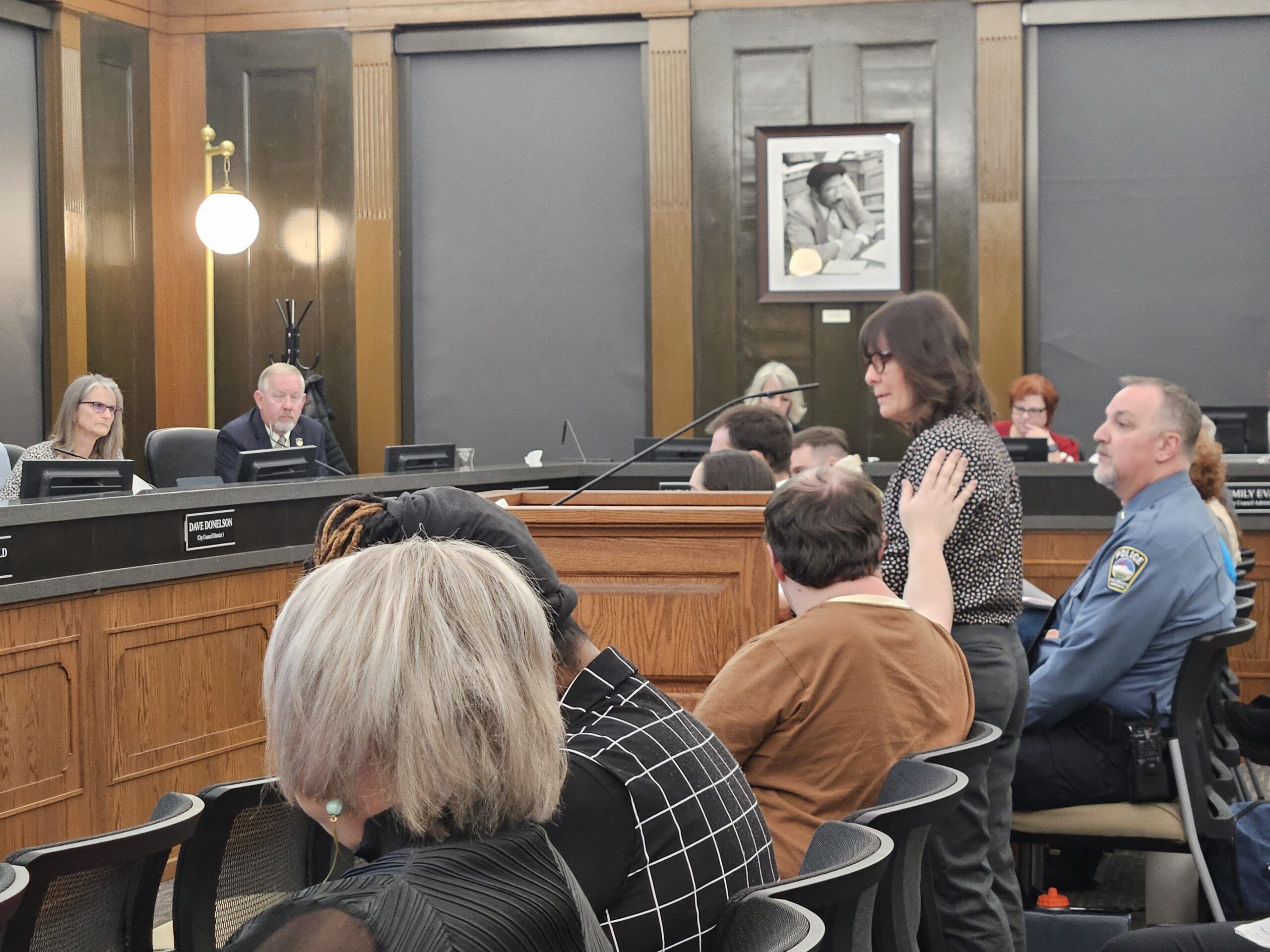
After listening to another lengthy and impassioned round of opposition Tuesday, the Colorado Springs City Council voted 7-2 to adopt a new municipal ordinance that makes living in a vehicle illegal on public property.
The law combines existing ordinances that ban overnight urban camping near waterways, along trails, in city parks and other public places and adds vehicle camping.
“Citizens have a right to expect the city to ensure their neighborhoods are orderly, safe and clean; allowing people to live in their vehicles does the opposite,” said City Council member Dave Donelson.
Nearly 30 people who spoke for three hours in opposition said banning car camping criminalizes homelessness and removes what Scott Browne, a nursing instructor at the University of Colorado’s Colorado Springs campus, called “the last vestige of autonomy that people have.”
A vehicle provides stability and allows the homeless families that Tim Close, executive director of Family Promise of Colorado Springs, works with to “maintain dignity while navigating a difficult situation.”
It also offers security and keeps people and their possessions safe, Edie Wren, who has been homeless, told the elected leaders seated at the dais.
“Housing is a human right,” she said. “Homeless individuals are not expendable; it is dehumanizing to ask them to just disappear. If you allow this ordinance to pass, we’ll have more people sleeping on the ground.”
But law enforcement officials need a better tool when responding to complaints from neighbors and business owners who are affected by people living in their cars near their homes and establishments, argued council members who supported the ordinance.
“This ordinance has nothing to do with criminalizing homelessness — it regulates camping,” Councilman David Leinweber said. “There’s an important legal and moral distinction between status and conduct. We don’t want unregulated camping — there’s not proper bathroom facilities, hygiene, trash. There are all these issues that happen around that for a public standpoint.”
Donelson said he created the proposal with the help of city staff after receiving complaints from residents and realizing the most police could do was issue a nominal traffic violation citation after someone was parked in one spot for 72 hours.
For example, Donelson said one man reported being chased by a homeless person camping in his neighborhood and that he had come across people defecating in the nearby creek.
Donelson initially suggested last fall that the council consolidate local camping laws, standardize penalties and expand the category to include living in a car, truck or RV.
But in a surprise move, members voted 5-4 on Nov. 10 to delay voting for six months to further study the issue.
Because Council members’ questions have been answered and the conditions of the ordinance adjusted in response to concerns from members who voted to postpone the proposal, Donelson said he was bringing the idea back earlier than expected, which the council approved two weeks ago.
Since November, council members spoke with the city attorney’s office, Colorado Springs police and some, including Nancy Henjum, met with service providers.
Under the new ordinance, police will issue a warning at the first contact with a vehicle dweller and give them 24 hours to move on. The second time they encounter the vehicle, the owner could be ticketed, but that’s up to the officer, Donelson said.
The vehicle would not be towed and impounded, according to the city attorney’s office, unless there was something illegal in it, such as drugs or guns. And a camper would not be taken to jail unless there was an outstanding warrant for an arrest.
Adding another strike on a record can negatively affect getting rehoused and gaining employment, said Jeron Cook, who lived in his car for a time with his daughter while they were homeless.
“The car wasn’t just transportation, it was safety from the cold,” he said. “If I’d been cited during that time that would have added another barrier, another charge, another stigma.”
Henjum, who made the motion at the Nov. 10 meeting to postpone the vote and on Tuesday voted against it along with Council member Kimberly Gold, said the new ordinance “does make sleeping in your car ultimately a jailable offense,” and there can be fines associated with it.
“The law may be interpreted by police in ways that are very compassionate, but the law makes that possible,” she said.
Emily Vandenburg from the city attorney’s office said a vehicle cannot be impounded under the camping ordinance; however, if a vehicle violates an existing parking ordinance, the vehicle could be towed after 72 hours.
“Generally speaking, that’s not what our Homeless Outreach Team is going to do,” she said.
A potential penalty is for the camper to spend up to 10 days in jail and be fined up to $300, according to the ordinance.
However, “State law and our ordinances prohibit us from collecting fines from people who are indigent. The court will make a finding of that and that’s it,” Vandenburg added.
About 150 communities prohibit vehicle camping, following a U.S. Supreme Court decision in June 2024, that ruled cities can enforce bans on sleeping and camping in public spaces, including vehicles, without violating the Eighth Amendment’s edict on cruel and unusual punishment.
Like previous City Council discussions, the issue on the table leapt from a narrow focus on urban camping to a larger debate on solving homelessness, which has been increasing in Colorado Springs.
The estimated size of the homeless population varies widely, from a record high of nearly 1,750 in last year’s annual Point-in-Time census to about 6,850 in a statewide study on Continuums of Care released last year.
Reduced federal and limited city funding, a shortage of affordable housing, a lack of mental health assistance and other roadblocks have stymied progress, said industry professionals.
“Where is our commitment to be solution-focused rather than criminal justice-focused?” Beth Roalstad, CEO of Homeward Pikes Peak, posed to council members. “As a society, do we allow homelessness to continue?”

How would Weiser, Bottoms, Bennet, Kirkmeyer address Colorado’s affordability problem? | Paula Noonan
Paula Noonan
paula-noonan@coloradopolitics.com
Updated 7 hours ago
It’s decision time in Colorado as primary election ballots hit mailboxes this week. Democrats will pick their candidates in every statewide race, and Republicans select candidates for governor and Attorney General. GOP operatives wanted to exclude unaffiliated voters from their...

The new trustees report is a wake-up call for Congress | GUEST COLUMN
Colorado Politics
colorado-politics@coloradopolitics.com
Updated 7 hours ago
By Sara Schueneman Every year, the Social Security Trustees Report provides an important snapshot of the long-term outlook for one of America’s most popular and important initiatives. This year’s report sends a clear message: Congress needs to act. The latest...
Colorado Supreme Court upholds police search of car based on arm movements
Michael Karlik
michael.karlik@coloradopolitics.com
Updated 10 hours ago
The Colorado Supreme Court decided last week that Denver officers’ search of a vehicle was constitutional, based on their perception of the occupants’ arm movements that a trial judge found to not be credible. Officers Keegan Grubb and Richard Eberharter...
Flat or graduated income tax? Colorado groups push dueling measures for November election
Marissa Ventrelli
marissa.ventrelli@coloradopolitics.com
Updated 2 hours ago
Colorado voters could face two opposing income-tax measures on the November ballot, with the dueling campaigns seeking to advance proposals that would take the state in sharply different fiscal directions. One initiative seeks to replace Colorado’s flat income tax with...
10th Circuit tosses Pueblo County sheriff defendants’ appeal in fatal shooting lawsuit
Michael Karlik
michael.karlik@coloradopolitics.com
Updated 18 hours ago
The Denver-based federal appeals court rejected an attempt from Pueblo County sheriff’s employees on Wednesday to rely on their own version of the facts to escape liability for fatally shooting an unarmed man outside a middle school. A trial judge...

Backers of Colorado road-funding initiative reject withdrawal deadline, negotiations with lawmakers continue
Marissa Ventrelli
marissa.ventrelli@coloradopolitics.com
Updated 15 hours ago
The standoff over Colorado’s road‑funding initiative will continue after supporters declined state lawmakers’ request to withdraw the measure, while both sides signaled they are still willing to pursue a broader agreement ahead of the fall deadline. Initiative No. 175, backed...

US primed for summer of unpredictable gas prices as Iran war rages on: ‘Living this uncertainty’
Emily Hallas, Washington Examiner
emily.hallas.washington.examiner@gazetteedit.wpenginepowered.com
Updated 17 hours ago
The war with Iran has made summer gas prices unpredictable, as President Donald Trump’s shifting messaging on hostilities keeps the energy markets in limbo. There’s little concrete direction on where gas prices could go in the coming months, an expert...

USPS proposes changes to mail-in ballots in states that don’t hand over voter rolls
Molly Parks, Washington Examiner
molly.parks.washington.examiner@gazetteedit.wpenginepowered.com
Updated 1 hour ago
The Postal Service proposed a new rule pushing states to turn over their mail-in and absentee voter rolls to the agency, a move in line with President Donald Trump’s March executive order tightening regulations on mail-in voting in federal elections....
Colorado justices uphold strict interpretation of consumer protection law against debt collector
Michael Karlik
michael.karlik@coloradopolitics.com
Updated 13 hours ago
The Colorado Supreme Court concluded last month that a debt collector failed to comply with state law by suing a woman for an unpaid credit card debt without documentation that it owned her account. Portfolio Recovery Associates, LLC filed a...
Colorado lupus patients can’t afford ‘most favored nation’ drug pricing | PODIUM
Colorado Politics
colorado-politics@coloradopolitics.com
Updated 1 day ago
By Kristy Kibler When you live with lupus, you learn quickly waiting is not an option. Lupus is unpredictable: flares can escalate overnight, organs can be damaged quickly, and access to the right treatment at the right time can determine...