

Colorado’s chief justice exceeds average number of dissents with 4-plus months left in term
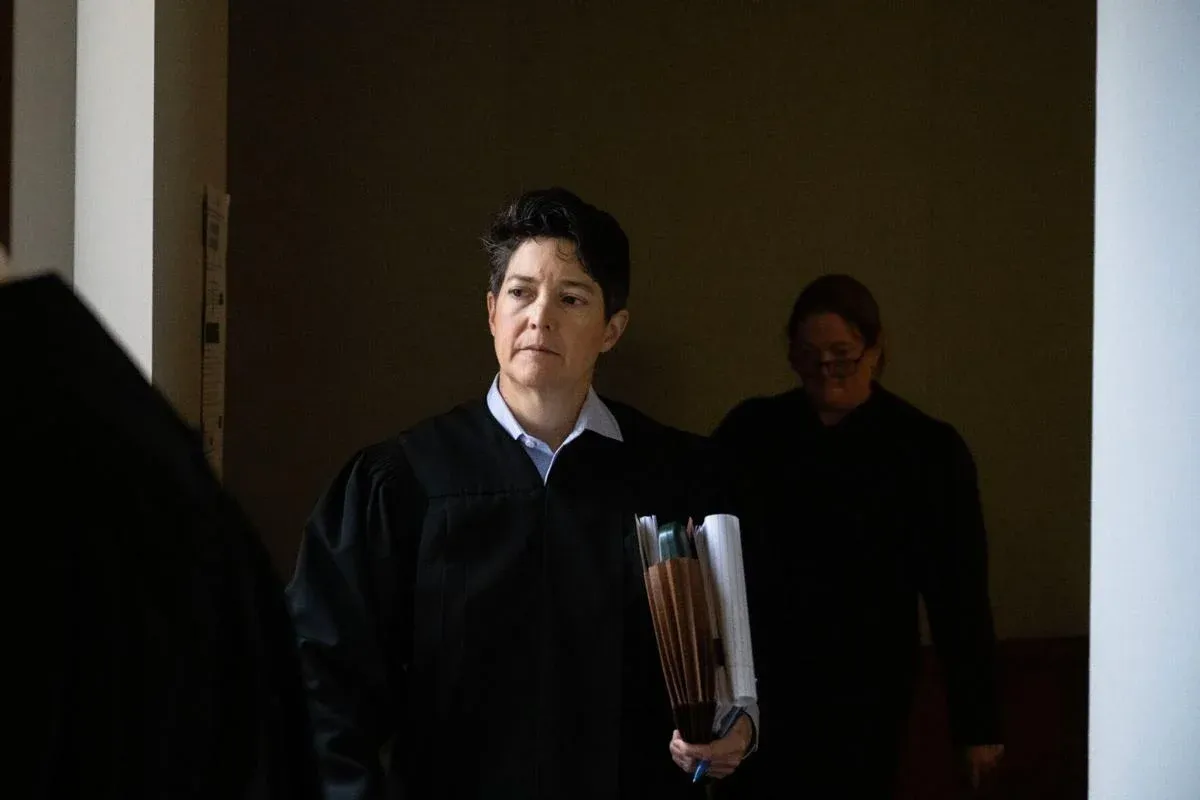
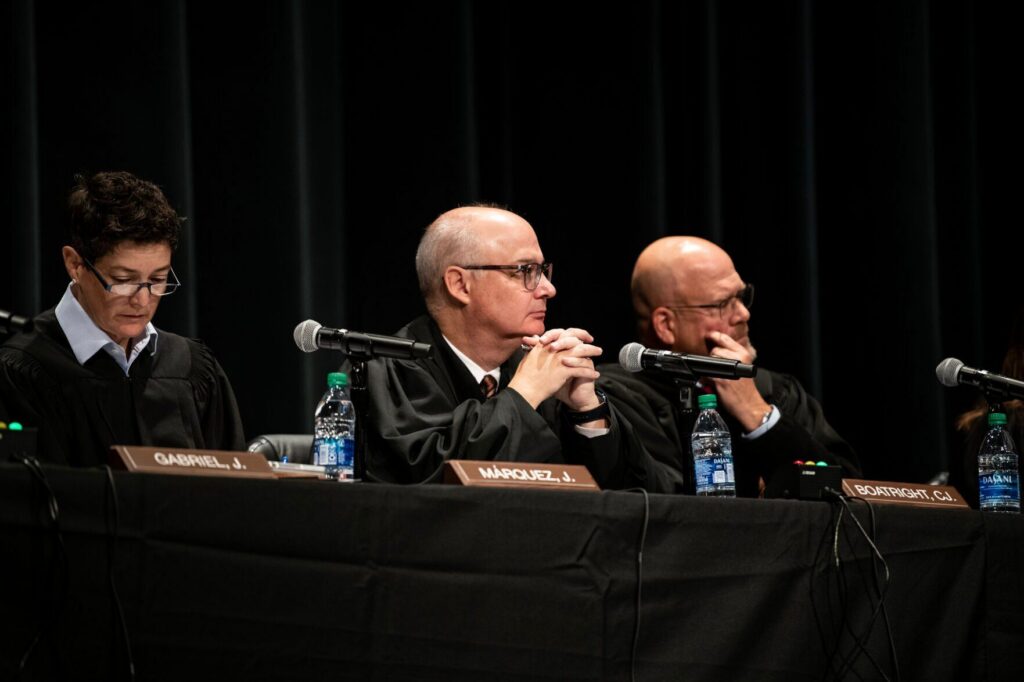
Since the start of the Colorado Supreme Court’s 2025-2026 term in September, Chief Justice Monica M. Márquez has now exceeded her average number of dissenting opinions, with more than four months remaining before the court breaks for the summer.
The Supreme Court has issued 27 new opinions since Labor Day, which is roughly in line with its past two terms. In addition, a 28th decision resulted in a rare 3-3 split, meaning no opinion was issued. Márquez has been in the minority nine times, for one-third of the cases. That number includes six dissents she has authored herself and three others she has joined.
In the Supreme Court’s prior term from 2024-2025, Márquez was in dissent only three times total. During the 2023-2024 term, Márquez authored six dissenting opinions and joined another two dissents, for a total of eight.
However, more than four months remain in the current term. The number of decisions released in the latter half of the term will likely exceed the number released so far, with split decisions continuing to surface.
Geoffrey Klingsporn, an attorney who tracks the opinions of the Colorado Supreme Court, compiles statistics about each member’s decision-making for the annual appellate event in the spring. According to his 12 years of data, Márquez has historically joined 7.5 dissents per year and was the author of four on average.
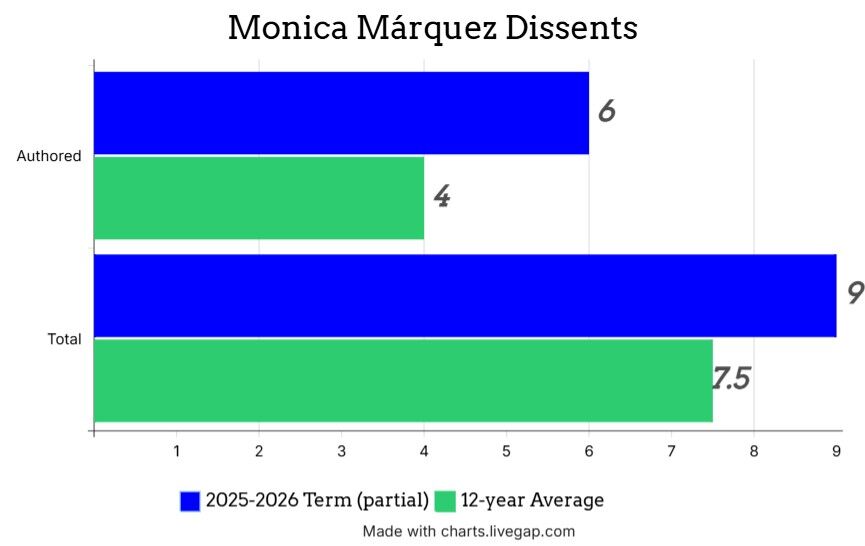
Although Klingsporn’s analysis uses a different annual reporting window than Colorado Politics uses for its statistical review, his data indicated that Márquez and Justices Brian D. Boatright and Richard L. Gabriel have dissented with roughly the same frequency between January 2022 and June 2025. So far this term, Gabriel has dissented three times and Boatright has dissented once.
Márquez’s nine dissents since September included the following:
- A criminal case involving the “involuntary intoxication” defense, where she found the majority’s interpretation too restrictive
- A postconviction criminal case, in which she believed the defendant’s claims of constitutionally deficient representation had merit
- A civil lawsuit against Xcel Energy, where she concluded the state’s regulator could limit a utility’s liability for injuries to non-customers
- A pair of open meetings lawsuits, where she disagreed with the majority about who is entitled to attorney fees for pursuing violations
- An attorney regulation case in which she believed the state’s disciplinary judge should have recused
- A crime victim restitution case, where she concluded money used by police in undercover drug operations can be recovered through sentencing
- A criminal case in which she believed prosecutors must prove a debit card is functional in order to convict a defendant of unlawfully possessing someone else’s financial device
- A criminal case in which she argued U.S. Supreme Court precedent rendered a piece of Colorado’s three-strikes law unconstitutional
In comparison to her frequency in dissent, the chief justice has only authored one majority opinion since September.
Justice Maria E. Berkenkotter is the only member of the court who has not been in the minority at all this term.

Appeals court finds state wrongly blocked ex-worker’s evidence in termination challenge
Michael Karlik
michael.karlik@coloradopolitics.com
Updated 4 hours ago
Colorado’s second-highest court ruled last week that the Colorado State Personnel Board wrongly blocked a former employee from submitting documentation to challenge his termination, even though he followed the board’s instructions to obtain the materials. Eric Strumpf was the budget...

Colorado’s ‘first public Christian school’ sues state, alleging discrimination
Eric Young
eric.young@gazette.com
Updated 12 minutes ago
Riverstone Academy, a public elementary school that opened last fall in Pueblo as a tuition-free option with Christian-based instruction, has filed a lawsuit against the state of Colorado over alleged religious discrimination. The lawsuit, filed in U.S. District Court for...
Divided Colorado Supreme Court rejects defendant’s claim of deficient DNA investigation
Michael Karlik
michael.karlik@coloradopolitics.com
Updated 10 hours ago
The Colorado Supreme Court decided on Tuesday, by 4-2, that a defendant failed to allege how uninvestigated, inaccessible DNA evidence would have shown he was wrongly convicted. When Jamale D. Townsell filed a petition from prison seeking postconviction relief, he...
Colorado justices uphold shooting conviction despite jury saying defendant not the shooter
Michael Karlik
michael.karlik@coloradopolitics.com
Updated 22 hours ago
The Colorado Supreme Court ruled on Tuesday that a man can stand convicted of murder, even though jurors found he was not the one who shot the victim and the evidence suggested he was not present for the shooting. There...

Susan Blanco new Colorado Supreme Court justice
Michael Karlik
michael.karlik@coloradopolitics.com
Updated 21 hours ago
Chief Judge Susan Blanco of Larimer and Jackson counties is the newest member of the Colorado Supreme Court, Gov. Jared Polis announced on Tuesday. “A few words come to mind: Innovation. Excellence. Creativity. Hard work. These are values we need...
Appeals court clarifies what materials judges may rely on for postconviction decisions
Michael Karlik
michael.karlik@coloradopolitics.com
Updated 2 days ago
Colorado’s second-highest court clarified on Thursday that trial judges who are deciding whether to grant relief to convicted defendants may rely on the materials attached to, or referenced in, the parties’ arguments. In contrast to direct appeals of criminal convictions,...

Colorado Supreme Court accepts cases about reliability of gun-to-bullet matching
Michael Karlik
michael.karlik@coloradopolitics.com
Updated 4 days ago
The Colorado Supreme Court announced on Monday that it will hear two cases questioning the reliability of expert testimony that purports to identify whether a specific bullet was fired from a specific gun. At least three of the court’s seven...

Colorado District Attorneys unveil 2026 legislative priorities | WHAT’S YOUR AGENDA?
Marissa Ventrelli
marissa.ventrelli@coloradopolitics.com
Updated 6 days ago
Welcome to What’s Your Agenda?: The Colorado Politics’ weekly publication of trade association priorities for the state’s 2026 legislative session. The Colorado District Attorneys’ Council provides training, resources, and legislative support to every prosecutor in the state. In order to...
Colorado justices skeptical of challenge to water enterprises’ eminent domain power
Michael Karlik
michael.karlik@coloradopolitics.com
Updated 4 days ago
Members of the Colorado Supreme Court appeared receptive on Wednesday to the notion that water-related enterprises have the legal authority to exercise the governmental power of eminent domain over private property. An enterprise is a government-owned business that provides fee-based...
Colorado justices skeptical that intimate messages relevant to assault case
Michael Karlik
michael.karlik@coloradopolitics.com
Updated 5 days ago
Members of the Colorado Supreme Court seemed to agree on Tuesday that a Douglas County judge acted reasonably by blocking evidence of a defendant’s BDSM-related conversations with the victim in his trial for assault and false imprisonment. Jurors found Donald Louis...
PREV
PREVIOUS

Appeals court finds state wrongly blocked ex-worker's evidence in termination challenge
Colorado’s second-highest court ruled last week that the Colorado State Personnel Board wrongly blocked a former employee from submitting documentation to challenge his termination, even though he followed the board’s instructions to obtain the materials. Eric Strumpf was the budget and business operations director for the Colorado Department of Corrections. He requested emergency sick leave […]

Colorado title board OKs language of ballot measure to privatize Pinnacol Assurance
The state’s title board on Wednesday unanimously voted to approve the wording of a ballot measure that would allow Pinnacol Assurance, the state’s workers’ compensation insurance provider of last resort, to privatize. Behind ballot measure No. 218 is Colorado Succeeds, a coalition of business leaders focused on education. The proposal would allow Pinnacol to become […]