

Federal judge warns DOJ against raising repeatedly rejected arguments in immigration detention cases

A federal judge in Colorado warned the U.S. Department of Justice on Monday against raising arguments that she and other judges have repeatedly rejected in cases challenging the lawfulness of immigration detentions.
In a Jan. 26 order finding the government is wrongfully detaining a Cuban national without a bond hearing, U.S. District Court Judge Charlotte N. Sweeney telegraphed her frustration with the Justice Department’s adherence to the same unsuccessful arguments advanced in the deluge of immigration-related challenges over the past year.
“Separately, the Court offers a word of caution: Respondents’ counsel is (or should be) well aware of the Court’s limited resources — indeed, the District of Colorado has already received over 40 immigration-related actions filed since the beginning of the year, many of which require prompt attention,” she wrote. “These actions have a significant impact on the Court’s docket, as it undoubtably has on Respondents’ office which is called upon to respond to such actions.”
The department “should take heed that there is no benefit in re-litigating an argument that this Court has already rejected absent a change in controlling law,” continued Sweeney, a Joe Biden appointee. “Respondents are thus cautioned to avoid raising meritless arguments with the Court — particularly when the most fundamental right to all, the right to be ‘(free) from imprisonment,’ is at stake.”
The U.S. Attorney’s Office for Colorado, which represents the government in such cases, declined to comment on Sweeney’s order.
For much of the past year, the government has asserted broad authority to detain people in immigration custody without providing a hearing to evaluate their suitability for release. Judges across the country have repeatedly rejected that assertion, although the issue has not made its way up to most circuit courts or the U.S. Supreme Court, where a ruling would set precedent for future cases.
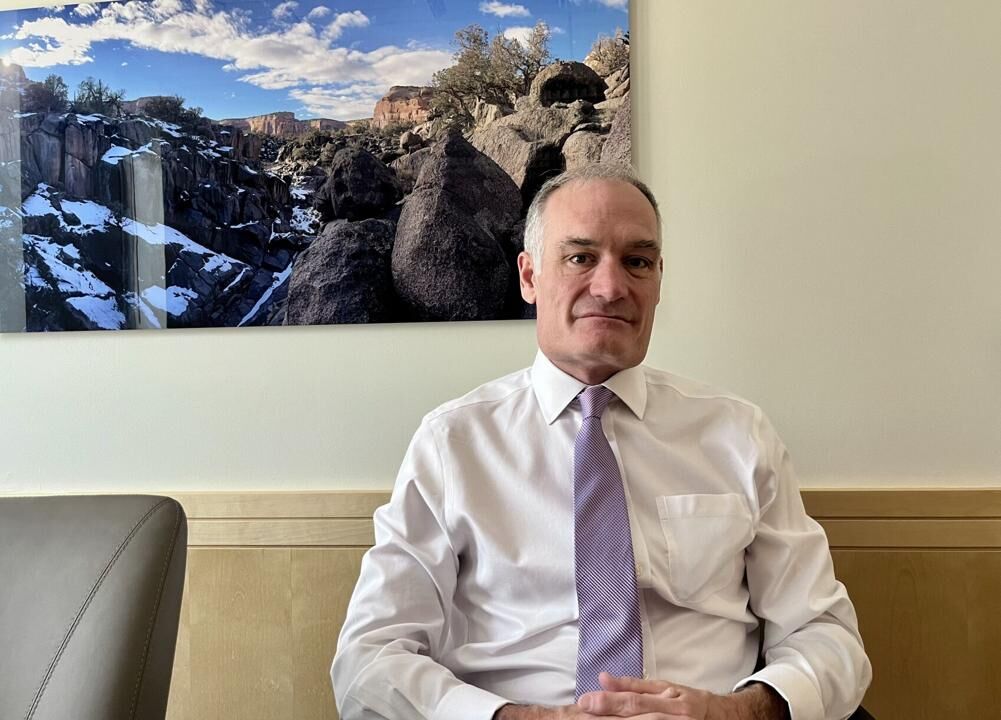
Jason R. Dunn, the U.S. attorney for Colorado during the first Trump administration, said he has not been closely following immigration-related cases. However, if he had seen Sweeney’s admonition during his time leading the office, “my initial thought is that I would tell them to reference those arguments and the court’s footnote, perhaps in a footnote of their own, to preserve them for appeal without restating them every time.”
On the same day as Sweeney’s ruling, eight more challenges to immigration detention were filed in Colorado’s federal trial court. POLITICO also reported that day about judges’ increasing alarm at the government’s tactics in arresting and detaining people.
“There has been an undeniable move by the Government in the past month to defy court orders or at least to stretch the legal process to the breaking point in an attempt to deny noncitizens their due process rights,” wrote U.S. District Court Senior Judge Michael J. Davis of Minnesota over the weekend.
In Colorado, judges’ criticism of the government has been more muted, but with occasional flashes of frustration.
On Tuesday, for example, U.S. District Court Judge Nina Y. Wang noted the U.S. Attorney’s Office had not even acknowledged a recent decision of hers that rejected the government’s identical reasoning.
Sweeney, in her same order from Monday, also slammed the government’s attorney for arguing she could not consider the petitioner’s challenge to his detention, which ran contrary to her previous rulings.
“Despite using three full pages in support of their unavailing and inapplicable arguments, Respondents fail to acknowledge (or perhaps do not care to grapple with) the fact that this Court has already considered and rejected as ‘borderline frivolous’ (those) jurisdictional challenges,” Sweeney wrote.
A few days prior, U.S. District Court Judge S. Kato Crews issued a decision with the less-common finding that the government was properly detaining a man without a bond hearing. However, Crews was nonetheless disturbed at the “haphazard and inconsistent actions” of immigration authorities, taken “without due care for proper procedure.”
“While Respondents’ conduct may comport with the bare minimum due process,” he wrote, “Respondents should strive for more particularly where, as here, individual life and liberty interests are at stake.”


Colorado judge explores sanctions against DOJ, ICE for rearresting man 4 days after release on bond
Michael Karlik
michael.karlik@coloradopolitics.com
Updated 9 hours ago
A federal judge in Colorado is considering sanctions against the government after immigration agents rearrested a man four days after an immigration judge found him suitable for release on bond. On July 28, U.S. Magistrate Judge N. Reid Neureiter ordered...
Divided disciplinary panel censures Montezuma County judge after agreement reached
Michael Karlik
michael.karlik@coloradopolitics.com
Updated 16 hours ago
A disciplinary panel formally imposed a public censure, suspension, and further training on Montezuma County Court Judge Ian J. MacLaren on Tuesday by a 2-1 vote. Under constitutional Amendment H, which voters adopted in November 2024, MacLaren was set to...
Colorado’s Western Slope magistrate judges describe unique role in federal judiciary
Michael Karlik
michael.karlik@coloradopolitics.com
Updated 1 day ago
Two of Colorado’s federal judges stationed on the Western Slope spoke to lawyers on Wednesday about their unique roles, the ways their workloads differ, and the need for more criminal defense lawyers to take cases outside the Front Range. “Here...

Denver sues Philip Morris, other tobacco companies over cigarette butt litter
Deborah Grigsby
deborah.smith@denvergazette.com
Updated 7 hours ago
Denver is demanding that some of the biggest tobacco companies in the world pay for the cleanup of discarded cigarette butts on its streets, following a similar campaign that cities in other states have pursued. Denver’s lawsuit, filed this week...
Federal judge rules that request for bond hearing not necessary to challenge immigration detention
Michael Karlik
michael.karlik@coloradopolitics.com
Updated 1 day ago
A federal judge in Colorado ruled last week that it is not mandatory for a person to seek a bond hearing with an immigration judge before they challenge the lawfulness of their detention in federal court. For the past year,...

Boulder Valley School District introduces new policies following antisemitism lawsuit
Marissa Ventrelli
marissa.ventrelli@coloradopolitics.com
Updated 10 hours ago
The chief of Boulder Valley School unveiled new policies for the 2026-2027 school year following a lawsuit filed on behalf of a student alleging antisemitic harassment. In June, the Anti-Defamation League filed a federal civil rights complaint against the school...

Colorado NRA chapter seeks injunction against new gun‑training requirement
Marissa Ventrelli
marissa.ventrelli@coloradopolitics.com
Updated 14 hours ago
The Colorado chapter of the National Rifle Association is seeking an injunction to stop the state from enforcing a new law that took effect earlier this month. The new law requires anyone buying or selling certain firearms to first complete...
Denver moves to dismiss Trump challenge to ‘assault-style’ weapons ban
Deborah Grigsby
deborah.smith@denvergazette.com
Updated 8 hours ago
Denver has filed a motion to dismiss a lawsuit brought by the Trump administration challenging the city’s ban on “assault-style” weapons and magazines exceeding a 15-round capacity. The U.S. Department of Justice filed a suit in federal court in May,...
Federal judge dismisses ex-Colorado judicial discipline director’s conspiracy lawsuit
Michael Karlik
michael.karlik@coloradopolitics.com
Updated 2 days ago
A federal judge dismissed a lawsuit from Colorado’s former judicial discipline director on Tuesday, finding that he failed to adequately state claims for conspiracy or constitutional violations. Christopher S.P. Gregory, who served as the executive director of the Colorado Commission on Judicial...
Federal judge allows retaliation claims to proceed against prison officials
Michael Karlik
michael.karlik@coloradopolitics.com
Updated 1 day ago
A federal judge agreed last week that a man incarcerated at Sterling Correctional Facility had credibly alleged that employees retaliated against him for filing grievances, including by taking away his disability accommodations and turning off his electricity. Louis Peoples Jr.,...
PREV
PREVIOUS

Will Denver see stepped-up immigration enforcement next? | ANALYSIS
Two years ago — as Denver grappled with a sharp influx of immigrants, many who arrived in the city after illegally crossing America’s borders — Mayor Mike Johnston joined the mayors of Chicago and New York City in criticizing Texas Gov. Greg Abbott’s busing campaign and called for a national strategy to address the crisis. […]
Colorado lawmakers hear about increased judicial discipline complaints, fallout from Missy Woods misconduct
Members of the Colorado legislature’s judiciary committees heard about a large increase in complaints against judges and additional forensic misconduct that has come to light, during three days of oversight hearings last week. Leaders of several judicial-related agencies appeared between Jan. 20-23 to address their priorities and field questions from legislators. On behalf of the […]