

Denver mayor aims to reduce gun violence, homelessness in 2026
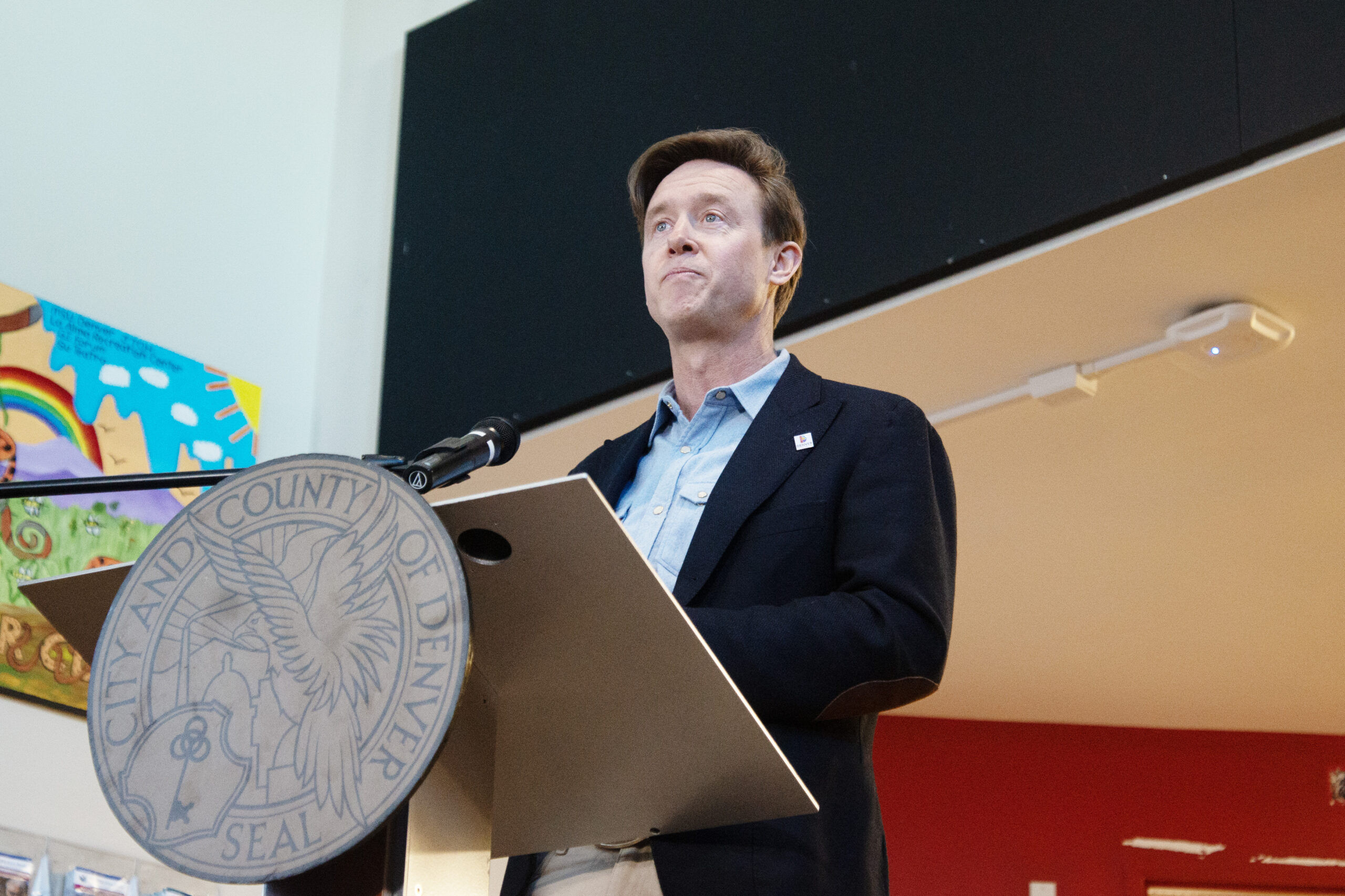
Denver Mayor Mike Johnston on Monday outlined his top 2026 priorities, with an eye toward the city’s most persistent challenges, notably homelessness, which has been growing under his administration, though there had been gains in some areas.
The city’s top goals, Johnston said at a news conference at the La Alma Recreation Center, include further reducing gun-related shootings and homicides, increasing housing opportunities, decreasing street homelessness and developing more green infrastructure.
The city also intends to expand access to childcare and bolster downtown by filling more office and retail space.
Decrease gun-related homicides by 10% and shootings in ‘high-risk’ neighborhoods by 20%
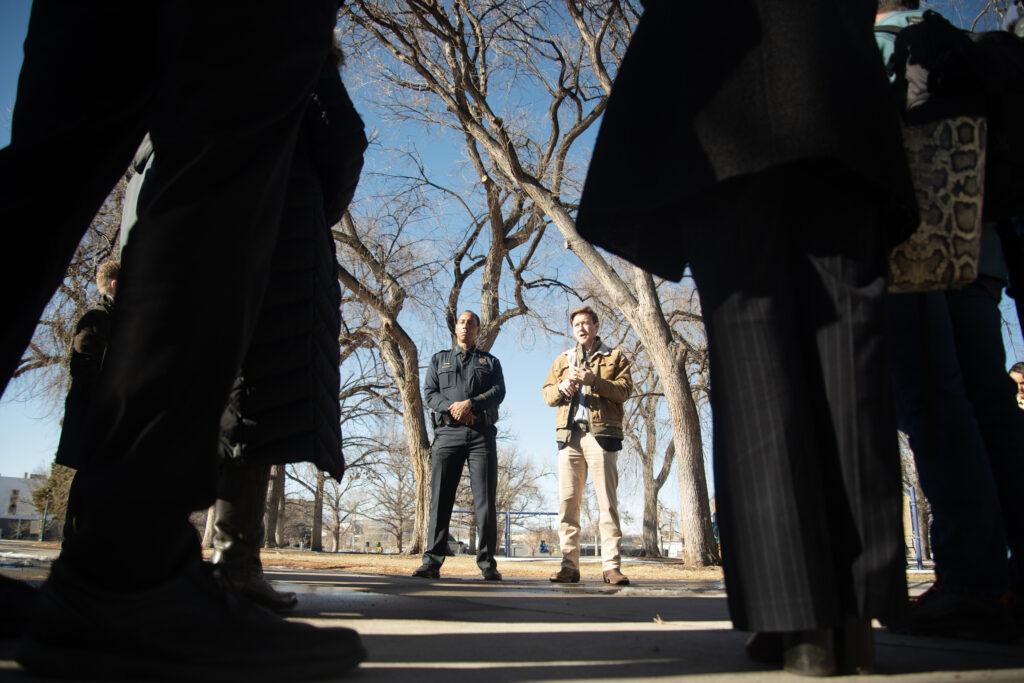
The good news, Johnston said, is that Denver just recorded one of the city’s lowest homicide totals – 37 in 2025.
“The challenge is there’s about twice in Denver’s history where (there’s) been this low level of homicides,” Johnston added. He said in the years following 2000 and 2014, homicide numbers increased significantly.
“If we deliver another 10% drop, we will be at or among the lowest violent crime rates in many cities in the country,” Johnston said. “Our goal is to reach that level and try to stabilize at that level.”
Fill 3 million square feet of downtown office and retail space
With the reopening and rebranding of 16th Street complete, Johnston said he plans to fill 3 million square feet of downtown office and retail space – just under half of the 7 million square feet currently available.
To accomplish this, he said, the city will look for “creative” ways to convert commercial office space into apartments, add more childcare facilities, and create more working space for artists and nonprofits.
Strategic public investments, he said, can drive growth in an uncertain economy.
“That means making sure all of our bond projects are moving on time, on budget,” he said. “That means our five-year capital improvement plan, which drives all the incremental construction that we do, neighborhood by neighborhood, is moving, and these larger signature projects, like the Park Hill Golf Course, like our work at the National Western complex, like the new Summit Stadium, and our Burnham work around the Broncos stadium.”
Reduce street homelessness by 75% compared to 2023 numbers
On Johnston’s first day in office in July 2023, he declared a state of emergency, freeing up funds and fast-tracking decisions in his quest to end homelessness in the city by the end of his first term as mayor, as he had promised during the campaign.
That allowed the city to move forward with plans to dismantle homeless encampments and move people indoors and off the streets, with financial backing from federal funding sources, such as the American Rescue Plan Act.
Since then, the city has spent more than $155 million — some $65 million more than what the mayor earlier said it would cost — in hotel shelters and service contracts to house the homeless and provide “wrap-around” services, such as case management, mental health services and job assistance.
A count last year showed that although fewer people were sleeping on the streets in Denver, the total number of homeless individuals in the city grew.
For 2026, Johnston said, the city plans to reduce its 2023 street homelessness numbers by 75%.
The city has also set its sights on addressing homelessness reports within one business day.
Deliver 2,500 affordable units and permit an additional 5,000 units
Denver has added close to 5,600 “affordable” housing units over the last 30 months, but Johnson said more are needed to ensure housing is available to people of all income levels.
“What we know is that we have had success in stabilizing and even dropping rental prices in the city because we have added more units,” Johnston said. “And the more units we have, the more supply there is, the more we can keep control of pricing.”
The state and local governments have imposed several regulatory strategies to spur housing development. Denver, for instance, requires housing development of 10 or more units to allocate a certain number to “affordable” units.
Supporters view it as ensuring that any new development would have dedicated housing for lower-income residents. Critics said it has only served as a barrier to new development, ultimately penalizing working-class residents.
Builders who work with higher density projects have also said that the state and local governments’ medicine doesn’t treat what ails the market for affordable homes.
Install more ‘clean’ energy systems and develop ‘green’ infrastructure
Looking to have more neighborhoods powered by “clean” energy and “protected from climate risks,” Johnston said the city will prioritize installing 5,000 clean energy systems and developing 50 acres of green infrastructure.
“Those focus on the needs of both cutting carbon pollution and providing a resilient environment,” he said.
“Clean” energy systems, according to Johnston, would include solar charging stations, battery storage, and heat pumps.
The development of more green infrastructure looks “a lot like less concrete and asphalt and more either open space or grass or permeable surfaces and trees that provide shade, that can absorb water, that can protect us from heat,” he said.
Like the state, Denver has adopted a regulatory framework to transition toward electrification. Notably, the city is requiring electrification of all buildings larger than 25,000 square feet.
The fundamental problem with the program, building owners have said, is that the standards set for energy savings have been intentionally set to make them impossible to meet without fully electrifying buildings and eliminating the use of natural gas for space and water heating entirely. Industry representatives have also said that, in many cases this is both financially and physically impossible for older, multi-family buildings to achieve.
Connect 5,000 young people to quality out-of-school programming
To achieve this goal of expanding affordable childcare and providing thousands of young people with after-school programming, Johnston outlined two priorities.
The first is to build a citywide framework to expand affordable childcare using Denver’s preschool model as a foundation.
The second is to increase out-of-school programs and youth employment, reaching 3,000 young people in the summer and connecting 2,000 additional high school students with paid job opportunities.

10th Circuit rejects ‘penalty’ for children of naturalized citizens seeking visas
Michael Karlik
michael.karlik@coloradopolitics.com
Updated 5 hours ago
The Denver-based federal appeals court joined three of its peers earlier this month and determined the child of a newly naturalized U.S. citizen is not moved to a longer visa line as a result of his parent gaining citizenship, and...

Colorado committee votes to rename César Chávez Day to Farm Workers Day
Marianne Goodland
marianne.goodland@coloradopolitics.com
Updated 5 hours ago
A Colorado House committee has voted to rename the March 31 state holiday from César Chávez Day to Farm Workers Day, following a national shift prompted by sexual abuse allegations against Chávez. House Bill 1339 was introduced on Friday and...
Colorado Sen. Mike Weissman calls for cold water on heated hate speech
Marianne Goodland
marianne.goodland@coloradopolitics.com
Updated 8 hours ago
Likening the recent record-setting warm temperatures to hot political rhetoric, Colorado Sen. Mike Weissman, D-Aurora, pleaded for an end to death threats and other hate speech directed at lawmakers of both parties. “The increasingly tragic reality of our politics, however, like...

Ethics panel dismisses complaint against Colorado agency chief Dan Gibbs
Marianne Goodland
marianne.goodland@coloradopolitics.com
Updated 4 hours ago
A state ethics panel has dismissed a complaint against Dan Gibbs, executive director of the Colorado Department of Natural Resources. The complaint, filed in December 2021 by the Republican-affiliated group Defend Colorado, alleged Gibbs awarded the think tank Keystone Policy...

Denver airport hasn’t had notice ICE agents will assist TSA yet. Wait times are short, though
Bernadette Berdychowski
bernadette.berdychowski@denvergazette.com
Updated 7 hours ago
As President Donald Trump deployed immigration agents to help U.S. airports manage hours‑long security lines during the partial government shutdown, Denver International Airport remained relatively calm on Monday. At the nation’s third‑busiest airport, TSA PreCheck lanes remained open to start...
Appeals court recognizes longer window to sue insurers for withholding policy details
Michael Karlik
michael.karlik@coloradopolitics.com
Updated 3 minutes ago
Colorado’s second-highest court split with its own prior decision earlier this month and concluded injured motorists have two years, not one, to sue insurance companies for withholding relevant information about an at-fault driver’s policy. In 2019, Colorado lawmakers enacted a measure to...

Trump open to $5 billion ICE funding cut if SAVE Act package passes
Zach LaChance, Washington Examiner
zach.lachance.washington.examiner@gazetteedit.wpenginepowered.com
Updated 11 hours ago
President Donald Trump signaled he is open to a $5 billion funding cut for U.S. Immigration and Customs Enforcement if the Senate passes the Save America Act, along with other amendments. “I don’t think we should make any deal with...

Appeals court decides free speech cases, error-prone judge reversed again | COURT CRAWL
Michael Karlik
michael.karlik@coloradopolitics.com
Updated 12 hours ago
Welcome to Court Crawl, Colorado Politics’ roundup of news from the third branch of government. The state’s Court of Appeals decided multiple cases implicating free speech rights, plus Colorado’s most error-prone judge was reversed on appeal yet again. Heard on...

Supreme Court sounds skeptical of late-arriving ballots, a Trump target
Mark Sherman
mark-sherman@coloradopolitics.com
Updated 5 hours ago
WASHINGTON • The Supreme Court ‘s conservative majority on Monday sounded skeptical of state laws that allow the counting of late-arriving mail ballots. The court heard arguments in a case from Mississippi that also could affect voters in 13 other...

Mum on his own replacement, Bennet disrespects voters | Dick Wadhams
Dick Wadhams
dick-wadhams@coloradopolitics.com
Updated 2 days ago
U.S. Sen. Michael Bennet is playing an arrogant game of hide-and-seek with Colorado voters as he seeks to abandon his Senate seat to become governor. Bennet insists that if he is elected governor in November, he will wait until he...