

Colorado lawmakers want officers to conduct ‘lethality assessments’ when responding to domestic violence calls
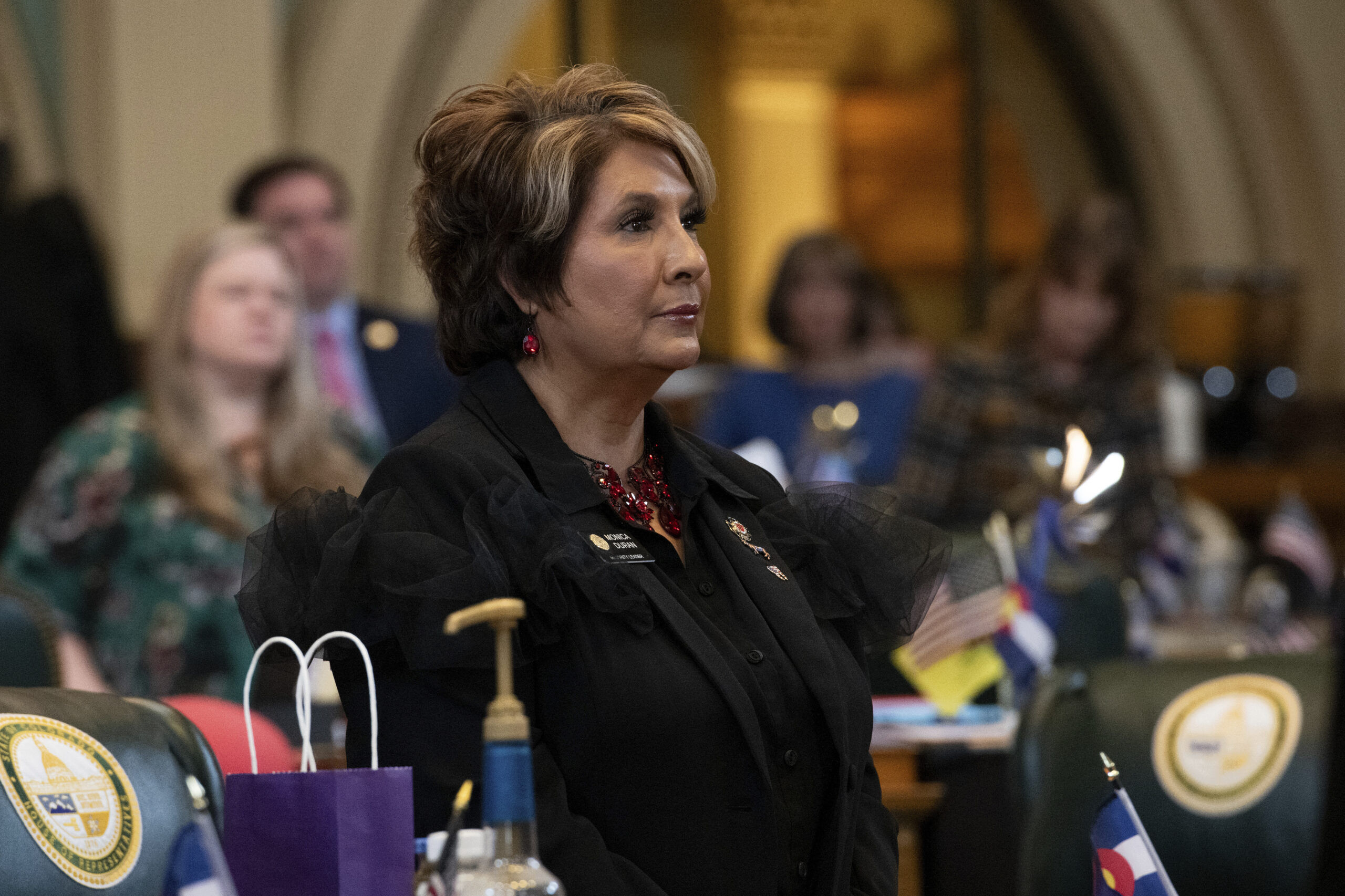
A bipartisan group of lawmakers is hoping to reduce to Colorado’s rising domestic violence fatalities through a bill that would require law enforcement agencies around the state to conduct “lethality assessments” on domestic violence victims.
In early December of last year, police found the body of 37-year-old Annette Valdez in a trash can near a park in Westminster. Her ex-partner, Thomas Perales, was ultimately charged in connection with her murder. He had a history of domestic violence and repeatedly violated Valdez’s protection order against him, according to authorities.
Rep. Ryan Gonzalez, R-Greeley, said Valdez might still be alive today had law enforcement been required to conduct a “lethality assessment” when responding to her previous calls.
Gonzalez is sponsoring House Bill 1009 with House Majority Leader Monica Duran, D-Wheat Ridge. The bill is personal for both of them: Duran was a victim of domestic violence, something she has shared openly throughout her time in office. Gonzalez said his mother was also a domestic violence victim and nearly died at the hands of her abuser.
“She was one of the lucky ones, but there’s other people who are not so lucky,” he said. “This bill aims to at least prevent that and curb these domestic violence incidents.”
Domestic violence fatalities in Colorado rose 24% from 2023 to 2024, accounting for 20% of all homicides in the state that year, according to an October report from the Attorney General’s Office.
Under the bill, law enforcement officers will be required to undergo “lethality assessment” training to learn how to detect signs of domestic abuse. When responding to a domestic violence call, they must conduct the assessment and include their findings in an incident report. If a victim is determined to be at a high risk of facing danger, officers would be required to immediately connect the person an advocate.
Many police departments in Colorado already conduct “lethality assessments” on domestic violence victims. Gonzalez said the legislation would ensure they’re all following the same protocol.
“We want to make sure that the peace officers are able to assess and detect whether a person needs resources or not, and we want to make it as consistent as possible to make sure the questions are the same across the state and it’s not different in different parts,” he said.
Duran, who has introduced domestic violence-related legislation every year, said HB 1009 is unique in a few ways.
“All of the other work that we have done to help victim-survivors is kind of after the fact, but what can we do in the immediate moment to prevent it?” she asked, adding that the most critical period after a domestic violence call is the first 72 hours. “It’s all about safety — saving lives and really trying to get a handle on survivors’ tools that they need at that moment, not 72 hours after a call.”
The bill is also one of the first 10 measures introduced in the House.
HB 1009 is sponsored in the Senate by Sens. Dafna Michaelson Jenet, D-Commerce City, and Byron Pelton, R-Sterling. It will be heard by the House Judiciary Committee on Jan. 28.

Ain’t Polis’ Peters commutation a pity? | Hal Bidlack
Hal Bidlack
hal-bidlack@coloradopolitics.com
Updated 12 hours ago
I am hoping that, yet again, my long-suffering and very forgiving editor will pardon my rambling thoughts today, as there are too many open tabs on my computer that deal with issues I want to talk about (Ed: pretty used...
Colorado House Democrats’ caucus finances under scrutiny as ethics case against leader advances
Marianne Goodland
marianne.goodland@coloradopolitics.com
Updated 17 hours ago
Democratic lawmakers told a legislative ethics panel that a leader’s management of caucus finances left them with unanswered questions, disputed reimbursements and a breakdown in communication that ultimately triggered a formal complaint. The House Ethics Committee is examining a complaint...

Colorado River crisis: Lake Mead, Lake Powell inch closer to ‘dead pool’
Marianne Goodland
marianne.goodland@coloradopolitics.com
Updated 16 hours ago
In the past 10 days, both Lake Mead on the Arizona-Nevada border and Lake Powell roughly 300 miles northeast on the Utah-Arizona line have recorded their lowest water levels since the reservoirs were first filled. Lake Mead, the nation’s largest...

Colorado lieutenant governor candidate Markert says early discipline and key mentors set his course
Marianne Goodland
marianne.goodland@coloradopolitics.com
Updated 23 hours ago
Editor’s note: This is the first installment in a three-part series examining Colorado’s candidates for lieutenant governor. In this piece, Colorado Politics speaks with George Markert, the Republican running mate to gubernatorial candidate Victor Marx. Marx is competing against Democrat...

Colorado, like America, past due for generational change in politics | Miller Hudson
Miller Hudson
miller-hudson@coloradopolitics.com
Updated 2 days ago
I was 27 before I ever voted for president. At 19, in 1964, the Constitution had not yet been amended establishing 18-year-old voting eligibility. In 1968, I was serving overseas with the U.S. Navy at a time when there was...

Farmers and ranchers win on NIETC cancellation | Rachel Gabel
Rachel Gabel
rachel-gabel@coloradopolitics.com
Updated 2 days ago
The Department of Energy rolled into Lamar last week and Office of Electricity Assistant Secretary Katie Jereza stood in her neat, green suit in front of a room filled with farmers, ranchers and landowners. The crowd was filled with straw...

Going after the wrong butts | Jon Caldara
Jon Caldara
jon-caldara@coloradopolitics.com
Updated 5 days ago
Mayor Mike Johnston proclaimed, “It is past time Big Tobacco cleaned up the big mess it’s created.” Yep. Denver is suing tobacco companies for the cigarette butts littering the city. Because Denver’s Big Mess couldn’t possibly be the fault of...

Jeff Crank, Jessica Killin set to face off in 2 debates in Colorado’s 5th Congressional District
Ernest Luning
ernest.luning@coloradopolitics.com
Updated 4 days ago
Republican U.S. Rep. Jeff Crank and Jessica Killin, his Democratic challenger, have agreed to debate twice in the weeks leading up to the general election in Colorado’s 5th Congressional District, their campaigns have said. Crank is seeking a second term...

CSI study reviews impacts of Colorado’s mandatory sex‑trafficking sentencing measure
Marissa Ventrelli
marissa.ventrelli@coloradopolitics.com
Updated 17 hours ago
A new report by the think-tank Common Sense Institute examines what could happen if Colorado voters approve Initiative No. 108, which establishes mandatory life sentences for offenders convicted of sexual trafficking of a minor. The measure is backed by Protect...
Three districts that will answer key Colorado political questions | Paula Noonan
Paula Noonan
paula-noonan@coloradopolitics.com
Updated 6 days ago
Colorado’s legislature used to be a place where neither party was dominant. Dozens of seats were competitive and House and Senate majorities switched regularly. From 2010 to 2020, the House was predominantly Democratic with one two-year assembly under Republicans. The...
PREV
PREVIOUS

Colorado Joint Budget Committee rejects DOC's $2.4M request for more beds
The state’s Joint Budget Committee voted on Wednesday to deny the Department of Corrections’ $2.4 million request for additional prison beds, citing the department’s lack of a plan to address its ongoing overcrowding problems. In September, the committee approved the DOC’s $2.8 million supplemental request for additional beds following the governor’s implementation of the Prison […]

Lakewood launches first 100% solar facility
The new canopy covering the Charles Whitlock Recreation Center’s parking lot in Lakewood isn’t just for decoration — it’s powering the entire facility. The city of Lakewood cut the ribbon on its first on-site solar installation at a city facility Thursday, unveiling the Whitlock Recreation Center Solar Project after nearly four years of designing and […]