

Report: Colorado government has grown beyond TABOR’s limits

Colorado’s government has grown substantially over the past three decades beyond the limits that voters approved to restrain that expansion, according to a new report from a think tank.
The analysis from the Independence Institute, which examines state spending, revenue sources, and employment trends since the Taxpayer’s Bill of Rights went into effect in 1992, concluded that Colorado’s state government has “deliberately and systematically circumvented” TABOR’s constitutional constraints.
At its core, TABOR limits the government’s ability to raise revenue. Notably, political subdivisions must obtain voter approval for any tax increase, and it requires dollars above the TABOR limit to be refunded to residents. Numerous attempts, mostly on the litigation front, have been made to overturn TABOR. As recently as November 2020, voters rejected efforts to significantly overhaul or repeal it.
The aim, according to the TABOR language, is to “reasonably restrain most of the growth of government” by requiring voter approval for tax hikes and by limiting revenue increases to inflation plus population.
Data collected from fiscal year 1993-1994 to 2024-2025 shows that the state government has expanded “more rapidly than expected” and likely more than would be considered “reasonable” under TABOR, according to the Independence Institute.
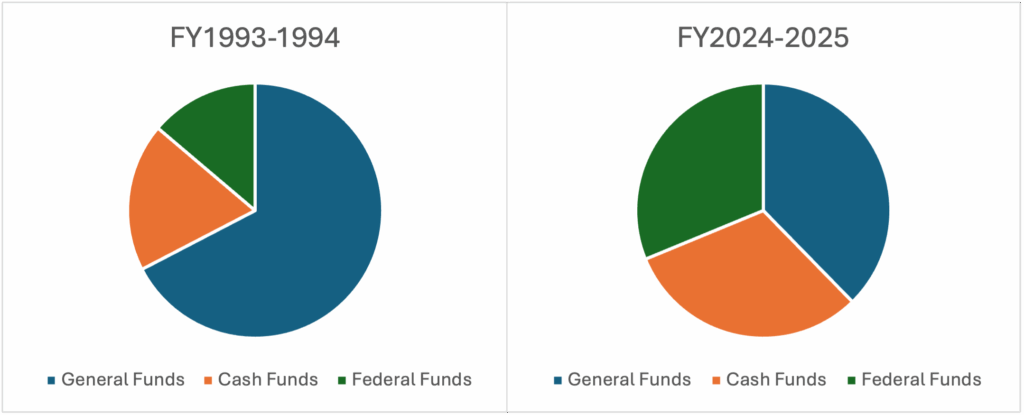
In Fiscal Year 1993, the General Fund, which is funded by taxes and used to pay for certain state programs, accounted for 56% of the state’s budget. By 2024, that number decreased to 35%.
Conversely, cash funds — revenue from fees and public university tuition that is legally required to be spent on certain programs — went from comprising 16% of the state budget in 1993 to 29% 31 years later, and federal funds increased from 12% of the budget to 29%.
According to the report, the increase in cash funds “was not accidental.” Fees often go toward state-run businesses called enterprises, which are exempt from TABOR caps.
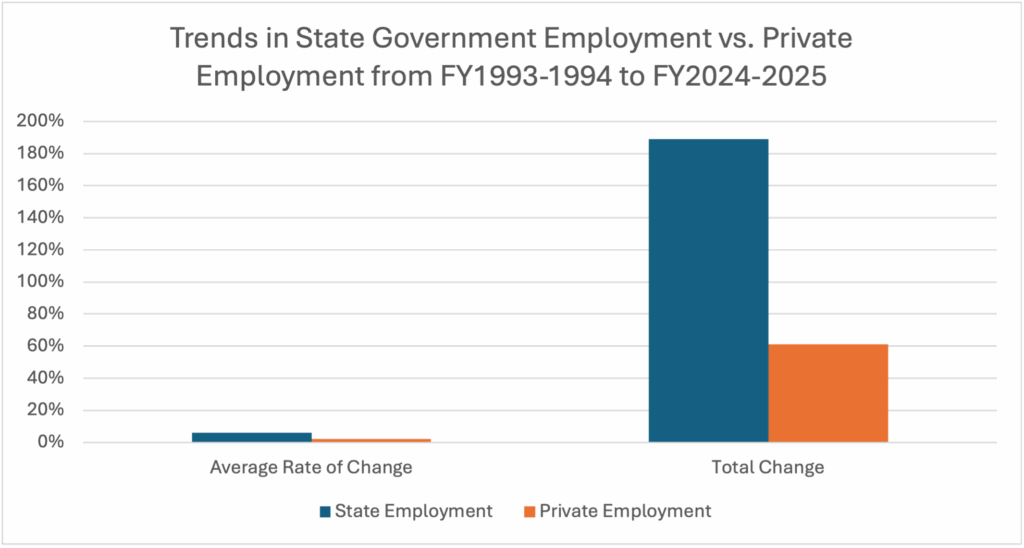
According to data from the Federal Reserve Bank of St. Louis and state Appropriation reports, the number of state government employees in Colorado has grown at a higher average annual rate than the private sector.
From 1993 to 2024, private employment rose at an average annual rate of 2%, while state employment increased by an average of 6% each year.
“The Taxpayer’s Bill of Rights is less controversial than debates in the state house might suggest,” the report stated, citing a 2025 poll by Let Colorado Vote that found 61% of the state’s active voters — 60% of independents, 83% of Republicans, and 41% of Democrats — agree Colorado should keep TABOR in place.
Last spring, Democratic lawmakers attempted to pass a resolution requiring the General Assembly to sue in state district court over TABOR’s constitutionality.
The resolution’s sponsors argued TABOR is unconstitutional because it prevents the state from fully functioning as a “republican form of government” as outlined in the Constitution’s Guarantee Clause.
The resolution ultimately failed to advance.
“Across all metrics examined, the government continues to grow faster than inflation and/or population growth,” the Independence Institute report said. “More state funds are TABOR-exempt than at any time since the amendment was passed in 1992. Meanwhile, Colorado is becoming less competitive and less appealing compared to other states.”

The ramifications of President Trump’s pursuit of Greenland | Kelly Sloan
Kelly Sloan
kelly-sloan@coloradopolitics.com
Updated 12 hours ago
President Donald Trump has evidently stepped back from his threatened fantasy of invading Greenland — the sovereign territory of a U.S. ally — to which many a sigh of relief has been expressed, including by the markets. There was next...
Rep. Ron Weinberg won’t seek reelection
Marianne Goodland
marianne.goodland@coloradopolitics.com
Updated 1 day ago
Republican Rep. Ron Weinberg of Loveland announced on Thursday evening that he will not seek another term in the Colorado House. “Serving this community has been one of the greatest honors of my life,” the two-term state representative said on...

Colorado title board OKs ballot measures to eliminate flat income tax in favor of graduated brackets
Marianne Goodland
marianne.goodland@coloradopolitics.com
Updated 2 hours ago
Proponents hoping to change Colorado’s income tax structure from a flat rate to graduated tiers — thereby raising taxes for some brackets — walked away from a Wednesday meeting with eight ballot measures approved by the title board. The coalition...
Colorado lawmakers want officers to conduct ‘lethality assessments’ when responding to domestic violence calls
Marissa Ventrelli
marissa.ventrelli@coloradopolitics.com
Updated 11 hours ago
A bipartisan group of lawmakers is hoping to reduce to Colorado’s rising domestic violence fatalities through a bill that would require law enforcement agencies around the state to conduct “lethality assessments” on domestic violence victims. In early December of last...

Colorado Joint Budget Committee rejects DOC’s $2.4M request for more beds
Marissa Ventrelli
marissa.ventrelli@coloradopolitics.com
Updated 1 day ago
The state’s Joint Budget Committee voted on Wednesday to deny the Department of Corrections’ $2.4 million request for additional prison beds, citing the department’s lack of a plan to address its ongoing overcrowding problems. In September, the committee approved the...

Colorado attorney general invites public to report ICE ‘misconduct’
Marissa Ventrelli
marissa.ventrelli@coloradopolitics.com
Updated 4 hours ago
Colorado Attorney General Phil Weiser has launched a new online mechanism that allows Colorado residents to report “misconduct” by federal immigration agents, his office announced on Wednesday. “Nobody is above the rule of law, including federal agents such as ICE...

Colorado Democrat John Hickenlooper raises over $1.1 million in 4th quarter for reelection bid
Ernest Luning
ernest.luning@coloradopolitics.com
Updated 24 hours ago
U.S. Sen. John Hickenlooper’s reelection campaign raised over $1.1 million in the fourth quarter of 2025 and finished the year with more than $3.8 million in the bank, the Colorado Democrat’s campaign said Thursday. The fundraising haul brings Hickenlooper’s total...

Enterprise fees surge as more of Colorado’s budget escapes TABOR limits
Marissa Ventrelli
marissa.ventrelli@coloradopolitics.com
Updated 3 hours ago
More than 30 years after Colorado voters approved the Taxpayer’s Bill of Rights, a growing share of state spending now falls outside the voter-approved limits intended to restrain government growth. A new report shows that fee-funded “enterprises” — state-owned businesses...

Let’s find out who’s up to the gubernatorial task post Polis | Paula Noonan
Paula Noonan
paula-noonan@coloradopolitics.com
Updated 1 day ago
Gov. Jared Polis is bold and his policies are bolder than bold. That’s the paraphrase of his State of the State speech to open the 2026 General Assembly and start off his last year in office. His sweeping review of...

We dream, we dare, we decouple — how Colorado turns values into policy | OPINION
Colorado Politics
colorado-politics@coloradopolitics.com
Updated 2 days ago
By Kathy White Gov. Jared Polis’ final State of the State address was a clear victory lap. After eight years as governor, he used the moment to highlight accomplishments, reflect on progress and remind Coloradans what his administration has delivered....
PREV
PREVIOUS

Appeals court overturns Adams County sex offense convictions due to prosecutor's misconduct
Colorado’s second-highest court reversed multiple child sex assault convictions on Thursday after concluding an Adams County prosecutor committed misconduct while cross-examining the defendant. A three-judge Court of Appeals panel observed the charges against Daniel Michael Boerner depended on the jury either believing the child witnesses’ original accusations or believing their trial testimony, which cast doubt […]

Vape shops challenge Denver's flavored tobacco ban in court
The smoke has yet to settle in the battle over the city’s flavored tobacco ban as local vape shop owners have sued the City and County of Denver, asking the court to declare the ordinance unconstitutional and stop its enforcement. The Rocky Mountain Smoke Free Alliance filed a complaint in Denver District Court on Thursday […]