

Gov. Jared Polis stops in Colorado Springs to tout emergency food stamp funding, as agencies say demand is up
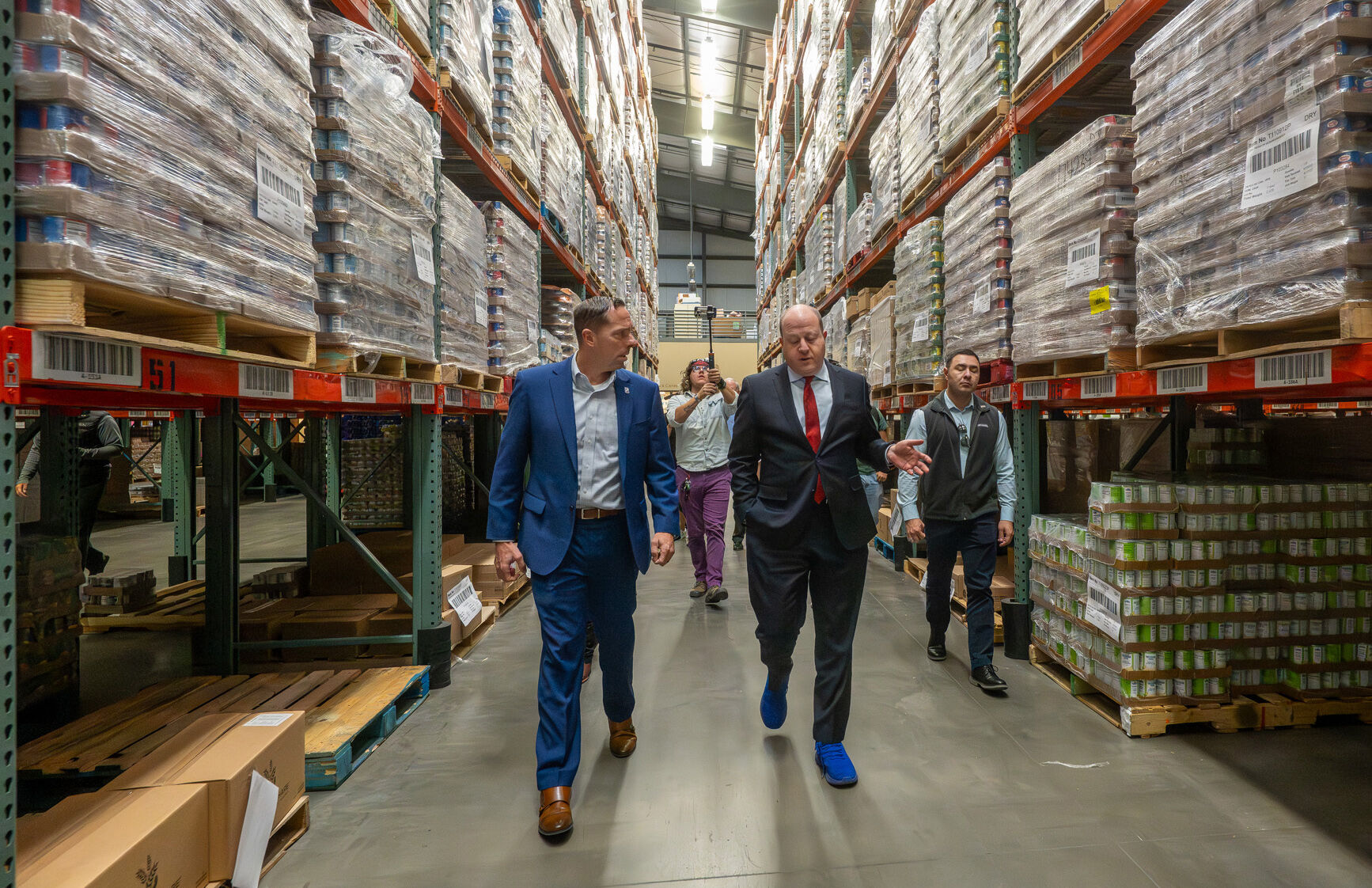
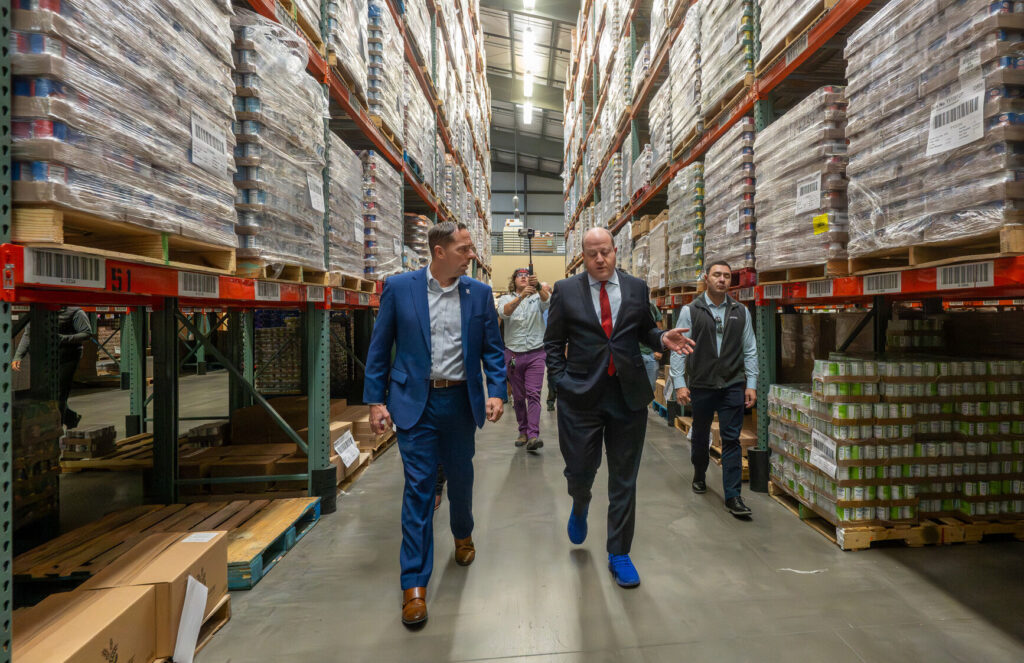
If you want to see the human face of the federal government shutdown, look for the hungry mouths, was the message Gov. Jared Polis delivered in Colorado Springs on Wednesday.
He stopped at Care and Share Food Bank for Southern Colorado’s headquarters after announcing at the state Capitol that he will ask the Joint Budget Committee next week for up to $10 million from the state’s general fund to divvy out to Colorado’s five food banks that supply some 1,200 food pantries statewide.
“We want to make sure kids are not going hungry,” Polis said while touring the 60,000-square-foot distribution center, one of three facilities Care and Share operates in southern Colorado.
Polis said he’s “confident” that the JBC will approve the request, since food stamp benefits from the federal government for needy Americans through the Supplemental Nutrition Assistance Program won’t be distributed to recipients beginning Nov. 1.
“This plan will cover early to mid-December,” Polis said. “The longer the shutdown continues, many things come unglued in many places. There’s a lot of people who rely on the federal government to buy weekly groceries to feed their families.”
About 620,000 Coloradans receive food stamps, and 183,000 live in El Paso County, according to Nate Springer, president and CEO of Care and Share.
Pantries are already overloaded with demand for free food, Springer said.
“Our 278 partner agencies in 29 counties are already seeing the most people they’ve ever seen in their history, and now it’s increasing,” he said.
Several state and federal funding cuts have reduced the food supply, though, Springer said. Care and Share’s distribution center in Colorado Springs is only 80% full, and the emergency funding from the state will help offset the losses, Springer told Polis.
The first allocation of $3.33 million should be released to food banks next week after the JBC’s decision, Polis said. Care and Share will receive about $750,000, Springer said. If the shutdown stretches through November, other funding infusions will happen on Nov. 15, and again on Dec. 1.
In all, Care and Share would get $2.3 million, unless the shutdown ends sooner.
“This only fills part of the gap,” Polis said. The state would have $120 million gap at retail prices of the charitable food available, he said. Food banks, however, leverage the money they receive to buy in bulk at what’s often below wholesale prices. Thus the $10 million will stretch beyond its face value.
“We hope they reopen before Thanksgiving,” Polis said. “We’re trying to help out for the next six weeks or so.”
Private monetary donations may be made at feedingcolorado.org/donate.
Effects of the shutdown also are showing up at Pikes Peak United Way’s 211 resource line that people can call to find places they can receive assistance with food, housing, employment and other social and human services.
Last month the line received 106 request for food referrals; there were 73 such requests just last week, said Cami Bremer, president and CEO of Pikes Peak United Way.
Food assistance remains among the top three requests, along with help paying utility bills and affordable housing needs, she said.
The call center continually updates capacity and resources that are available in the community, Bremer said.
Pikes United Way served nearly 10,000 individuals in the third quarter at its Family Success Center, a community hub of various services in southeast Colorado Springs, compared with 4,200 people in the second quarter, she noted.
“That increase shows there is a large need across the community for more than food — also for all of the resources needed for family stability,” Bremer said.


Tapped: Douglas County looks to diversify water supply as population grows
Nicholas Fogleman
nicholas.fogleman@denvergazette.com
Updated 1 day ago
Tapped: The Denver metro region sits at the center of one of the American West’s most complex and consequential water challenges. This series examines the interconnected systems that determine how the region secures, stores, and conserves its water — while...

Tribes sue to halt exploratory drilling in Black Hills near sacred ceremonial site | OUT WEST ROUNDUP
Ernest Luning
ernest.luning@coloradopolitics.com
Updated 4 days ago
SOUTH DAKOTA Tribes sue to halt drilling SIOUX FALLS — Nine Native American tribes in South Dakota, North Dakota and Nebraska are suing the federal government in a bid to stop exploratory drilling for graphite near a sacred site in...
Tapped: Is water a problem for data centers in Colorado?
Deborah Grigsby
deborah.smith@denvergazette.com
Updated 18 hours ago
Editor‘s Note: The Denver metro region sits at the center of one of the American West’s most complex and consequential water challenges. This series examines the interconnected systems that determine how the region secures, stores, and conserves its water while...
TAPPED: Front Range residents face higher water rates, restrictions as rapid snowmelt threatens supplies
Kyla Pearce
kyla.pearce@gazette.com
Updated 20 hours ago
Tapped: The Denver metro region sits at the center of one of the American West’s most complex and consequential water challenges. This series examines the interconnected systems that determine how the region secures, stores, and conserves its water while navigating...
TAPPED: Front Range residents face higher water rates, restrictions as rapid snowmelt threatens supplies
Kyla Pearce
kyla.pearce@gazette.com
Updated 20 hours ago
Tapped: The Denver metro region sits at the center of one of the American West’s most complex and consequential water challenges. This series examines the interconnected systems that determine how the region secures, stores, and conserves its water while navigating...
TAPPED: Aurora cracks down on water use as reservoirs fall, runoff shrinks
Kyla Pearce
kyla.pearce@gazette.com
Updated 9 hours ago
Editor’s note: The Denver metro region sits at the center of one of the American West’s most complex and consequential water challenges. This series examines the interconnected systems that determine how the region secures, stores, and conserves its water while...
Tapped: Colorado River overallocation collides with record drought conditions
Nico Brambila
nico.brambila@denvergazette.com
Updated 1 day ago
Editor’s Note: The Denver metro region sits at the center of one of the American West’s most complex and consequential water challenges. This series examines the interconnected systems that determine how the region secures, stores and conserves its water while...
TAPPED: Front Range residents face higher water rates, restrictions as rapid snowmelt threatens supplies
Kyla Pearce
kyla.pearce@gazette.com
Updated 20 hours ago
Tapped: The Denver metro region sits at the center of one of the American West’s most complex and consequential water challenges. This series examines the interconnected systems that determine how the region secures, stores, and conserves its water while navigating...
Tapped: Denver residents face hotter, costlier summer under new drought rules
Deborah Grigsby
deborah.smith@denvergazette.com
Updated 9 hours ago
Editor’s note: The Denver metro region sits at the center of one of the American West’s most complex and consequential water challenges. This series examines the interconnected systems that determine how the region secures, stores, and conserves its water while...

Tapped: Golden tightens water rules as Clear Creek snowpack falters
The Denver Gazette
the-denver-gazette@coloradopolitics.com
Updated 9 hours ago
Editor’s Note: The Denver metro region sits at the center of one of the American West’s most complex and consequential water challenges. This series examines the interconnected systems that determine how the region secures, stores, and conserves its water while...
PREV
PREVIOUS

Colorado soars in 3rd quarter EV sales
Coloradans are electrified by the state’s incentives to buy an EV despite the end of federal subsidies Sept. 30, driving Colorado into first-place in the nation for EV sales as a percentage of all motor vehicle sales. From July 1 to Sept. 30 Colorado buyers comprised 32.4% of new vehicle sales, the highest single-quarter percentage […]

10th Circuit rejects assortment of legal theories challenging workplace vaccine mandates
The Denver-based federal appeals court rejected an array of legal theories on Tuesday that challenged employers’ ability to impose COVID-19 vaccination requirements under the U.S. Constitution, laws governing emergency drug authorizations and the rules for human experimentation. A three-judge panel of the U.S. Court of Appeals for the 10th Circuit followed in the footsteps of […]