

This special session, lead us not into temptation… | SLOAN
The special legislative session is now underway, the assigned task list for which includes measures to deal with the roughly (another) $1 billion hole in the budget.
The reasons offered for the 11-digit deficit depend a great deal on one’s political affiliation: Democrats, rather conveniently, are blaming the One Big Beautiful Bill, the federal budget reconciliation act passed just in time for Fourth of July fireworks. And there is a sliver of truth in this — pro-growth fiscal policy at the federal level does have trickle-down impacts, as us supply-siders like to say. But the state’s structural deficit cannot be blamed on President Donald Trump or the congressional GOP — it is necessarily and directly the cause of policy decisions made at the state level in recent years, policies like the expansion of Medicaid, new programs such as FAMLI and all-day kindergarten, a bevy of climate initiatives, and so on and so on. The state budget has grown every year in the past decade, and that has nothing to do with Trump.
The majority party in Colorado is philosophically committed to the principle of the functionality of government as universal problem solver. So the natural temptation inclines less toward cutting government and more toward finding new and creative ways to keep financing it. One pot of money that would be especially tempting, were it not mercifully cordoned off-limits, is the state’s share of the opioid settlement funds. You will recall Colorado was among the states which accepted a settlement payment from certain manufacturers of opioid-based painkillers for the explicit and limited purpose of mitigating damage from the opioid epidemic.
Colorado has gotten an awful lot wrong in recent years, but one thing the state was correct with was the manner in which it handled the appropriation of those settlement funds. Eighty percent of the money is distributed locally: 60% to regional opioid abatement councils and 20% to local governments. Ten percent is set aside for opioid abatement infrastructure projects, and the state gets the remaining 10%, ostensibly for administrative costs and such.
Why is this important? Well, for one thing, unlike much of the money government touches, it is being spent at the appropriate level. The opioid issue is a complicated one, with unique complications manifesting at different levels. The problem on the national scale is different from the one at the local level; as the problem has undergone its metamorphosis from the abuse of legally prescribed painkillers to complex international drug-trafficking enterprise, the federal government is confronted with the need to address issues like Red China’s role in funneling fentanyl precursor chemicals to Central American drug cartels, and trying to stem the flow of the drug into the country.
But the more intimate issues of addiction — issues the settlement funds are intended to address — are inherently local and require local approaches. The problem is different in La Junta, for instance, than it is in Aurora. Local authorities who are closer to the ground know what they need and how to do it, and possess the ability to do so without strings and interference from Washington D.C. or the State Capitol.
Not every state does this, by the way. In several states where they are more centrally controlled, the opioid settlement funds have been misappropriated, sometimes directed toward backfilling budget problems. In Arizona, for instance, a good chunk of their settlement was shuffled into the Department of Corrections to pay for programs the state already had running, magically freeing up money for new ideas. It’s not just that creative bookkeeping was not the intent of that money, but the governing principle; consider how grand a temptation it would be to use this windfall to bankroll any number of liberal priorities — say, to shore up engorged Medicaid rolls, or backfill expensive new programs, or subsidize climate initiatives. The profligate political mind can enlist a great deal of elasticity in justifying alternate and unintended uses of money.
It is of course prudent to keep an eye on how local governments and councils actually spend the settlement dollars, but another benefit is it is much easier to monitor the crisscross of dollars at that level than it is at the state. And it is comforting to know the state’s share is structurally immune from the sort of budgeting sleight-of-hand other funding pots have been subject to.
It is a good reminder structural protections like this — which also include TABOR (which denies the state the temptation to reflexively raise taxes) and the balanced budget amendment (which denies the state the temptation to rack up the credit card) — occupy an important place in government: defusing temptation, which might, just might, encourage thoughtful prioritization. Hope springs eternal.
Kelly Sloan is a political and public affairs consultant and a recovering journalist based in Denver.


A daring and fearless rescuer — is afraid of a debate | Dick Wadhams
Dick Wadhams
dick-wadhams@coloradopolitics.com
Updated 1 day ago
Victor Marx, the Republican nominee for governor who says he can exorcize demons and who claimed he has fearlessly rescued 45,000 women and children during 150 “high-risk” missions around the world, appears to be intimidated by the notion of debating...

A new day? Colorado’s troubled guardianship office pursues ‘cultural reset’
Marianne Goodland
marianne.goodland@coloradopolitics.com
Updated 4 days ago
Colorado’s guardianship program, long criticized for mismanagement and high staff attrition, is undergoing a “cultural reset,” as its new director works to repair partnerships and prepare for a major expansion under recent legislation. Created by lawmakers in 2017, the Office...

Colorado Democrats, your time is coming | Jon Caldara
Jon Caldara
jon-caldara@coloradopolitics.com
Updated 1 day ago
Hey, Colorado Democrats! All the fun you’ve had watching Republican dysfunction in Colorado for the last 20 years was just a preview of what is about to happen to you. The Colorado Republican Party no longer exists as a competitive...

Democratic group aims Spanish-language TV ad at Gabe Evans in Colorado’s battleground 8th CD
Ernest Luning
ernest.luning@coloradopolitics.com
Updated 2 days ago
A national group tied to House Democratic leadership launched a six-figure Spanish-language TV ad in Colorado this week targeting Republican U.S. Rep. Gabe Evans and the GOP’s signature budget legislation. The 30-second spot is part of $15 million in new...
Judge dismisses lawsuit seeking records from Colorado Democratic group
Marianne Goodland
marianne.goodland@coloradopolitics.com
Updated 2 days ago
A lawsuit seeking to obtain records from Democratic lawmakers affiliated with a caucus has been thrown out by a Denver District Court judge. On July 17, Judge Ericka Englert dismissed the April lawsuit filed by progressive activist Derrick Blanton, who...
Colorado must continue finding common ground on wildfire policy | GUEST COLUMN
Colorado Politics
colorado-politics@coloradopolitics.com
Updated 3 days ago
By John Herrick Colorado has never lacked for opinions about wildfire policy. We debate forest management, climate change, prescribed burns, land use, air quality and budgets. Those debates are familiar territory, but a new discussion is beginning to happen around...
Proposition NN is the best investment for Colorado’s students and schools | GUEST COLUMN
Colorado Politics
colorado-politics@coloradopolitics.com
Updated 3 days ago
By Justin Ogden Colorado families know what it means to make difficult budget decisions. Inflation has driven up the cost of groceries, housing, utilities and just about everything else. Families like mine work hard to stretch every dollar while still...

Right-to-natural-gas proposal in Colorado qualifies for ballot
Marissa Ventrelli
marissa.ventrelli@coloradopolitics.com
Updated 3 days ago
A citizen initiative that seeks to enshrine the right to natural gas has qualified for the November ballot, Colorado’s election office confirmed on Thursday. Petitions containing signatures for Initiative No. 177 were turned in to the Secretary of State’s Office for review...
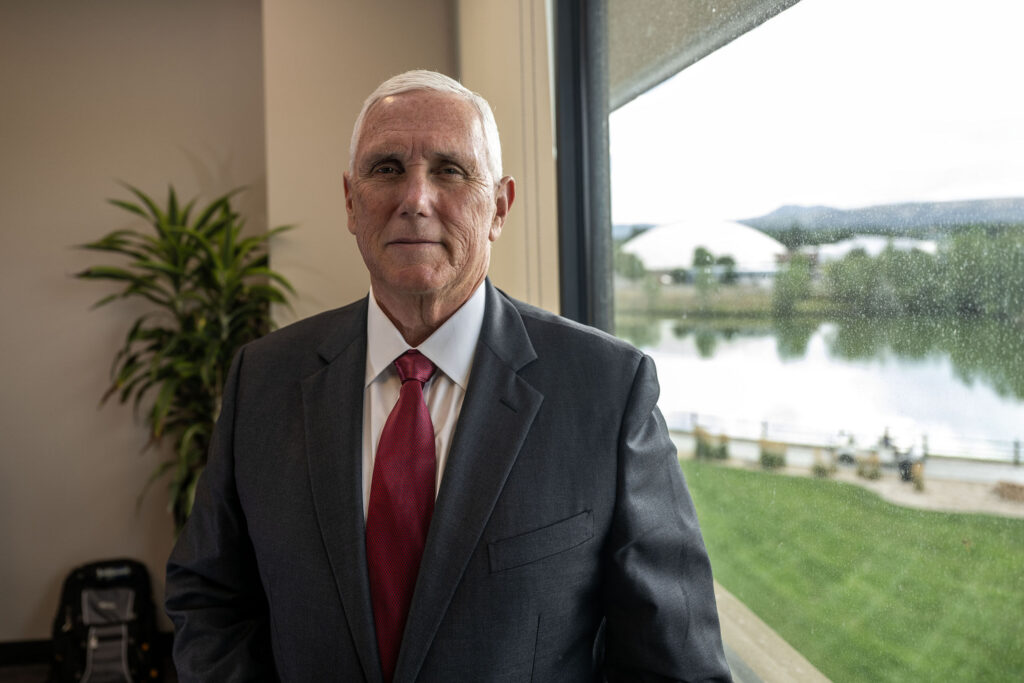
Former VP Mike Pence joining Colorado Christian University faculty
Marissa Ventrelli
marissa.ventrelli@coloradopolitics.com
Updated 3 days ago
Former Vice President Mike Pence has been hired as a visiting faculty member at Colorado Christian University, the Lakewood-based private evangelical university announced Tuesday. Pence will be on campus about once a month during the 2026-2027 school year to give...
Were the primaries a preview for consequential general election? | Paula Noonan
Paula Noonan
paula-noonan@coloradopolitics.com
Updated 4 days ago
Colorado’s political future will go the way of this election. Historically, the state has not had both chambers controlled by a supermajority. This election may change that. The primaries suggest how the general election may play out. Democrats had solid...
PREV
PREVIOUS

Even in a deficit, Planned Parenthood gets special treatment | OPINION
You know our Colorado legislators are beholden to a special-interest lobby when they may choose to forego federal dollars during a budget crunch to fund their client’s interests. Who might that be? The abortion lobby and Planned Parenthood. The so-called “Big Beautiful Bill” (BBB) withdrew Medicaid funding from organizations that provide abortion services. This means Planned Parenthood […]

Bipartisan PBM reform bill is major win for Colorado patients | OPINION
By Victoria Vicory Managing a chronic health condition isn’t easy. For hundreds of thousands of Coloradans, it means daily medication, careful monitoring, regular appointments, and constant worry about how to afford it all. For too long, the high cost of prescription drugs has forced patients into impossible choices: skip a dose, cut pills in half, or […]