

Fiscal dumpster-fire furthers disaster that was Colorado’s failed wolf reintroduction | GABEL
Rachel Gabel

Waiting for word on the names of the newly appointed Colorado Parks and Wildlife Commission members has been a bit like waiting for an upcoming birthday, knowing you’re not going to get what you asked for. If there weren’t a special commission meeting on July 7 to discuss — without public comment or in the area affected or even in person — the fate of the Copper Creek wolf pack, Gov. Jared Polis would have until the regular meeting July 17-18 to appoint two commissioners, but as it is, his feet are to the fire. The first will replace Karen Bailey, an at-large member, and the second will fill the seat vacated by Marie Haskett representing sportspersons and outfitters. The meeting to potentially decide the removal of the Copper Creek pack is not one to leave any details undone.
These two appointments, though, are important ones and the administration needs them to go relatively well. By that, I mean no major heartburn or headlines with neither side terribly excited about the choices. The fact there are sides here should be the first clue stakeholders are speaking to deaf ears, but we already knew that. However, that there appears to be discussion between the two camps is welcome news.
Gabriel Otero, the sportsperson representative and a member west of the Continental Divide, will end his term July 1, 2026. Eden Vardy, production agriculture representative, will end his term July 1, 2026, as will Chair Richard Reading, an at-large representative. These will be Polis’ final three appointments to the CPW Commission before his term ends in January 2027.
There’s no doubt the stakeholders represented by the agriculture and sportsperson representatives are paying attention and have become more battle wise since 2020. They’re paying close attention to appointments, especially since the hotly contested appointments and confirmations of Commissioners Jay Tutchton and Jessica Beaulieu and the failure to confirm Gary Skiba.
Stay up to speed: Sign up for daily opinion in your inbox Monday-Friday
Sportsmen and agriculture producers are watching closely the State Land Board’s hiring of rewilding advocate Nicole Rosmarino and the appointments of James Pribyl, who signed a letter in support of the ballot proposition to outlaw mountain lion hunting, alongside current CPW Commissioners Jessica Beaulieu and Jack Murphy.
The new agriculture representative on the State Land Board is Mark Harvey, a winemaker, rancher and shellfish farmer originally from Aspen who hopefully shares more in common with the ranchers who operate on state lands than it appears at first blush.
Just days after the revelation the wolf program is a stunning $2.2 million over budget, I revisited one of my March 2023 columns about the elusive real cost of the wolf program. Estimates put together by members of the stakeholder groups convened by CPW guessed the $2.1 million appropriation for 2023 and 2024 would be $4 million shy of the real costs. They also estimated, prior to realizing what the cattle market would do for the value of cattle, depredation payments at $13,000 and conflict mitigation at $40,000. The Blue Book, of course, estimated the annual cost for Fiscal Year 2024 at $800,000, which Sen. Dylan Roberts aptly pointed out is $2.2 million taken away from roads and classrooms.
Wolves were a fool’s errand to begin with, but the proverbial cat is out of the bag now. If CPW sticks to the wolf plan by removing problem wolves and refusing to allow the anti-rancher crowd to attempt to reverse compensation funding for losses, they’ll be a step ahead. Chair Richard Reading’s handling of citizen petitions that come before the commission will also be closely watched, with plenty of activist-driven wish lists set to come before the commission in the coming months. This new commission is dealing with a base of stakeholders who don’t trust the administration, are functioning with a new regard for the importance of paying attention, and with strong partnerships across rural Colorado, especially between agriculture and sportsmen and women. An attack on hunting is an attack on the whole of rural Colorado, and vice versa, earning the other Colorado a more formidable voice than it possessed five years ago.
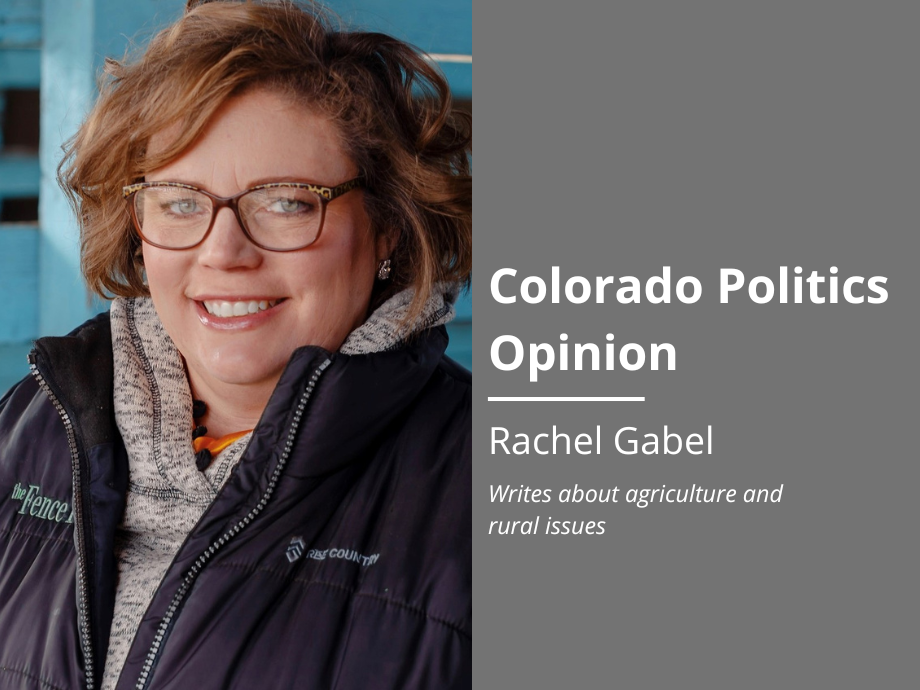
Rachel Gabel writes about agriculture and rural issues. She is assistant editor of The Fence Post Magazine, the region’s preeminent agriculture publication. Gabel is a daughter of the state’s oil and gas industry and a member of one of the state’s 12,000 cattle-raising families, and she has authored children’s books used in hundreds of classrooms to teach students about agriculture.
Colorado Politics Must-Reads:


Hunting is a privilege, not a constitutional right | PODIUM
Colorado Politics
colorado-politics@coloradopolitics.com
Updated 5 hours ago
By Roland Halpern Colorado voters may soon be asked to place hunting and fishing in the state constitution. Proposition 302 would establish the right to hunt, fish and take wildlife using “traditional methods,” while declaring hunting and fishing are the...

DEA’s Miguel Chino describes Colorado’s place on the ‘fentanyl pill superhighway’ | The OpEdge Podcast
Tony Olivero
tony.olivero@gazette.com
Updated 23 hours ago
Miguel Chino, Acting Special Agent in Charge of the Drug Enforcement Administration’s Rocky Mountain Field Division, joins The OpEdge to paint the picture of Colorado’s place on America’s “fentanyl pill superhighways.” Chino updates Gazette and Colorado Politics Deputy Opinion Editor...
A right to buy a product? | Hal Bidlack
Hal Bidlack
hal-bidlack@coloradopolitics.com
Updated 2 days ago
A recent story in Colorado Politics caught my eye, as I learned of a “citizen initiative” that has qualified for the November ballot. It seems supporters of Initiative 177 have collected enough signatures, 146,165 legitimate ones out of a total...
Fourteen years after Aurora — we can’t afford to go backward | GUEST COLUMN
Colorado Politics
colorado-politics@coloradopolitics.com
Updated 2 days ago
By John Hickenlooper and Gabby Giffords Two Saturdays ago, a gunman shot and killed three people and wounded several others in Twin Falls, Idaho. This latest deadly shooting comes only days after we remembered the lives we lost 14 years...

A daring and fearless rescuer — is afraid of a debate | Dick Wadhams
Dick Wadhams
dick-wadhams@coloradopolitics.com
Updated 4 days ago
Victor Marx, the Republican nominee for governor who says he can exorcize demons and who claimed he has fearlessly rescued 45,000 women and children during 150 “high-risk” missions around the world, appears to be intimidated by the notion of debating...

Colorado’s ballot-initiative process again a battleground for deep pockets, special interests — not the people | Miller Hudson
Miller Hudson
miller-hudson@coloradopolitics.com
Updated 2 days ago
The Oxford English Dictionary defines a constitution as, “The set of fundamental principles according to which a state is constituted and governed, a body of rules prescribing the major elements of the structure and activities of any organization.” Somewhere in...
Proposed EPA changes could save truckers billions | Rachel Gabel
Rachel Gabel
rachel-gabel@coloradopolitics.com
Updated 4 days ago
Agriculture is in distress across nearly every segment across much of the nation, and certainly to a more dire degree in the western United States. If it were not a historic drought, some pressures could be eased. Others can be...

Colorado Democrats, your time is coming | Jon Caldara
Jon Caldara
jon-caldara@coloradopolitics.com
Updated 4 days ago
Hey, Colorado Democrats! All the fun you’ve had watching Republican dysfunction in Colorado for the last 20 years was just a preview of what is about to happen to you. The Colorado Republican Party no longer exists as a competitive...
Perspective: Hunters and anglers are pushing back
Chris Dorsey
chrisd@gmail.com
Updated 2 days ago
For generations, Coloradans hunted elk, caught trout and managed wildlife without consulting a constitutional attorney. That was before wildlife management became a recurring statewide election issue, replete with consultants, national pressure groups and enough political mail to denude an aspen...
The relevance of Watergate more than a half-century later | SONDERMANN
By Eric Sondermann
by-eric-sondermann@coloradopolitics.com
Updated 7 days ago
It was the scandal for which all other scandals are now named. In June 1972, a small group of Cuban burglars with high-level connections broke into the headquarters of the Democratic National Committee. Those headquarters were located in the Watergate...