

‘BBB’ more of the same | SLOAN

In what turned out to possibly be one of the last truly cogent thoughts publicly articulated by then-Democratic presidential candidate Joe Biden was his observation during his 2020 campaign, “Milton Friedman isn’t running the show anymore.” No kidding — the next few years saw the federal government’s fiscal spigots open wide. The inflationary outcome played out exactly as Friedman predicted it would throughout his career. So Biden was absolutely correct: it was quite clear the economic wisdom of Friedman was no longer welcome to offer its sage guidance, and America became poorer for it.
One could just as easily say today it is equally clear Paul Ryan is no longer in the federal budget-writing business, let alone Milton Friedman.
The House just passed its 2025 budget reconciliation package, dubbed, in the vernacular of the Trump era, the “Big, Beautiful Bill.” The title is two-thirds correct — it is a big bill. And as a political document, its passage was a beautiful moment for House Speaker Mike Johnson, who deserves a great deal of credit for navigating the factious environs of his narrow majority. But as a document of fiscal prudence, it falls rather too short to be truly considered a thing of beauty.
In fairness, it’s not all bad, and in fact there is much to applaud in it: it avoids an egregious $4.5 trillion tax increase by making the 2017 tax cuts permanent — this is critical. It also restores full expensing (a good pre-growth provision whose full benefits are arrested by attaching a 2029 expiration date). It establishes work requirements for able-bodied adults on Medicaid, moves their start date up to 2026, and strengthens them for food stamp recipients. It expands the use of Health Savings Accounts, begins rolling back licentious federal student loan giveaways, and starts phasing out the Inflation Reduction Act’s market-distorting renewable energy tax credits. Perhaps most importantly, it provides a $150 billion atropine injection for defense, on the assumption we cannot always count on the good fortune of our adversaries’ newest warships capsizing upon their initial launch. (Yes, that just happened in North Korea, with Kim Jong Un watching. Amusing in the abstract, but one can be sure a whole lot of rather unpleasant deaths are taking place in the hermit kingdom at the moment).
Anyway, those are the good parts. Now for the bad.
First, the bill seems like an enormous missed opportunity for real, substantive spending cuts and entitlement reform. On the tax side, though it is gratifying the 2017 cuts were made permanent and the statist temptation to raise the marginal rates on “The Rich” was resisted, the bill certainly does not do anything to make the tax code simpler. As a matter of fact, it makes it even more convoluted, riddled with giveaways and gimmicks, such as those concerning tipped wages and overtime.
Stay up to speed: Sign up for daily opinion in your inbox Monday-Friday
Most disconcertingly, on the tax side, is the quadrupling of the state and local tax (SALT) deduction from $10,000 to $40,000 for those making less than $500,000. The SALT deduction is fiscal malfeasance in the first place, essentially the subsidization of liberal states’ profligacy. This means a taxpayer in a state like Colorado, which enjoys a relatively low tax rate (thanks to TABOR, and thanks only to TABOR) is not only paying more for the federal government than California or New York, but in effect rewarding those states for their own fiscal irresponsibility.
Tragically, though the bill does include a late provision to incentivize the remaining states that have not fallen for the Obamacare Medicaid expansions to not go down that pernicious route, the bill missed an opportunity to make serious, meaningful reforms to Medicaid, let alone other entitlement spending. This was probably not helped by President Donald Trump’s diktat to not touch Medicaid, but is disheartening to say the least.
Bottom line: though making some modest improvements in spending, the 2025 budget bill still adds another $3 trillion of borrowing and grows federal spending by $85 trillion through 2034.
Supporters of President Trump and his Big Beautiful Bill will retort that given the political realities, this was the best that they could do. And they are absolutely right.
There is an irony in this, as Charles C.W. Cooke points out in National Review in a piece pithily titled “Trump Is Not Different” he writes, “In 2013, I watched with bemusement as the wing of the party that eventually glommed onto Trump insisted that, from their position within the minority, the Republicans must force President Barack Obama to repeal his entire presidency. Back then, anyone who thought that this would not work was called a ‘RINO,’ a stooge for the GOPe’, or a weakling, and accused of yearning for a squishy ‘uniparty’…”
I eagerly await to see if “RINO Watch Colorado”, the Dave Williams fanpage, will put President Trump on their “RINO wall of shame.”
Of course not. Messianic politics does not work like that. In any case, the Senate now has a chance to make some corrections, but all in all the 2025 budget is, alas, more of the same.
Kelly Sloan is a political and public affairs consultant and a recovering journalist based in Denver.


A daring and fearless rescuer — is afraid of a debate | Dick Wadhams
Dick Wadhams
dick-wadhams@coloradopolitics.com
Updated 2 days ago
Victor Marx, the Republican nominee for governor who says he can exorcize demons and who claimed he has fearlessly rescued 45,000 women and children during 150 “high-risk” missions around the world, appears to be intimidated by the notion of debating...

Proposed EPA changes could save truckers billions | Rachel Gabel
Rachel Gabel
rachel-gabel@coloradopolitics.com
Updated 2 days ago
Agriculture is in distress across nearly every segment across much of the nation, and certainly to a more dire degree in the western United States. If it were not a historic drought, some pressures could be eased. Others can be...

Colorado Democrats, your time is coming | Jon Caldara
Jon Caldara
jon-caldara@coloradopolitics.com
Updated 2 days ago
Hey, Colorado Democrats! All the fun you’ve had watching Republican dysfunction in Colorado for the last 20 years was just a preview of what is about to happen to you. The Colorado Republican Party no longer exists as a competitive...

The relevance of Watergate more than a half-century later | SONDERMANN
By Eric Sondermann
by-eric-sondermann@coloradopolitics.com
Updated 5 days ago
It was the scandal for which all other scandals are now named. In June 1972, a small group of Cuban burglars with high-level connections broke into the headquarters of the Democratic National Committee. Those headquarters were located in the Watergate...

Colorado must continue finding common ground on wildfire policy | GUEST COLUMN
Colorado Politics
colorado-politics@coloradopolitics.com
Updated 4 days ago
By John Herrick Colorado has never lacked for opinions about wildfire policy. We debate forest management, climate change, prescribed burns, land use, air quality and budgets. Those debates are familiar territory, but a new discussion is beginning to happen around...

Proposition NN is the best investment for Colorado’s students and schools | GUEST COLUMN
Colorado Politics
colorado-politics@coloradopolitics.com
Updated 4 days ago
By Justin Ogden Colorado families know what it means to make difficult budget decisions. Inflation has driven up the cost of groceries, housing, utilities and just about everything else. Families like mine work hard to stretch every dollar while still...
Were the primaries a preview for consequential general election? | Paula Noonan
Paula Noonan
paula-noonan@coloradopolitics.com
Updated 5 days ago
Colorado’s political future will go the way of this election. Historically, the state has not had both chambers controlled by a supermajority. This election may change that. The primaries suggest how the general election may play out. Democrats had solid...

Disagreement doesn’t have to mean disrespect | GUEST COLUMN
Colorado Politics
colorado-politics@coloradopolitics.com
Updated 5 days ago
By Vincent Atchity These days, it doesn’t take long to feel overwhelmed by politics. Turn on the news, scroll through social media or read the comments on almost any political post and you’ll find anger, outrage and personal attacks. For...

Keeping Colorado’s kids’ trust online | PODIUM
Colorado Politics
colorado-politics@coloradopolitics.com
Updated 5 days ago
By Stuart Jenkins Almost every day, the kids and teens we serve across Colorado are introduced to new generative artificial intelligence and other emerging technology, including conversational AI systems designed to simulate human conversation. These tools are no longer a...
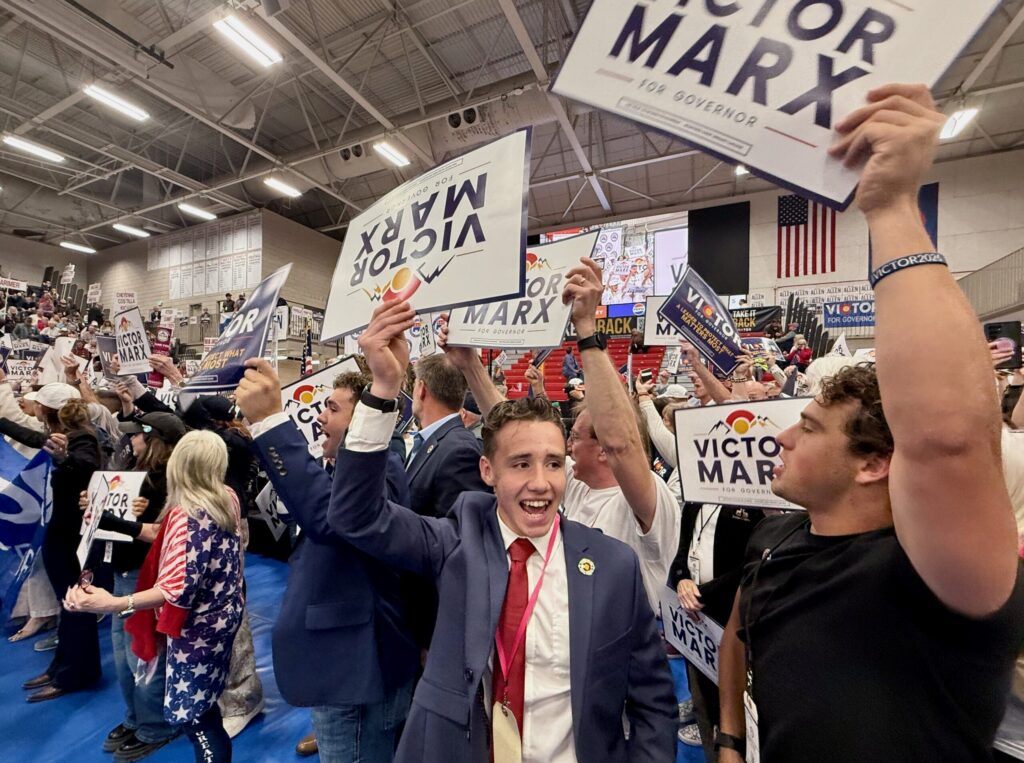
Marx’s ‘through line’ predates Trump, connects to Maes | FEEDBACK
Colorado Politics
colorado-politics@coloradopolitics.com
Updated 5 days ago
Eric Sondermann is of course correct Victor Marx is an unserious, unelectable, embarrassing Republican nominee for governor of Colorado. But I respectfully submit that the “through line,” as Mr. Sondermann describes it, is not from Trump to Marx, despite their...