

Satellite swarm pitched as part of Golden Dome missile defense upgrade
What if a satellite constellation could track incoming missiles and then select one satellite to drop from orbit to take down the incoming threat?
That’s Booz Allen Hamilton’s vision for Brilliant Swarm, a rebooted idea from President Ronald Reagan’s administration that was known at the time as Brilliant Pebbles.
Chris Bogdan, an executive vice president for the company, explained the concept during a media presentation this week, saying that each of the satellites in a constellation of up to 2,000 could function as a communications node, a tracker, a seeker and then would become the hit-to-kill vehicle.
“It’s like a bullet in space,” said Bogdan, who is based in Colorado Springs. In this case, the bullet would be the size of a small refrigerator.
The company pitched Brilliant Swarm as a component of Golden Dome, a vision outlined in a presidential executive order to invest heavily in ballistic, cruise and hypersonic missile defense.
A look at how Colorado Springs businesses are embracing AI
The order issued by President Donald Trump in January called for an Iron Dome, referencing Israel’s missile defense in place. But it’s since been rebranded as Golden Dome.
The plans for the dome were due on Friday, but Defense One reported the documents will likely be submitted this coming week, citing anonymous sources.
Right now, the U.S. relies in part on 44 ground-based missile interceptors in Alaska and California. The interceptors can bring down a ballistic missile in flight, similar to a bullet hitting a bullet, said Trey Obering, a senior executive at Booz Allen Hamilton. He was previously the director of the Missile Defense Agency. But these missile interceptors do not address threats from Russia or China, he said.
The proposed solution would build on the peer-to-peer networking demonstrated when the Ukrainian Army built a system based on Uber’s ride sharing network, Bogdan said.
“When a Russian tank appeared, someone with the application could take a photo of the tank and then provide the coordinates of that tank into the network,” he said. “Then the software algorithm within the system determined which artillery battery or missile unit was best positioned to fire on that tank, much like the Uber system, which figures out which drivers are in (the) best position to pick up a passenger.”
The system cut the Ukrainian Army’s response time from 30 to 40 minutes down to less than a minute, he said.
The proposed satellite constellation would track missiles autonomously as well and select amongst themselves the best satellites to hit the missile, Bogdan said.
Lockheed Martin developing software to bring the right information to the right warfighter
The company modeled intercepting a single North Korean missile with 1,000 satellites and found it would have 14 different opportunities to take down that missile within the first 15 minutes of flight, he said, long before ground-based interceptors would see the missile.
Obering cautioned it would not be able to protect the U.S. from everything that Russia and China could launch, but it would intercept a substantial number of their missiles.
“It would place a big question mark in their mind as to whether their attack would be successful,” he said.
The constellation could be made possible by the falling cost of both satellites and launching them into orbit. The lower costs are major advancements since the original concept was floated in the 1980s, Bogdan said. In addition, the technology to make the satellites communicate in orbit did not exist during the Reagan administration.
Obering said a single ground-based midcourse interceptor currently costs about $60 to $90 million. It would cost about $70 million to put 100 satellites into orbit.
The constellation the company is proposing would compliment, rather than replicate the constellations the Space Development Agency is currently funding, Bogdan said.
Space gets safer for business with new industry watch center in Colorado Springs
Colorado-based companies such as Lockheed Martin in Littleton and Sierra Space in Louisville are under contract to build missile warning and missile tracking satellites for the agency, according to a 2024 news release.
Booz Allen Hamilton would not build the satellites for this concept, they would provide the technical expertise for the project, Obering said.


Colorado board permits state to appeal injunction against arthritis drug price cap
Marissa Ventrelli
marissa.ventrelli@coloradopolitics.com
Updated 14 hours ago
A Colorado board voted Friday to allow the Attorney General’s Office to fight an injunction against a price cap on a drug that treats arthritis. A U.S. district court judge had granted the company Amgen a preliminary injunction, temporarily blocking...

Federal judge rejects constitutional claims, ‘expressions of hatred’ by Club Q defendant
Michael Karlik
michael.karlik@coloradopolitics.com
Updated 14 hours ago
A federal judge rejected a defendant’s claims that he received constitutionally ineffective assistance of counsel while facing federal hate crime and firearms charges for murdering five people at a Colorado Springs LGBTQ nightclub in 2022. Anderson Lee Aldrich is serving...

Divided 10th Circuit upholds Colorado congestion fee on car rentals
Michael Karlik
michael.karlik@coloradopolitics.com
Updated 10 hours ago
The Denver-based federal appeals court concluded on Monday that a 2024 “congestion impact fee” that lawmakers imposed on short-term vehicle rentals did not conflict with a federal prohibition on certain airport-related charges. Beginning in the 1970s, Congress began limiting the...

Space Force should measure workforce needs as it prepares to double in size, GAO report says
Mary Shinn
mary-shinn@coloradopolitics.com
Updated 19 hours ago
The Space Force needs more people. It’s just not precisely sure how many more. A Government Accountability Office report released earlier this month found that the youngest and smallest military branch does not have a process to consistently or accurately...

Colorado schools receive $24 million for free meals program
Marissa Ventrelli
marissa.ventrelli@coloradopolitics.com
Updated 14 hours ago
The Colorado Department of Education is providing Colorado schools with nearly $24 million in grant funding to implement a free lunch program. Approved by voters in 2022, the Healthy School Meals for All provides free breakfast and lunch to all...

Secret Service agent placed on administrative leave after arrest for near-deadly hazing ritual
Claire Carter
claire.carter@washingtonexaminer.com
Updated 21 hours ago
A Miami Secret Service agent in Florida was placed on administrative leave following his arrest on Sunday in connection with a near-deadly hazing incident at a University of Miami fraternity. Marquez Christopher Pinder, 29, was arrested alongside two other individuals...
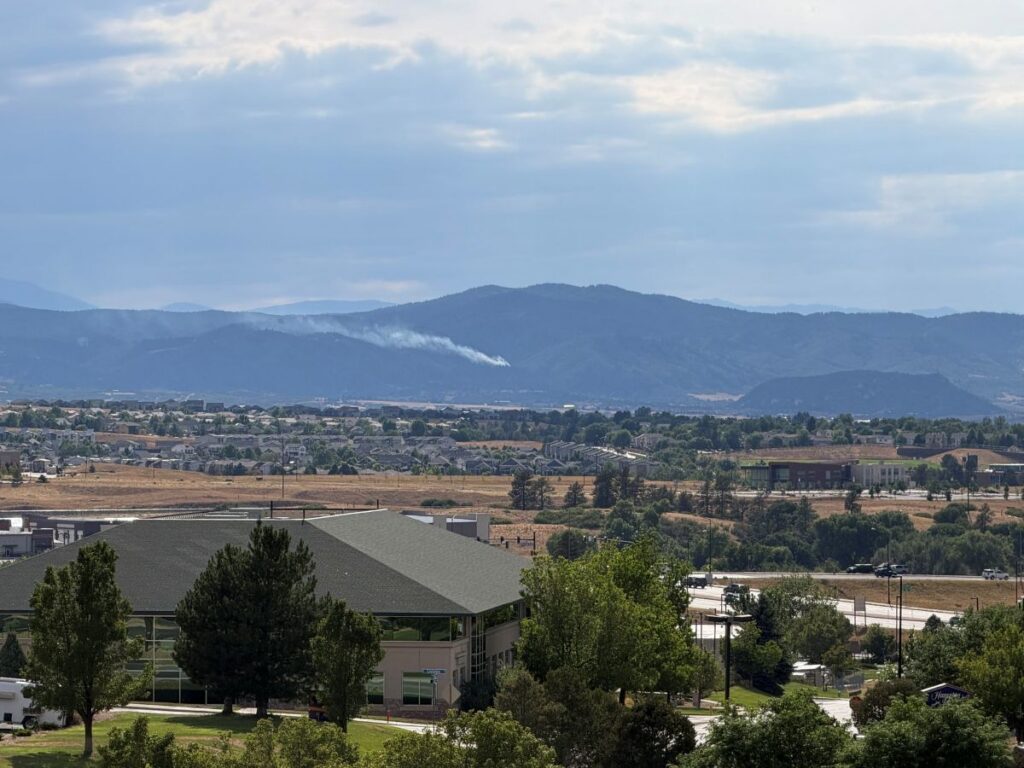
Forest fire west of Sedalia prompts evacuations in Douglas County
Nicholas Fogleman
nicholas.fogleman@denvergazette.com
Updated 23 hours ago
Emergency crews are responding to a forest fire burning west of Sedalia, prompting evacuation orders for nearby residents Sunday afternoon. At about 5 p.m. Sunday, the Douglas County Sheriff’s Office issued an evacuation order for residents within a 2-mile radius...

Airstrikes have paused and talks are pressing forward. But can the US and Iran take the off-ramp?
The Associated Press
the-associated-press@coloradopolitics.com
Updated 23 hours ago
WASHINGTON (AP) — The U.S. military has paused its airstrikes on Iran after nearly two weeks of intensifying bombing, while diplomatic efforts have pushed forward to try to avert a return to all-out war. But it remains to be seen...

Penrose fortune paved the way for Colorado Springs to be a military, space and sports town
Mary Shinn
mary-shinn@coloradopolitics.com
Updated 23 hours ago
Colorado Springs is always working to catch the next big economic wave. “We’re always trying to figure out what the next thing is going to be,” explained Matt Mayberry, director of the Colorado Springs Pioneers Museum. In the early days,...

Colorado Politics Calendar July 27-Aug. 2
Rachael Wright, Special to Colorado Politics
rachael.wright@coloradopolitics.com
Updated 6 days ago
CoPo’s weekly political calendar will help you find political and public-policy events throughout Colorado. It includes candidate and issue campaign events, public policy meetings, court hearings, state and local party conventions, assemblies, debates, rallies, parades, speaking engagements, traveling dignitary appearances,...