

When judges break the rules, it’s time to judge the judges | Vince Bzdek
Despite five years of searing reports by investigative reporter David Migoya into serious problems afflicting the Colorado Supreme Court, the commission that reviews judicial performance gave all the justices on the ballot this year glowing recommendations.
The two most senior members of the Supreme Court, Chief Justice Monica M. Márquez and Justice Brian D. Boatright, plus junior Justice Maria E. Berkenkotter, will be on the ballot for a retention vote. Now it’s up to voters to decide if their coverup and unethical handling of a pay-for-silence scandal, their stonewalling of investigations into that scandal, and their rule breaking and conflicts of interest uncovered by Migoya warrant a “NO” vote.
The three justices involved in this coverup will get a 10-year uncontested term if voters retain them, the longest of anyone on any ballot in our state, senators and presidents included.
Dennis Maes, a retired chief judge in Pueblo who previously served on the state’s commission for judicial discipline, the body that investigated the court over its handling of the scandal, said this during testimony to legislators:
“It is my belief that the Boatright court lost its way concerning this sad and embarrassing moment in the history of the Colorado Supreme Court when it disregarded and disrespected long established principles, rules, processes and ethical considerations that judges take an oath to obey.”
The findings of a legislative commission led directly to the ballot initiative also up for a vote this election that asks Coloradans to decide whether to create an independent board to oversee judicial discipline and put in place other reforms to increase the transparency and independence of the disciplinary process.
In other words, because of the lack of self-discipline by justices on our highest court, voters are being asked to take that discipline out of their hands.
There are some who say that former Chief Justice Boatright and the other current justices didn’t know enough about the scandal to lose their jobs over it.
What utter bunk.
The head of a legislative commission charged with investigating the scandal said the justices up for retention threw up roadblock after roadblock at efforts to investigate, at times refusing to outright hand over information and trying to manipulate the probes, Migoya reported.
“The bottom line is this: Members of the Colorado Supreme Court, directly and through its senior staff, made a series of decisions and took a series of actions throughout 2021 and 2022 that limited the ability of the commission … to do its constitutionally mandated work,” commission Executive Director Christopher Gregory wrote in a letter.
He also pointed to public comments made by several justices dismissing the scandal allegations when Migoya broke the news in February 2021 that then-Chief Justice Nathan “Ben” Coats allegedly approved a contract to former Chief of staff Mindy Masias to forestall her threats of going public with the misdeeds of judges in a sex-discrimination lawsuit.
Judicial canons prohibit judges from making public statements on the validity of such accusations being investigated, because the jurists might be asked to decide a related case.
Boatright also insisted the commission investigating allegations of judicial misconduct issue a subpoena for any information from the Supreme Court in order to prevent the media — and by extension the public — from getting access to details about the scandal inquiry, according to emails obtained by Migoya and The Gazette.
And at least six of Colorado’s Supreme Court justices — including Boatright and current Chief Justice Márquez — knew about conflicts of interest they allegedly had with ongoing disciplinary investigations into the conduct of at least two of their colleagues but did nothing about it, according to letters obtained by Migoya.
The state’s Commission on Judicial Discipline sent personalized letters to each of the justices outlining their conflicts and their obligation under judicial conduct rules to recuse themselves from the entire investigative process, according to a letter Boatright wrote the commission in reaction to the correspondence.
Yet despite those apparent conflicts, none of the justices ever stepped aside throughout the 20 months the inquiries were ongoing.
So why are these justices’ performance evaluations so damn glowing then?
Migoya’s reporting also uncovered the reasons for that:
“Colorado’s system of judicial discipline is so secret that the state’s nearly two dozen performance review commissions that evaluate judges have rarely known for sure whether a jurist they recommended voters keep on the bench had a record of misconduct or not,” he wrote last year. “One member of a performance commission who spoke to The Gazette said they weren’t even aware they could request a judge’s discipline record. Others said it was unclear how they could use the information as part of their review process.”
The performance commission doesn’t look at prior discipline. That would be like me hiring an ax murderer to be a reporter, because I didn’t happen to look at his criminal record.
The performance commission is only tasked with looking at six things: integrity, legal knowledge, communication skills, judicial temperament, administrative performance and service to the legal profession and the public designed to educate and improve the legal system.
Migoya also did reporting that revealed 120 judges in Colorado failed to comply with financial disclosure laws.
But financial disclosure violations are not part of the six criteria, either, so voters did not receive any information on those 120 judicial scofflaws.
The critical concern among people who actually want a functioning justice system, Maes has said, “is that nobody really gives a crap.”
Most people in Colorado don’t feel as if they are getting impact when it comes to a scandal like this. None of the justices who handled this whole affair faced any discipline except Coats, who received a public censure after he retired from the bench. But that censure didn’t come from his former colleagues on the Supreme Court, who recused themselves in the matter. It came from a special tribunal of Court of Appeals judges. Coats had already retired in 2020, and was replaced by Berkenkotter when the scandal exploded.
When the justices are handling their own investigation, the justices are able to corral whatever it is that they need to stay corralled, and the probe doesn’t impact them. There’s a phrase for this practice. It’s called “protecting the robe.”
But that’s not really good enough, is it, for the people we entrust with deciding right and wrong?
If you are given the title of Supreme Court justice and a 10-year term, your resumé ought to be impeccable.
And we don’t have impeccable here.
The only person who can now bring justice to the justices, who has a say over their behavior at the end of the day, is you, the voter, when those justices are up for retention. Which is right now.
So what’s our final answer to Migoya after five years of dogged watchdogging: Do we really give a crap?

It’s almost Sine Die and it can’t come soon enough | Capitol M | Week of May 9, 2026
Marianne Goodland
marianne.goodland@coloradopolitics.com
Updated 2 days ago
The lighter side of the state Capitol, usually. At first, May the Fourth might have been a bit of a disappointment. Usually, there’s a lot of Star Wars foolishness on this particular day, but early on, it was low-key. The...
NRA carves out early success story battling 1981 Colorado gun legislation | A LOOK BACK
Rachael Wright, Special to Colorado Politics
rachael.wright@coloradopolitics.com
Updated 2 days ago
Forty-Five Years Ago This Week: After House Bill 81-1542, which would have mandated detention for juveniles carrying concealed weapons, cleared the Senate Judiciary Committee, Sen. Paul Powers, R-Denver, said he had received 45 letters per day denouncing the legislation. And...

Colorado Politics Calendar May 11-17
Rachael Wright, Special to Colorado Politics
rachael.wright@coloradopolitics.com
Updated 3 days ago
CoPo’s weekly political calendar will help you find political and public-policy events throughout Colorado. It includes candidate and issue campaign events, public policy meetings, court hearings, state and local party conventions, assemblies, debates, rallies, parades, speaking engagements, traveling dignitary appearances,...
Colorado needs a sane, viable opposition party | SONDERMANN
By Eric Sondermann
by-eric-sondermann@coloradopolitics.com
Updated 4 days ago
If you are upset with the increasing regulatory burden in Colorado, the exodus of too many large employers, accelerating property taxes, the condition of the roads, and all of the funding for transit schemes with low demand, of course, you...

Colorado lawmakers eye 5% fee on online gaming ‘skins,’ other game features
Marissa Ventrelli
marissa.ventrelli@coloradopolitics.com
Updated 12 hours ago
Colorado lawmakers are seeking to impose a new fee on online game purchases, in particular targeting “add-on transactions,” referring to features or enhancements that players can buy. Sponsors said they want to earmark the new revenue toward youth mental health...
TABOR showdown: Senate moves bill forward, Advance Colorado prepares for legal action
Marianne Goodland
marianne.goodland@coloradopolitics.com
Updated 12 hours ago
Despite objections from legislative staff and Republican opposition, Senate Democrats on Friday moved forward with a proposal to reroute $306 million in taxpayer refunds. Already, critics are preparing to sue over the proposal that seeks to take $300 million in Taxpayer’s...
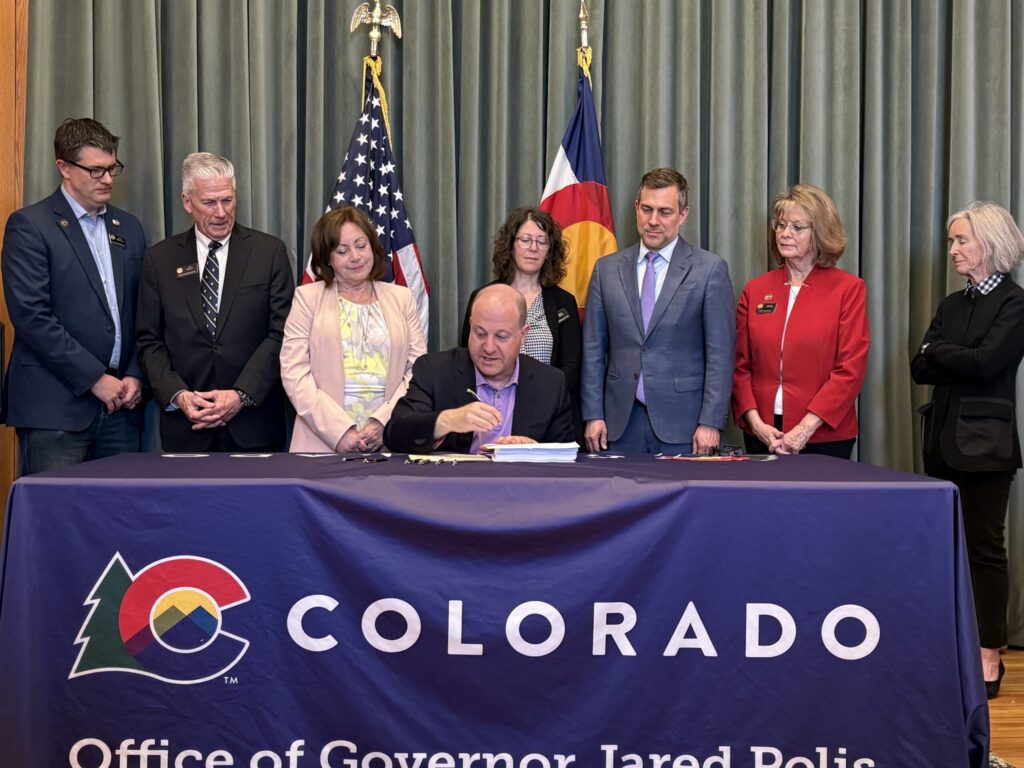
Colorado governor signs $47 billion budget in which ‘nobody won’
Marianne Goodland
marianne.goodland@coloradopolitics.com
Updated 13 hours ago
Gov. Jared Polis on Friday officially signed a $46.87 billion spending plan for the Colorado state government in the next fiscal year. His signature is the culmination of months of work by legislators, who resorted to cuts, transfers and other...

Latest Pinnacol proposal shifts sponsors, cuts state benefits and triggers union standoff
Marianne Goodland
marianne.goodland@coloradopolitics.com
Updated 16 hours ago
Colorado’s long‑running bid to let Pinnacol Assurance break away from state control is suddenly in jeopardy, as a newly revised bill — stripped of the payouts and structural changes once central to the deal — has triggered fresh tensions among...

Denver could be back in DNC spotlight 20 years later
Deborah Grigsby
deborah.smith@denvergazette.com
Updated 17 hours ago
It’s been nearly two decades since Denver shared the spotlight as host to the 2008 Democratic National Convention — and a lot has happened in the city since then. But not major party conventions. In fact, before 2008, Denver hadn’t...

Bill permitting lawsuits against ICE agents reaches Gov. Jared Polis’ desk
Marissa Ventrelli
marissa.ventrelli@coloradopolitics.com
Updated 12 hours ago
Colorado lawmakers advanced two high‑profile measures Thursday — one seeks to reshape how the state manages its strained prison population and another allows Coloradans to sue federal immigration agents for alleged constitutional violations. The state policymakers sent both bills to...