

State Supreme Court scandal’s stench lingers still | MAES

One would think that the stench from the pay for silence scandal that has engulfed the Colorado Supreme Court under the leadership of Chief Justices Ben Coats, Brian Boatright and Monica Marquez would have caused the state Supreme Court and its faithful sidekick, the Commission on Judicial Discipline (CJD), to finally come clean. Recent events have proven to be just the opposite with the continued effort to play the public a fool.
Marquez was appointed chief justice on July 26 although she was anointed to succeed Boatright during the time the scandal was unraveling. She, as well as the other justices at the time, were fully aware of the depths of the scandal. Upon Boatright’s departure as chief justice, Marquez praised his performance and committed to follow his example, as poor as it was, in her new role as chief justice.
Recall that Marquez walked in lockstep with Boatright as he impeded the scandal investigation to the point criminal charges could not be brought because the many lawyers involved, including the Denver DA, state attorney general and Supreme Court legal staff failed to keep track of the appropriate statute of limitations and allowed it to run — something taught in the first weeks of law school.
Recall also the massive change in the composition of the members on the CJD. Many were vocal critics of the Supreme Court’s unethical behavior. Judge David Prince was one of the critics. Although Prince was eligible for reappointment to the CJD, Boatright refused to reappoint him and instead replaced him with a known Boatright supporter and CJD critic.
The new commission, absent Prince and other Boatright critics, selected a new chair. The new chair promptly initiated a plan for the removal of Christopher Gregory as executive director of the CJD. Gregory was steadfast in his insistence that Boatright cooperate with the investigation and hold those accountable who were responsible for the scandal including Boatright. The plan succeeded and Gregory was fired for his courageous stand to speak truth to power. Hence, the need to hire a new executive director.
Enter Anne Mangiardi who was hired to fill the position in July 2024.
Mangiardi was interviewed by Michael Karlik, reporter for Colorado Politics, regarding her new employment with the CJD in a report published on Oct. 17. Absent from the interview is what, if any, involvement Mangiardi may have had in the scandal as a result of her employment with the state attorney general office.
The office of the attorney general represented the Supreme Court during the scandal. The AG office engaged in efforts to impede the investigation including drafting non-disclosure agreements, which prevented individuals with knowledge of the scandal from sharing said information.
It appears the lack of transparency which was at the heart of the scandal may exist here, posing serious questions that should be answered by Mangiardi.
According to the Karlik interview, Mangiardi’s primary responsibility with the AG was litigating tax cases but, at times, would involve representing “state agencies that were facing an investigation.” Hold that thought.
Mangiardi claims she “was vaguely aware of the commission.” She added “the commission is in a good place and working well” and what she is seeing at the commission “is really positive.”
It appears Mangiardi’s knowledge about the workings of the CJD was minimal to moderate. What is clear is that other of her colleagues in the AG office had major roles in the investigation. One such individual is Grant Sullivan who was appointed to the Court of Appeals at the time Boatright chaired the nominating commission that submitted Sullivan’s name for consideration for the appointment. Because secrecy in the nomination process is required, it is unknown if Boatright informed the other members of the nominating commission of the depth of Sullivan’s involvement in the scandal, including when he first became aware of the scandal.
The Supreme Court commissioned two “independent” investigations and reports concerning the scandal and the workplace culture of the judicial branch. Some $350,000 in taxpayer dollars was expended on the two reports. One such report was prepared by Investigations Law Group (ILG). Mangiardi was not asked if she was aware of the “independent” reports nor did she volunteer any information of her knowledge of the reports.
What is known and places Mangiardi’s knowledge in question is that on page 131 of the ILG report, attested to by Elizabeth R. Rita, Esq. and Anne McCord, SPHR. SHRM_SCP. PI. AWI-CH is the statement, “This Colorado Judicial Branch Investigation Report and Culture Assessment is respectfully submitted to Anne Mangiardi. Esq. this 11th day of July, 2022.” Assuming the names of Anne Mangiardi reflect the same individual who is the subject of this article she was fully aware of the ILG report two years before being hired by the CJD.
The public has a right to know the circumstances and process under which Ms. Mangiardi was hired, especially in light of the commission’s perceived effort to rid itself of those who had the courage to oppose the enormous power of the Supreme Court. The last thing that is needed is another rubber stamp commission that does not believe the law should be equally applied.
To quote Sir Walter Scott, “Oh, what a tangled web we weave when first we practice to deceive!” Scott must have had a premonition of the judicial scandal when he coined the phrase.
Vote YES on Amendment H and NO on the retention of Justices Marquez, Boatright and Berkenkotter
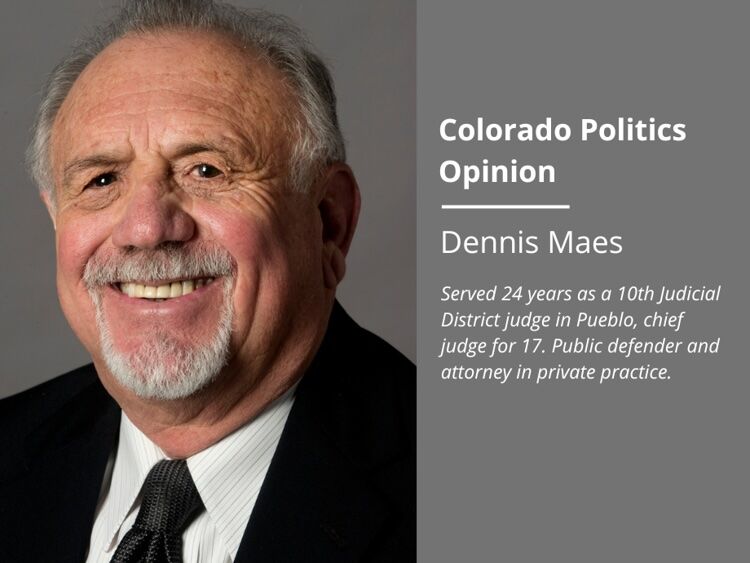
Dennis Maes served 24 years as a 10th Judicial District judge in Pueblo and was chief judge for 17 of those years. He previously served as director of Pueblo County Legal Services, Inc.; as a public defender and as an attorney in private practice.


Clock is ticking on Colorado’s new AI rules | PODIUM
Colorado Politics
colorado-politics@coloradopolitics.com
Updated 4 hours ago
By Aashis Luitel On Jan. 1, organizations using covered automated systems must begin complying with Senate Bill 26-189, Colorado’s new Automated Decision-Making Technology Act. They can identify those systems and start building the processes the statute clearly requires. What they...

Meghan Shay on recovery, responsibility and second chances | The OpEdge Podcast
Tony Olivero
tony.olivero@gazette.com
Updated 1 day ago
Step Denver and Step Springs CEO Meghan Shay joins The OpEdge to explore addiction recovery, homelessness, and the role of accountability in lasting change. Shay tells host and investigative columnist Jimmy Sengenberger why she believes recovery is built on personal...
The outrages mount | Hal Bidlack
Hal Bidlack
hal-bidlack@coloradopolitics.com
Updated 2 days ago
My kindly and forgiving editors understand that, from time to time, I can’t help myself from leaping atop my rickety soapbox to vent. And, like many other political commentators have already done, I could easily fill this entire missive with...

Rural Colorado deserves a tax holiday | GUEST COLUMN
Eric Mulder
jstooksberry@gmail.com
Updated 2 days ago
Spend enough time in Colorado’s Eastern Plains, the San Luis Valley, or the Western Slope, and you’ll see boarded-up storefronts, schools consolidating classrooms, and small rural communities stretching every dollar to keep basic services afloat. Once the backbone of Colorado’s...

Weiser’s leadership crucial for rural win-win | Rachel Gabel
Rachel Gabel
rachel-gabel@coloradopolitics.com
Updated 6 days ago
Attorney General Phil Weiser is going to win the gubernatorial election. That said, Colorado agriculture and rural communities have a 30-year track record of finding the win-win be it for species or industries or habitat. Former Governor Roy Romer possessed...

A Colorado history lesson for Victor Marx | Dick Wadhams
Dick Wadhams
dick-wadhams@coloradopolitics.com
Updated 5 days ago
Victor Marx, who narrowly won the Republican nomination for governor by one half 1% after boasting of a massive 44-point lead, is just as misguided on Colorado political history. During the primary, Marx made a clumsy attempt to denigrate his...
‘Be prepared to march in the streets’ | Miller Hudson
Miller Hudson
miller-hudson@coloradopolitics.com
Updated 4 hours ago
It was early in 1974 when I first met Tim Wirth as he announced his candidacy for Congress, challenging Republican incumbent Don Brotzman. Although I had only resided in Colorado two years, I was drafted to serve as a Democratic...

‘CoCo’ would take taxpayers for a ride | Jon Caldara
Jon Caldara
jon-caldara@coloradopolitics.com
Updated 2 days ago
Colorado wants taxpayers to spend another $4.73 billion on passenger rail. Don’t worry. They have a plan. Which is a little like your brother-in-law announcing he’s launching another exciting restaurant venture after his last three restaurants ended in bankruptcy. Please....

The through line from Donald Trump to Victor Marx | SONDERMANN
By Eric Sondermann
by-eric-sondermann@coloradopolitics.com
Updated 1 week ago
Over 10 years ago, before Donald Trump could ever defeat Hillary Rodham Clinton, he had to first engineer a hostile takeover of the Republican Party. Prior to his descent of that golden escalator, the previous seven Republican presidential nominees had...
Primary voters rejected big money in politics | Paula Noonan
Paula Noonan
paula-noonan@coloradopolitics.com
Updated 5 days ago
While we’re in an election campaign lull between now and Labor Day, we have time to consider the impact of $102 million in campaign contributions in the primary. In the general election, more money will fill candidate campaign coffers, and...