

Colorado Supreme Court to analyze revisions to child neglect law
The Colorado Supreme Court announced on Monday it will decide whether a recent change to the state’s child neglect law requires more than speculation that a parent’s drug use will cause future, negative effects on a newborn.
At least three of the court’s seven members must agree to hear a case on appeal.
The justices also signaled they may intervene to review two recent decisions by trial judges. The first implicates a recent U.S. Supreme Court ruling that alters how prosecutors must prove prior convictions and the second addresses the legality of municipal ordinances that punish identical offenses more harshly than state law does.
Drug use affecting newborns
Prior to 2020, a court could declare a child neglected if, among other things, they tested positive at birth for controlled substances not authorized by a prescription. That year, however, lawmakers enacted a new set of criteria. Now, a child is neglected if they are “born affected by” alcohol or drug exposure and their “health or welfare is threatened” by the substance use.
Interpreting that language for the first time in August, a three-judge panel for the Court of Appeals decided, 2-1, the government must prove more than the potential that symptoms of the drug exposure will manifest someday.
“We recognize, and do not mean to understate, the devastating effects that may befall a child after being exposed to methamphetamine or other substances during pregnancy,” wrote Judge Matthew D. Grove for himself and Judge Grant T. Sullivan. “With the General Assembly having decided that mere exposure is no longer enough to justify a child’s adjudication, we may not substitute our judgment for the legislature’s policy decision.”

Colorado Court of Appeals Judge Matthew D. Grove speaks with Morgan Rasmussen and Brisais Vargas, 17-year-old juniors. STRIVE Prep — RISE school in Green Valley Ranch hosted a Courts in the Community event, featuring oral arguments before a three-judge panel with the Colorado Court of Appeals on Tuesday, April 19, 2022. Photo by Steve Peterson
Courtesy of Steve Peterson

Colorado Court of Appeals Judge Matthew D. Grove speaks with Morgan Rasmussen and Brisais Vargas, 17-year-old juniors. STRIVE Prep — RISE school in Green Valley Ranch hosted a Courts in the Community event, featuring oral arguments before a three-judge panel with the Colorado Court of Appeals on Tuesday, April 19, 2022. Photo by Steve Peterson
Judge Terry Fox distanced herself from that reading, observing it would permit parents to use harmful substances during their pregnancy, “but if the child was not born prematurely, did not have immediate, detectable growth impairments, or was not experiencing withdrawal symptoms, the child would not be a dependent or neglected child.”
“We definitely agree with the court’s finding,” Heather Thompson, who testified in favor of the 2020 legislation on behalf of the nonprofit Elephant Circle, told Colorado Politics after the panel’s decision. “We do believe this was the intention of the statutory change.”
The government appealed to the state Supreme Court, asking it to review the panel’s interpretation and its related conclusion that the evidence was insufficient to find an El Paso County child neglected under the circumstances.
The justices will address those issues.
The case is People in the Interest of B.C.B.
New rule
Colorado’s “three strikes” law, known as the Habitual Criminal Act, requires judges to impose three or four times the maximum sentence if a defendant is convicted of a felony and has multiple prior felonies. However, the prior convictions must arise “out of separate and distinct criminal episodes.”
This June, however, the U.S. Supreme Court issued a decision in Erlinger v. United States, ruling juries must decide beyond a reasonable doubt whether a defendant committed prior felonies on different occasions under the federal habitual criminal law.
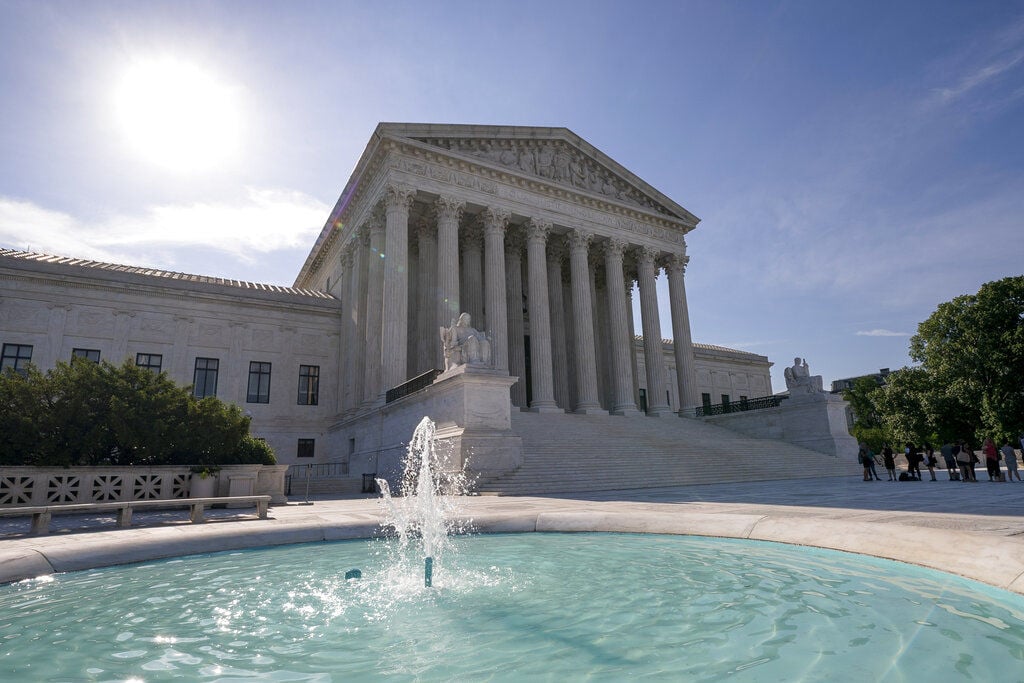
The Supreme Court is seen in Washington as the justices prepare to hand down decisions, Monday, June 17, 2019.
(AP Photo/J. Scott Applewhite)

The Supreme Court is seen in Washington as the justices prepare to hand down decisions, Monday, June 17, 2019.
At the time the decision dropped, a Mesa County jury had recently convicted Andrew Gregg of two felonies and one misdemeanor. Prosecutors also alleged Gregg should be sentenced as a habitual criminal because he had four prior robbery convictions — but the priors were not part of the jury’s verdict.
After Erlinger and in anticipation of Gregg’s sentencing, the defense moved to dismiss the habitual criminal counts because Gregg disputed whether three of his prior convictions were from “separate and distinct” episodes. The prosecution conceded the Supreme Court’s decision meant such questions could no longer be decided by judges after the jury’s verdict. But it argued a “replacement jury” could determine whether Gregg qualified as a habitual criminal.
In a Sept. 9 order, District Court Judge Matthew D. Barrett believed there could be no further proceedings on the habitual criminal allegations. He invoked the constitutional prohibition on double jeopardy, reasoning that case law prohibited him from assembling another jury after the prosecution already had the chance to prove its allegations beyond a reasonable doubt.
“While acknowledging that at the time of trial the prosecution did not know that it needed to prove Defendant’s habitual criminal counts to the jury, I am nonetheless bound to follow applicable law,” Barrett wrote.
The district attorney’s office appealed directly to the state Supreme Court, arguing the principle of double jeopardy does not apply in Gregg’s scenario.
The Supreme Court ordered Gregg and Barrett to respond to the prosecution’s petition. It also invited the criminal defense bar, the ACLU of Colorado, the district attorneys’ council, the attorney general’s office and the state public defender to submit their thoughts.
The case is People v. Gregg.
Municipal punishments
Finally, the Supreme Court has indicated its interest in an appeal out of municipal court.
Last year, the justices faced a scenario involving a pair of defendants in Rifle. Two people received a summons for a theft charge under the municipal code. The city’s maximum jail time for the offense was 18 times longer than if the defendants had been charged under Colorado’s theft statute.
The defendants asked the Supreme Court to declare Rifle’s code unconstitutional to the extent it punished an identical offense more harshly. However, after the justices ordered Rifle to respond, the city council backed down and begrudgingly changed its code. Consequently, the Supreme Court dismissed the appeal.


Several months later, Aleah Michelle Camp was charged in Westminster Municipal Court with theft. Compared with the identical state offense, she would face a maximum municipal fine nine times greater and jail time 36 times longer than Colorado law imposed.
As in the Rifle case, Camp challenged the legality of Westminster’s ordinance. Similarly, the local prosecutor defended the city’s right to penalize theft more harshly under its inherent authority.
“Theft in Westminster happens in Westminster. Theft in Westminster affects Westminster retailers. When Westminster retailers are affected, they have trouble doing business in Westminster,” the city attorney’s office argued. “So, it is a local concern to address that criminal behavior.”
Judge Rebekah B. Watadah declined to find the ordinance unconstitutional, believing a locality’s sentencing scheme does not have to be consistent with the state’s.
Camp appealed to the Supreme Court, arguing municipalities are undermining the legislature’s effort to impose statewide uniformity in criminal sentencing and giving unreviewable discretion to officers about which venue to charge defendants.
The Supreme Court ordered a response to Camp’s petition and invited the attorney general’s office, the criminal defense bar and the Colorado Municipal League to weigh in.
The case is People v. Camp.


Judicial performance evaluations released, Montezuma County judge disciplined | COURT CRAWL
Michael Karlik
michael.karlik@coloradopolitics.com
Updated 13 hours ago
Welcome to Court Crawl, Colorado Politics’ roundup of news from the third branch of government. Colorado’s citizen-led judicial performance commissions released their voter narratives for the judges standing for retention in November, plus a disciplinary panel imposed consequences on a...
Federal judge holds off on dismissing formerly bankrupt medical contractor from Jeffco jail death lawsuit
Michael Karlik
michael.karlik@coloradopolitics.com
Updated 15 hours ago
A federal judge declined on Monday to dismiss the formerly bankrupt medical contractor from a lawsuit over a detainee’s death in Jefferson County jail, but indicated she would do so if the plaintiffs’ attorneys go through the process to ensure...
Federal judge green-lights excessive force, retaliation claims for trial against Fort Collins officers
Michael Karlik
michael.karlik@coloradopolitics.com
Updated 2 days ago
A federal judge green-lit a jury trial last week against multiple Fort Collins police officers on claims that they used excessive force on one man who was standing unarmed in his underwear, and retaliated against another man for exercising his...

10th Circuit revives wage violation lawsuit against Papa John’s operator
Michael Karlik
michael.karlik@coloradopolitics.com
Updated 3 days ago
The Denver-based federal appeals court on Tuesday reinstated a former Papa John’s delivery driver’s lawsuit alleging violations of federal and state wage law. Steve Mighell worked for one month at a Denver Papa John’s location in summer 2023. He alleged...
Colorado appeals judge’s delays in releasing opinions noted by performance commission
Michael Karlik
michael.karlik@coloradopolitics.com
Updated 3 days ago
The citizen-led performance commission that provides guidance to voters about whether to retain members of Colorado’s second-highest court raised concerns by judges and attorneys that Judge Elizabeth L. Harris sometimes struggles with releasing opinions promptly. Harris, who joined the Court...

Colorado judge explores sanctions against DOJ, ICE for rearresting man 4 days after release on bond
Michael Karlik
michael.karlik@coloradopolitics.com
Updated 4 days ago
A federal judge in Colorado is considering sanctions against the government after immigration agents rearrested a man four days after an immigration judge found him suitable for release on bond. On July 28, U.S. Magistrate Judge N. Reid Neureiter ordered...

Divided disciplinary panel censures Montezuma County judge after agreement reached
Michael Karlik
michael.karlik@coloradopolitics.com
Updated 4 days ago
A disciplinary panel formally imposed a public censure, suspension, and further training on Montezuma County Court Judge Ian J. MacLaren on Tuesday by a 2-1 vote. Under constitutional Amendment H, which voters adopted in November 2024, MacLaren was set to...

Colorado’s Western Slope magistrate judges describe unique role in federal judiciary
Michael Karlik
michael.karlik@coloradopolitics.com
Updated 5 days ago
Two of Colorado’s federal judges stationed on the Western Slope spoke to lawyers on Wednesday about their unique roles, the ways their workloads differ, and the need for more criminal defense lawyers to take cases outside the Front Range. “Here...

Denver sues Philip Morris, other tobacco companies over cigarette butt litter
Deborah Grigsby
deborah.smith@denvergazette.com
Updated 4 days ago
Denver is demanding that some of the biggest tobacco companies in the world pay for the cleanup of discarded cigarette butts on its streets, following a similar campaign that cities in other states have pursued. Denver’s lawsuit, filed this week...
Federal judge rules that request for bond hearing not necessary to challenge immigration detention
Michael Karlik
michael.karlik@coloradopolitics.com
Updated 4 days ago
A federal judge in Colorado ruled last week that it is not mandatory for a person to seek a bond hearing with an immigration judge before they challenge the lawfulness of their detention in federal court. For the past year,...