

Federal judge hears religious exercise case of Castle Rock church, with SCOTUS looming in background
In a case that appears designed to catch the attention of the U.S. Supreme Court’s conservative majority, a federal judge heard arguments on Monday about whether a Castle Rock church’s religious belief that it should house the homeless is enough to let the congregation bypass the town’s zoning restrictions and continue operating temporary shelters in its parking lot.
On the surface, The Rock evangelical church is seeking a short-term court order that would allow it to continue to use one recreational vehicle and one camping trailer to temporarily shelter homeless individuals and families, notwithstanding the town’s position that the church’s zoning does not permit a residential use.
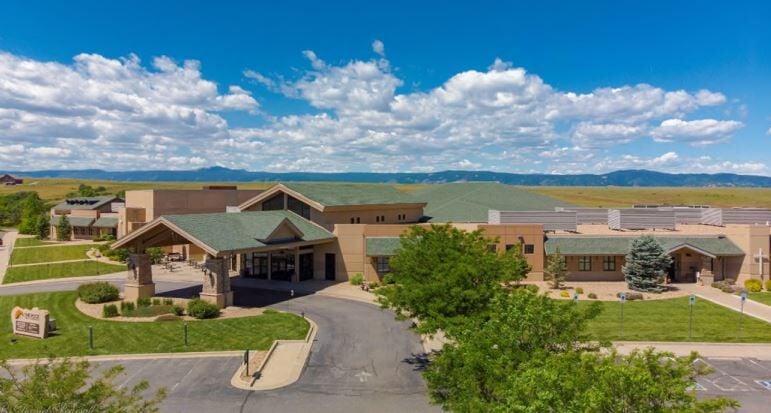
The Rock church in Castle Rock, Colo. Source: Church of The Rock, Inc. v. Town of Castle Rock

The Rock church in Castle Rock, Colo. Source: Church of The Rock, Inc. v. Town of Castle Rock
However, U.S. District Court Judge Daniel D. Domenico voiced his concern that granting a preliminary injunction to the church would mean other religious institutions could disregard zoning restrictions, too. More concretely, exempting two temporary shelters from the zoning code on religious grounds could mean The Rock’s more expansive plans to construct housing on its 54-acre property may also be entitled to a religious exemption.
“There’s a lot more going on. There’s a lot more that your client wants to do with this property,” Domenico told the church’s lawyer. “If I grant this injunction … we’re right back here and I’m telling the town of Castle Rock they have to permit this much bigger project. We’re not just really talking about a couple of families. We’re talking about really changing the nature of what goes on on that property.”
And, he added, “the town can’t do anything about it.”
In the underlying case, The Rock has used its RV and trailer in recent years to temporarily house people who are homeless. The town, responding to complaints from neighbors, told the church Castle Rock’s zoning did not permit RV living.
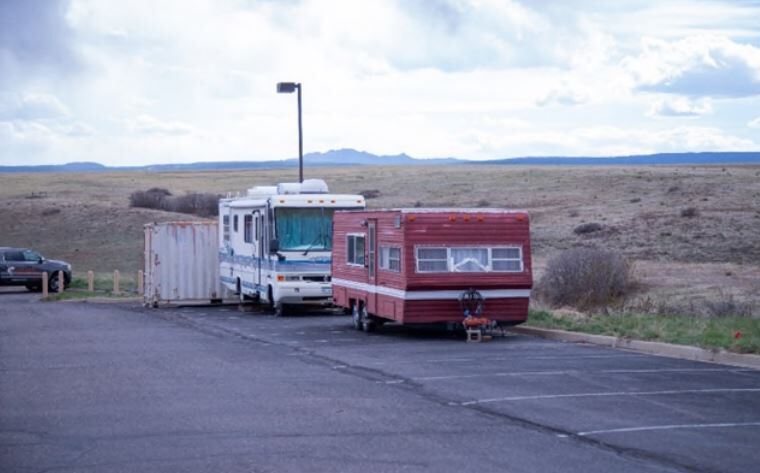
A recreational vehicle and a camping trailer on the grounds of The Rock church in Castle Rock, Colo., which are the subject of a religious freedom challenge. Source: Church of The Rock, Inc. v. Town of Castle Rock

A recreational vehicle and a camping trailer on the grounds of The Rock church in Castle Rock, Colo., which are the subject of a religious freedom challenge. Source: Church of The Rock, Inc. v. Town of Castle Rock
The Rock then filed suit against Castle Rock.
Among other things, it alleged a violation of the Religious Land Use and Institutionalized Persons Act (RLUIPA), a federal law prohibiting any land use regulation that imposes a “substantial burden” on religious exercise. For the government to prevail, it needs to establish a compelling interest and demonstrate the regulation is the least-restrictive method of fulfilling that interest.
Multiple aspects of the lawsuit suggested the eventual audience for its arguments was the Supreme Court. The church’s attorneys included an experienced Supreme Court litigator and the First Liberty Institute, which has brought multiple religious exercise cases to the Supreme Court, including the appeal of a high school coach who wanted to lead prayers publicly after football games.
The church’s lawyers also noted they explicitly sought to overrule a 34-year-old Supreme Court precedent about religious freedom. Although Domenico is bound to follow it, multiple conservative justices have signaled their interest in partially getting rid of Employment Division v. Smith, a 1990 ruling that largely permits courts to uphold generally applicable, religiously neutral laws that happen to impose burdens on religion.
At least three current justices have endorsed the idea that governments should always have to demonstrate a neutral regulation affecting religious exercise is narrowly tailored and furthers a compelling interest — a position The Rock’s lawyers have now teed up should the case get that far.
At the preliminary injunction hearing, Domenico’s main concern with the church’s position was avoiding a cascade of religious institutions seeking further exemptions to the town’s zoning code on the grounds that their religious beliefs were burdened for no compelling reason. At the extreme, he observed, it could mean land use codes may no longer apply to faith houses.
“Why couldn’t you or the next church say, ‘We want 10 RVs’ or ‘We want to build a small apartment building on our property?’ Wouldn’t the principles you’re asking me to apply here require me to allow that, too?” said Domenico, a Donald Trump appointee.
Misha Tseytlin, the church’s lawyer, countered that RLUIPA was “strong medicine” that Congress enacted to provide special protection for faith houses in land use decisions.
“To the extent that some citizens would complain about that, I would tell them that, with all respect, their complaint needs to be to their congressman or their senator or whoever is gonna be president,” Tseytlin said.
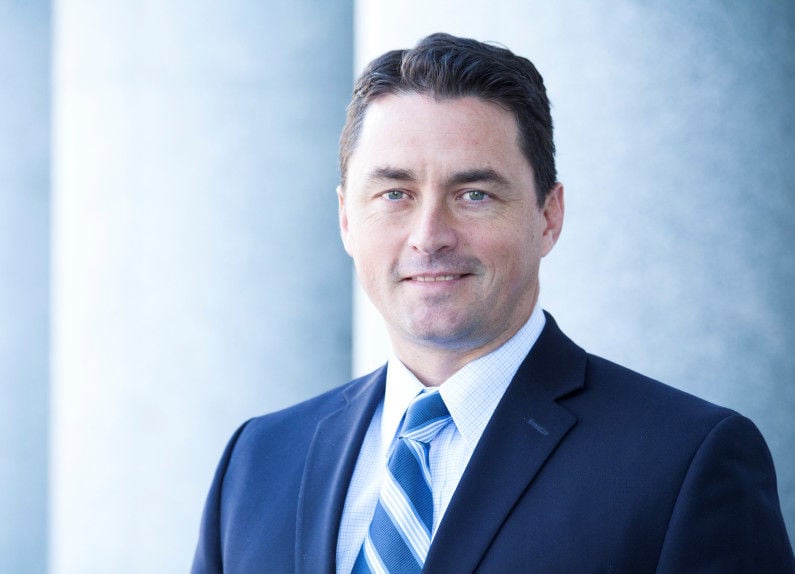
Daniel Domenico.
Colorado Politics file

Daniel Domenico.
The town countered that, if the church wanted to change its zoning to permit residential living, it could simply go through the normal legislative process, rather than immediately resort to a federal lawsuit. Further, the 2003 land annexation agreement between The Rock and the town explicitly contained the church’s acknowledgement that the land use regulations do not impose a substantial burden on religious exercise.
Castle Rock also disputed that the onsite homeless shelters were the only means by which the church could exercise its religious beliefs, considering the RV and trailer did not operate for much of the church’s existence.
“We dispute the sincerity of that. Because if it was sincere, where was that in 2003 when they agreed to the non-residential zoning of their property and they agreed it didn’t interfere with their mission?” argued attorney Geoffrey C. Klingsporn for the town.
Domenico acknowledged the church’s other options for helping families obtain shelter “all seem like great ideas to me. But if they (the church) say, ‘Nope, we feel religiously motivated to use this wonderful property we have for this particular purpose,'” Domenico wondered, “who am I to tell them, ‘No, you should try something else?'”
He added: “Are we gonna have a trial on what the Bible says about people sleeping in RVs on church property? I’m not excited about that prospect.”
The case is Church of The Rock, Inc. v. Town of Castle Rock.

‘I thought I was gonna die;’ JeffCo teen shot in face recounts shooting during trial
Matt Kyle
matt.kyle@denvergazette.com
Updated 1 day ago
A Jefferson County teen who was shot in the face when he and his friend were seeking a spot to take homecoming photos said he believed he was going to die as he recounted the shooting during trial testimony on...

Legislature overrules state Supreme Court decisions, federal judges contend with violations of orders | COURT CRAWL
Michael Karlik
michael.karlik@coloradopolitics.com
Updated 4 days ago
Welcome to Court Crawl, Colorado Politics’ roundup of news from the third branch of government. The Colorado legislature overruled two recent state Supreme Court decisions in this year’s session, plus federal judges are addressing the government’s violations of their orders...
Appeals court reinstates murder case despite ex-DA Linda Stanley’s conduct
Michael Karlik
michael.karlik@coloradopolitics.com
Updated 5 days ago
Colorado’s second-highest court reinstated the murder and child abuse charges on Thursday against a Fremont County defendant, reasoning that the former district attorney’s misconduct did not warrant dismissal of the charges. A judge previously dismissed the criminal case against defendant...

How a CU Boulder law school program helped free a Denver man after 27 years in ‘shaken baby’ murder case
Matt Kyle
matt.kyle@denvergazette.com
Updated 3 days ago
From the first time she looked at Stephen Martinez’s case, Boulder attorney Jeanne Segil knew she had a shot at getting him released from prison. Martinez, 58, spent 27 years behind bars for a crime he now says never happened....
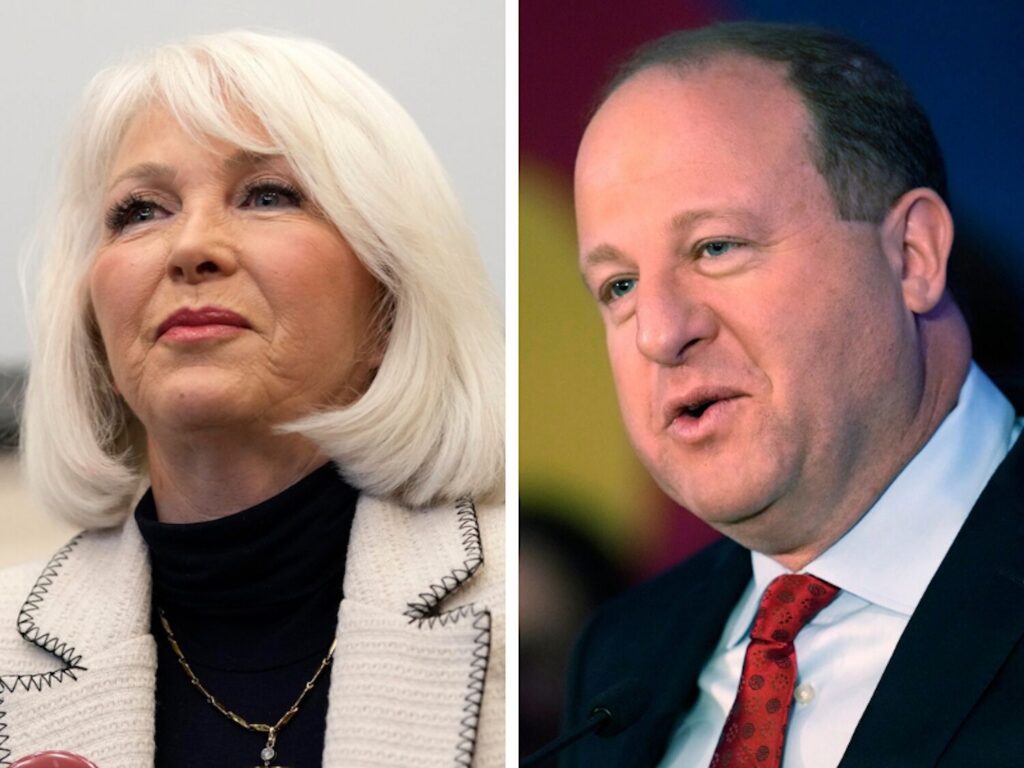
Tina Peters thanks Polis for shortening her sentence, calls Colorado Democrats’ censure a ‘travesty’
Ernest Luning
ernest.luning@coloradopolitics.com
Updated 1 week ago
Two days after the Colorado Democratic Party formally condemned Gov. Jared Polis over his decision last week to shorten Tina Peters’ prison sentence for tampering with election equipment, Peters heaped praise on the term-limited Democrat and slammed his party for...
Federal judge green-lights jury visit to Aurora detention center in forced-labor lawsuit
Michael Karlik
michael.karlik@coloradopolitics.com
Updated 1 week ago
A federal judge granted a request on Thursday to have jurors visit the privately run U.S. Immigration and Customs Enforcement detention center in Aurora as part of an upcoming civil trial over alleged forced labor practices. U.S. District Court Senior...
Federal judges’ responses vary to immigration authorities’ disregard of orders
Michael Karlik
michael.karlik@coloradopolitics.com
Updated 1 week ago
Colorado’s U.S. District Court judges have responded in recent days to the government’s violations of, or unclear compliance with, their orders in immigration detention cases, resulting in directives to immediately free the petitioners. “I’m just struggling to understand how he...
Colorado Supreme Court ditches debt collection case
Michael Karlik
michael.karlik@coloradopolitics.com
Updated 3 days ago
The Colorado Supreme Court declined to rule on Friday in a case questioning the procedure a creditor may use to obtain records from entities related to a debtor, in which the court initially expressed its interest. Joel Farkas is liable...
Colorado Supreme Court to evaluate test for alimony after remarriage
Michael Karlik
michael.karlik@coloradopolitics.com
Updated 3 days ago
The Colorado Supreme Court announced on Monday that it will evaluate whether divorcing spouses must explicitly agree that alimony payments from one partner to the other will continue after one person remarries, or whether a “clear implication” will suffice. The...
Retired Colorado appeals judge speaks about civic advocacy, SCOTUS
Michael Karlik
michael.karlik@coloradopolitics.com
Updated 4 days ago
Retired state Court of Appeals Judge Russell Carparelli offered mild critiques of the U.S. Supreme Court earlier this month as he spoke about the rule of law, and urged lawyers to “get in the game” by advocating in the political...