

As Colorado Supreme Court weighs life without parole for felony murder, ex-lawmaker casts doubt on state’s argument
As the Colorado Supreme Court sits down on Monday to decide whether defendants convicted of felony murder prior to 2021 should receive new sentences less severe than life without the possibility of parole, a key legislative change will play a prominent role in the legal analysis.
However, according to the lawmaker who led the effort to abolish life without parole for felony murder defendants going forward, the government’s opposition to extending relief to those already incarcerated rests on a flawed understanding of what the legislature did three years ago.
Felony murder does not require a person to kill the victim themselves. Instead, a defendant can be guilty of felony murder when they participate in certain serious crimes, such as robbery or sexual assault, and someone dies as a result. Prior to 2021, felony murder was the highest classification of felony, punishable by life in prison without parole.

FILE PHOTO: The State Capitol on Wednesday, Jan. 24, 2024, in Denver. (AP Photo/David Zalubowski)
David Zalubowski/Associated Press

FILE PHOTO: The State Capitol on Wednesday, Jan. 24, 2024, in Denver. (AP Photo/David Zalubowski)
But that year, the legislature enacted Senate Bill 124. The measure reclassified felony murder to a lesser offense after hearing testimony from academics, advocates and even prosecutors that it was unjust to continue mandating the harshest punishment available in Colorado for someone who did not actually pull the trigger or intend for the victim’s death.
#dsk-box-ad-e.new-ad-loading [id*=”-outstream-icon”] {display: none !important;}[id*=”-outstream-icon”],[id*=”-outstream-icon”] > img {width: 24px;height: 24px;display: block;cursor: pointer !important;font-size: 24px !important;line-height: 1 !important;max-width: unset !important;vertical-align: unset !important;box-shadow: unset !important;}[id*=”-outstream-icon”]:hover {filter: drop-shadow(black 0px 0px 6px);}#bottom-controls_videoPlayer_1547 {position: absolute;bottom: 5px;left: 5px;display: grid;grid-template-columns: 24px 24px;}#tpd-volume-control_videoPlayer_1547.muted > #volume-on-outstream-icon_videoPlayer_1547,#tpd-volume-control_videoPlayer_1547:not(.muted) > #volume-muted-outstream-icon_videoPlayer_1547 {display: none;}#tpd-play-pause-control_videoPlayer_1547[playing=”true”] > #click-to-play-outstream-icon,#tpd-play-pause-control_videoPlayer_1547[playing=”false”] > #click-to-pause-outstream-icon {display: none;}@media (max-width: 770px) { #dsk-box-ad-e.new-ad-loading iframe[src],#dsk-box-ad-e.new-ad-loading video {display: none !important;} } #dsk-box-ad-e.new-ad-loading #ad-container_videoPlayer_1547 {background: #5a585830 !important;mask: linear-gradient(315deg, #000 30%, #88888855, #000 70%) right / 350% 100%;animation: tpd-shimmer 1.15s infinite;}@keyframes tpd-shimmer {100% {mask-position: left}}#dsk-box-ad-e:not(.new-ad-loading) {background: black;}#dsk-box-ad-e {opacity: 1;animation-name: fadeInOpacity;animation-iteration-count: 1;animation-timing-function: ease-in;animation-duration: 0.75s;}@keyframes fadeInOpacity {0% {opacity: 0;}100% {opacity: 1;}}#dsk-box-ad-e.new-ad-loading #progress-row_videoPlayer_1547,#dsk-box-ad-e.has-countdown #progress-row_videoPlayer_1547 {display: none;}#progress-row_videoPlayer_1547 {width: 100%;display: block;bottom: 0px;position: absolute;}#dsk-box-ad-e.new-ad-loading #progressLabel-container_videoPlayer_1547 {display: none;}@media (max-width: 770px) { #progressLabel-container_videoPlayer_1547 {display: none;} } #dsk-box-ad-e.has-countdown #progressLabel-container_videoPlayer_1547 {display: none;}#progressLabel-container_videoPlayer_1547 {width: 640px;position: absolute;bottom: 15px;height: 0px;}#progressLabel_videoPlayer_1547 {color: white;font-size: 7pt;font-family: Arial, Sans-Serif;text-align: center;width: fit-content;height: 5px;margin: auto;}#progressBar_videoPlayer_1547 {width: 640px;height: 3px;background-color: lightgray;}#progress_videoPlayer_1547 {height: 100%;background-color: cornflowerblue;width: 0;}#dsk-box-ad-e:not(.replay) #replay-outstream-container_videoPlayer_1547 {display: none !important;}#dsk-box-ad-e.replay #replay-outstream-container_videoPlayer_1547 {display: flex;height: 100%;width: 100%;z-index: 99;position: relative;background: black;}#dsk-box-ad-e.replay #replay-outstream-icon_videoPlayer_1547 {width: 30px;height: 30px;margin: auto;position: relative;background-image: url(‘data:image/svg+xml,%3Csvg fill=”white” height=”30px” width=”30px” xmlns=”https://www.w3.org/2000/svg” viewBox=”0 0 74.999 74.999″ xml:space=”preserve” stroke=”black”%3E%3Cpath d=”M33.511 71.013c15.487 0 28.551-10.563 32.375-24.859h9.113L61.055 22 47.111 46.151h8.006c-3.44 8.563-11.826 14.628-21.605 14.628-12.837 0-23.28-10.443-23.28-23.28 0-12.836 10.443-23.28 23.28-23.28 6.604 0 12.566 2.768 16.809 7.196l5.258-9.108c-5.898-5.176-13.619-8.32-22.065-8.32C15.034 3.987 0 19.019 0 37.5c-.002 18.481 15.03 33.513 33.511 33.513z”/%3E%3C/svg%3E’);}#dsk-box-ad-e.replay #bottom-controls_videoPlayer_1547_videoPlayer_1547,#dsk-box-ad-e.replay [id*=”-outstream-icon”]:not([id^=”replay-outstream-icon”]) {display: none !important;}#dsk-box-ad-e.replay #video-container_videoPlayer_1547 {display: none !important;}#dsk-box-ad-e {margin-left: auto;margin-right: auto;}/* Main Styling */#dsk-box-ad-e.first-render {display: none !important;}#page-content_videoPlayer_1547 {display: inline-block;}#video-container_videoPlayer_1547 {position: relative;}#video-element_videoPlayer_1547 {position: absolute;top: 0;left: 0;}/* Some providers inject their ad content into the video element *//* but if not we hide it. */#video-element_videoPlayer_1547:not([src]) {display: none;}#ad-container_videoPlayer_1547 {position: absolute;top: 0;left: 0;cursor: pointer;}#dsk-box-ad-e,#page-content_videoPlayer_1547,#video-container_videoPlayer_1547,#video-element_videoPlayer_1547,#ad-container_videoPlayer_1547 {width: 640px;height: 360px;}#dsk-box-ad-e div[id*=”google_ads_iframe_”] {width: 640px !important;height: 360px !important;z-index: -1;position: absolute;}
Because lawmakers only applied the change to felony murder convictions going forward, the Supreme Court has elected to answer whether defendants already serving life sentences for felony murder are entitled to reduced sentences — either by finding life without parole categorically unconstitutional or that the sentence is now “grossly disproportionate” in light of current law.
For the Colorado Attorney General’s Office, which opposes the attempt of Wayne Sellers IV to seek a resentencing for his 2019 felony murder conviction, the fact that lawmakers did not extend SB 124 to him and similarly situated defendants was enough to foreclose any relief to their existing lifetime sentences.
“Sellers’s claim that the 2021 change was ‘obviously made’ because the legislature determined that LWOP sentences for felony murder were cruel and unusual punishment is refuted by the fact the changes are not retroactive,” wrote Senior Assistant Attorney General Katharine Gillespie. “If the legislature believed that to be true, it had the authority and knowledge to make the reclassification retroactive.”
Former Sen. Pete Lee, D-Colorado Springs, who sponsored SB 124, told Colorado Politics the government’s argument did not reflect the reality of why existing felony murder defendants were excluded from the change.
“Had I thought the legislature could make the change in the felony murder law retroactive to impact previously sentenced individuals, I would undoubtedly have done so,” he said.

Colorado Sen. Pete Lee talks to Colorado Politics about social and criminal justice in 2018.
Photo by Joey Bunch/Colorado Politics

Colorado Sen. Pete Lee talks to Colorado Politics about social and criminal justice in 2018.
Lee disclosed the existence of a memorandum from the nonpartisan Office of Legislative Legal Services, which Sellers’ attorneys also submitted to the Supreme Court, describing the way criminal sentencing authority is divided among the branches of government by the Colorado Constitution. Specifically, the governor has the power to grant “reprieves, commutations and pardons after conviction.”
“The Colorado Supreme Court has consistently interpreted this provision as resting the power to commute a sentence solely in the prerogative of the Governor and prohibiting either the judicial department or the legislative department from reducing punishment from a greater to a lesser sentence, after the sentence becomes final,” the December 2014 memo noted.
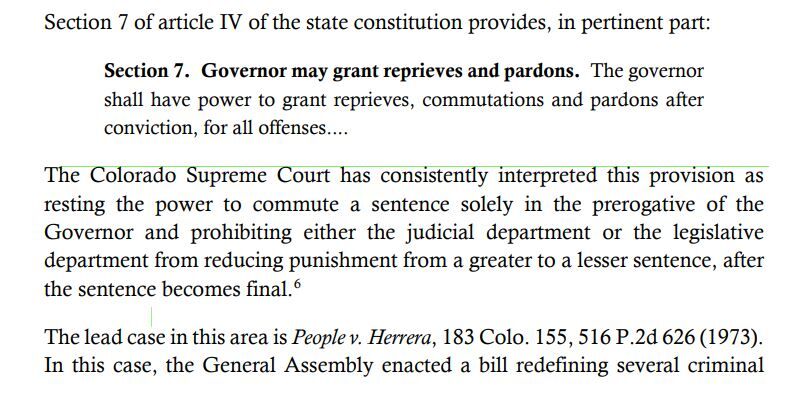
An excerpt of an Office of Legislative Legal Services memo dated Dec. 17, 2014, to then-Rep. Pete Lee, D-Colorado Springs, about criminal sentencing authority within the Colorado Constitution.

An excerpt of an Office of Legislative Legal Services memo dated Dec. 17, 2014, to then-Rep. Pete Lee, D-Colorado Springs, about criminal sentencing authority within the Colorado Constitution.
The document went on to cite the Supreme Court’s 1973 decision of People v. Herrera, in the wake of the General Assembly’s extensive revamp of the criminal code. The court concluded any attempt by the judicial branch to commute a sentence after it is final — even if the legislature grants the authority — would run afoul of the governor’s power.
The government’s argument to the Supreme Court in Sellers’ appeal did not mention Herrera or the 2014 memo. Instead, Gillespie repeatedly noted the legislature deliberately chose not to give current defendants the benefit of a sentence less severe than life without parole.
Lee, however, emphasized the legal guidance he received from legislative staff and the possibility of his bill being declared unconstitutional across the board dissuaded him from expanding relief to defendants like Sellers.
“Yes, of course I believe the Supreme Court should correct the manifest injustice of the disproportionate sentencing in these cases,” he said. “It was my initial goal to do so. But because of my understanding of the separation of powers doctrine, non-partisan staff wrote the bill to apply the bill prospectively.”
An El Paso County jury convicted Sellers for the 2018 murder of Kenyatta Horne. Sellers was part of a group that intended to rob drug dealers the night of the shooting. Although Sellers fired his gun, his bullets did not hit Horne. Another member of the group shot the bullet that killed Horne.
Several outside organizations have weighed in to the Supreme Court, urging the justices to find that Sellers and other non-triggermen convicted before SB 124 are entitled to resentencing, with a maximum of 48 years under the current law.
Life without parole, wrote seven criminal law professors, “is the most severe sentence available under Colorado law. Yet it is being applied to persons convicted of crimes that cannot be considered among the most blameworthy.”


Colorado board permits state to appeal injunction against arthritis drug price cap
Marissa Ventrelli
marissa.ventrelli@coloradopolitics.com
Updated 11 hours ago
A Colorado board voted Friday to allow the Attorney General’s Office to fight an injunction against a price cap on a drug that treats arthritis. A U.S. district court judge had granted the company Amgen a preliminary injunction, temporarily blocking...

Federal judge rejects constitutional claims, ‘expressions of hatred’ by Club Q defendant
Michael Karlik
michael.karlik@coloradopolitics.com
Updated 11 hours ago
A federal judge rejected a defendant’s claims that he received constitutionally ineffective assistance of counsel while facing federal hate crime and firearms charges for murdering five people at a Colorado Springs LGBTQ nightclub in 2022. Anderson Lee Aldrich is serving...

Divided 10th Circuit upholds Colorado congestion fee on car rentals
Michael Karlik
michael.karlik@coloradopolitics.com
Updated 7 hours ago
The Denver-based federal appeals court concluded on Monday that a 2024 “congestion impact fee” that lawmakers imposed on short-term vehicle rentals did not conflict with a federal prohibition on certain airport-related charges. Beginning in the 1970s, Congress began limiting the...
10th Circuit dismisses woman’s lawsuit following 10-year attempt to undo restraining order
Michael Karlik
michael.karlik@coloradopolitics.com
Updated 3 days ago
The Denver-based federal appeals court rejected a woman’s challenge on Friday to a restraining order imposed on her more than a decade ago, finding that she cannot credibly claim she will be prosecuted for violating the restraining order through her...
10th Circuit dismisses woman’s lawsuit following 10-year attempt to undo restraining order
Michael Karlik
michael.karlik@coloradopolitics.com
Updated 4 days ago
The Denver-based federal appeals court rejected a woman’s challenge on Friday to a restraining order imposed on her more than a decade ago, finding that she cannot credibly claim she will be prosecuted for violating the restraining order through her...
Colorado equal pay law does not require plaintiffs to allege gender-based retaliation, appeals court finds
Michael Karlik
michael.karlik@coloradopolitics.com
Updated 3 days ago
The 2019 Colorado law aimed at rooting out pay discrimination on the basis of sex does not require a plaintiff to allege their employer retaliated against them for sex- or gender-related reasons, the state’s second-highest court decided on Thursday. Lawmakers...
Hudson faces lawsuit over ICE detention facility
Nicole C. Brambila
nicole-c-brambila@coloradopolitics.com
Updated 4 days ago
A nonprofit organization filed a lawsuit against the Town of Hudson Wednesday, challenging plans to reopen a former federal prison in the town as a U.S. Immigration and Customs Enforcement detention facility. Together Colorado, along with Janet E. Carlson, filed...
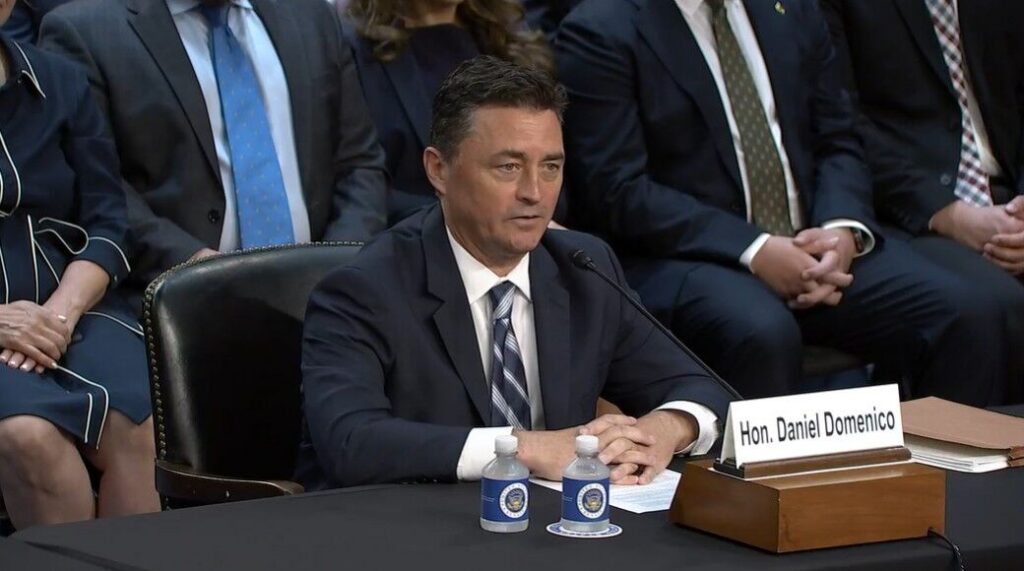
Senate committee advances Trump’s 10th Circuit nominee, as Domenico responds to questions about delays
Michael Karlik
michael.karlik@coloradopolitics.com
Updated 4 days ago
The U.S. Senate Judiciary Committee advanced President Donald Trump’s nominee to the Denver-based federal appeals court on Thursday by a party-line vote of 12-10. U.S. District Court Judge Daniel D. Domenico, who was Trump’s first-term appointee to Colorado’s federal trial...

Colorado justices to hear embryonic donation dispute
Michael Karlik
michael.karlik@coloradopolitics.com
Updated 4 days ago
The Colorado Supreme Court announced on Monday that it will decide whether lower court judges properly applied its framework for adjudicating disputes over the fate of pre-embryos, in which one person wants to use them to become a parent and...

Isolation, emotion, persona: Colorado judicial programming prepares people for life on the bench
Michael Karlik
michael.karlik@coloradopolitics.com
Updated 4 days ago
As a trial judge and now as a member of the Colorado Supreme Court, Justice Carlos A. Samour Jr. has heard the view that being a judge is isolating. “In neither court have I felt isolated. I’ve always interacted a...