

Snowpack is melting faster than expected in southern Colorado, slower in northern Colorado
The water year 2023-24 is showing signs of being one of the warmest on record, according to a state climatologist who presented the latest water data to the state’s water watchers Tuesday. Water years run from Oct. 1 to Sept. 30.
The group, formerly known as the Water Availability Task Force and now known as the Water Conditions Monitoring Committee, also got an update on the status of reservoirs in Colorado, which is quite good compared to previous years.
Russ Schumacher, a state climatologist with the Colorado Climate Center at Colorado State University, said during the meeting that almost everywhere in the state has been in the top 10 of warmest years out of 129 years of recordkeeping.
The exception has been in the central and southern mountains.
But May has made up for a lot of that, with some of the wettest conditions, thanks to big snowfalls in the central mountains in late April and early May. He noted that for Alamosa, for example, May has been the second-wettest month on record. But there’s context to that, Schumacher explained: Alamosa got 1.46 inches of precipitation over a three-day period from May 9 to 11, the second-most on record going back to 1935.
That’s a lot for Alamosa, but Schumacher noted Yuma got at least 2 inches of rain in 20 minutes on Monday.
Warm conditions in southwestern Colorado have meant the snowpack is melting rapidly, according to Brian Domonosko of the Natural Resources Conservation Service with the U.S. Department of Agriculture.
The snowmelt has been ahead of schedule in the southwestern area, which includes the San Juan, San Miguel, Dolores and Las Animas rivers, and for the Rio Grande in the San Luis Valley. The southwest area lost more than 8 inches of snowmelt over 14 days in April, some of the most rapid snowmelt in the past 16 years. The upper Rio Grande similarly experienced rapid snowmelt, losing almost 6 inches of snowmelt in that same 14-day period in April.
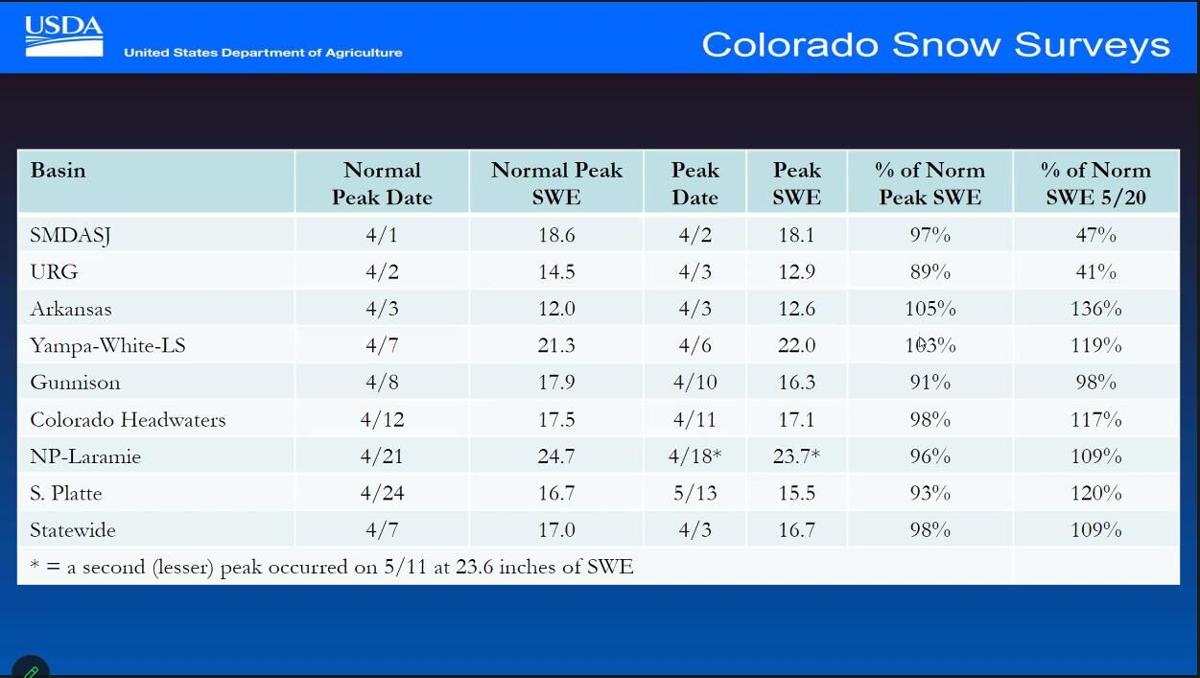
Statewide snow-water equivalent, which shows peak snowmelt.
Courtesy of the Natural Resources Conservation Services, U.S. Department of Agriculture

Statewide snow-water equivalent, which shows peak snowmelt.
Peak snowmelt has been delayed in other parts of the state, due to some of those intense mountain snowstorms in late April and early May, and that meant the peak for the South Platte Basin, for example, was delayed by more than three weeks. The peak was also delayed by three weeks for the North Platte Basin.
The upper Arkansas, for example, regained more than 2 inches of snow water equivalent, a measurement of how much water comes from the snow, in a four-day period in early May. Schumacher said that was the largest four-day increase on record for the Arkansas Basin for this late in the year.
Snowpack statewide is at 109% of median, Domonosko said. He anticipates near normal runoff in the Colorado River Basin, the upper Arkansas and in Northern Colorado.
Colorado is likely headed to a La Niña summer and fall, which means dry conditions for much of the state.
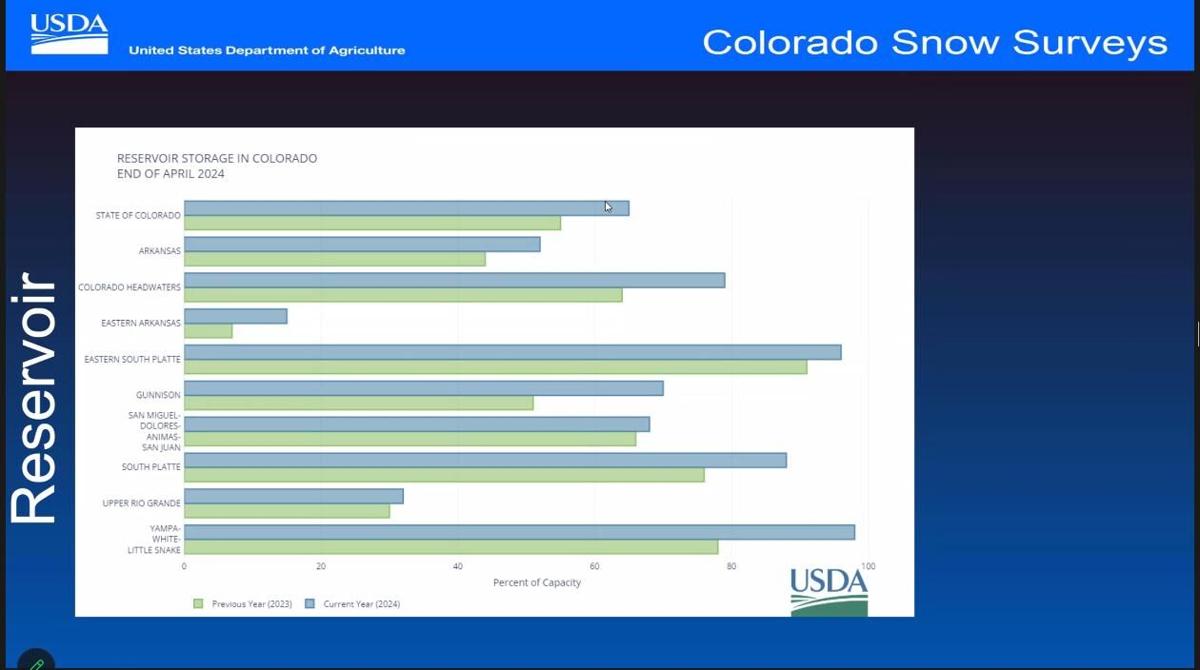
Reservoir storage, however, is well above average, and well above levels even from a year ago. That’s good news for the state’s largest reservoirs, Blue Mesa in Gunnison County and Navajo, which straddles the Colorado-New Mexico border near Durango.

Drought conditions are beginning to creep into the state, with Prowers County, in southeastern Colorado, with the most severe drought conditions statewide.
Overall, about 38% of the state is experiencing low-levels of drought, primarily in the southwest and southeastern plains. But even that news isn’t bad: Much of the state has improved in its drought conditions, save for southeastern Colorado, and in the San Luis Valley, the improvement has been dramatic.
All of those conditions contribute to soil moisture, which is well above average in the San Luis Valley and in southern Park County. Soil moisture, which examines the amount of moisture in soil that isn’t saturated, “plays an important role in agricultural monitoring, drought and flood forecasting, forest fire prediction, water supply management, and other natural resource activities,” according to the U.S. Drought Monitor.


Registered voters on the eve of the 2026 primaries | Cronin & Loevy
Tom Cronin Bob Loevy
tom-cronin-bob-loevy@coloradopolitics.com
Updated 1 day ago
The Colorado Secretary of State’s Office has published the latest voter registration figures for the state and its counties as of June. Colorado ranks among the highest states for independent, or unaffiliated, voters. Only Alaska and Massachusetts have more. New Hampshire, New Jersey, Maine and Oregon also rank highly. So here...
A decade after Standing Rock protests, Dakota Access oil pipeline segment gets OK | OUT WEST ROUNDUP
The Associated Press
the-associated-press@coloradopolitics.com
Updated 4 days ago
NORTH DAKOTA Pipeline segment OK’d BISMARCK — Federal officials on May 21 gave final approval for the Dakota Access oil pipeline to continue operating its contentious Missouri River crossing, an outcome that comes nearly a decade after boisterous protests against...
Rep. Jeff Crank thinks Democrats are too focused on Trump, not enough on Colorado Springs | Vince Bzdek
Vince Bzdek
vince.bzdek@gazette.com
Updated 22 hours ago
For U.S. Rep. Jeff Crank, who’s unopposed in the Republican primary for the 5th Congressional District but the main target of both candidates in the lively Democratic primary, the big question in the midterms is not who will stand up...

Colorado Politics Calendar June 22-28
Rachael Wright, Special to Colorado Politics
rachael.wright@coloradopolitics.com
Updated 4 days ago
CoPo’s weekly political calendar will help you find political and public-policy events throughout Colorado. It includes candidate and issue campaign events, public policy meetings, court hearings, state and local party conventions, assemblies, debates, rallies, parades, speaking engagements, traveling dignitary appearances,...
Vice president attends Denver event to support energy freedom; more news from the past | A LOOK BACK
Rachael Wright, Special to Colorado Politics
rachael.wright@coloradopolitics.com
Updated 4 days ago
Forty-Five Years Ago This Week: Vice President George H.W. Bush flew to Denver to address the annual meeting of the American Association of Petroleum Landmen, where he assured the audience that the Reagan administration’s strong belief was that the private...
Does character matter anymore? | SONDERMANN
By Eric Sondermann
by-eric-sondermann@coloradopolitics.com
Updated 4 days ago
The last few weeks have been illuminating in the manner of a headlamp pointing the way to some deep, dark, murky netherworld. Graham Platner, a hero to the populist set on the Democratic side, became his party’s Senate nominee in...
A special edition of Capitol M: In remembrance of the outrageous Lynn Bartels
Marianne Goodland
marianne.goodland@coloradopolitics.com
Updated 2 days ago
I had Lynn Bartels envy. For almost longer than I can remember. There, I said it. And it’s true. Lynn died Friday, age 69, after a short battle with glioblastoma. I was just heartsick when that news of her diagnosis...

Bernie Sanders endorses DeGette challenger Melat Kiros in Colorado’s 1st CD Democratic primary
Ernest Luning
ernest.luning@coloradopolitics.com
Updated 2 days ago
U.S. Sen. Bernie Sanders on Friday endorsed congressional candidate Melat Kiros, one of two Democrats challenging 15-term U.S. Rep. Diana DeGette in Colorado’s June primary. Sanders, a Vermont independent who caucuses with the Democrats, called the 29-year-old Kiros “exactly the...
Trump’s 10th Circuit nominee recuses from cases against federal government without explanation
Michael Karlik
michael.karlik@coloradopolitics.com
Updated 1 hour ago
President Donald Trump’s nominee to fill a vacancy on the Denver-based federal appeals court recused himself without a clear explanation from nine cases against the executive branch while he was undergoing vetting by the White House this spring. U.S. District...

Trump’s low approval unchanged as Iran war perceptions continue to plague him
Rena Rowe, Washington Examiner
rena.rowe.washington.examiner@gazetteedit.wpenginepowered.com
Updated 2 days ago
A new poll shows most Americans disapprove of President Donald Trump’s handling of Iran, with views on the issue closely mirroring his overall job approval rating. Just 37% of U.S. adults approve of the way Trump is handling his presidency,...