

Surely there’s some health care we can provide for everyone? | BIDLACK
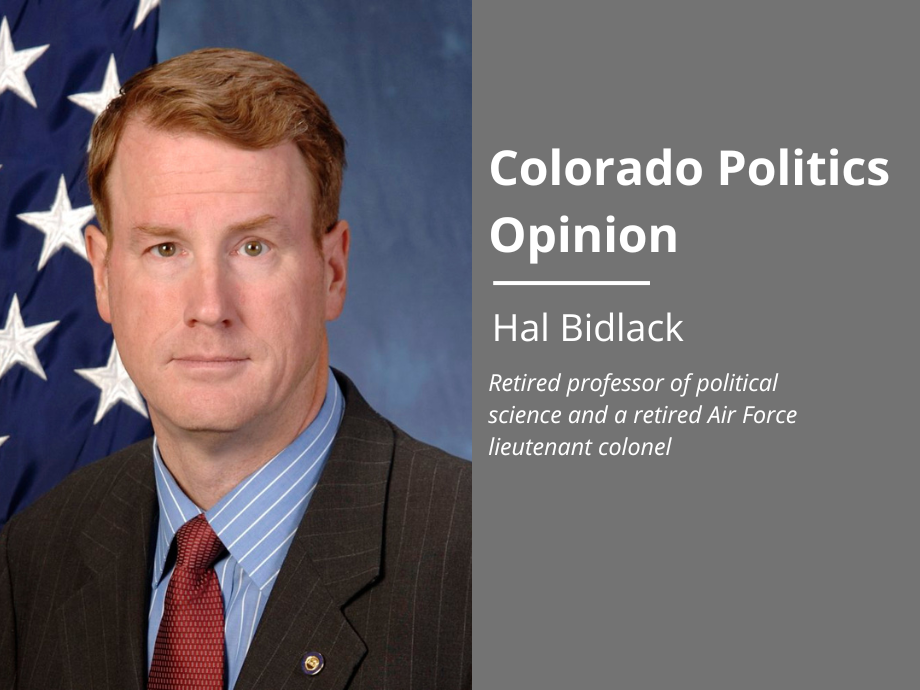
Hal Bidlack

Hal Bidlack
As I type these words, I am four days out from a surgical procedure that, well, lacks dignity and often impacts folks of a certain age, with my 66 years being right in the ballpark. I will, of course, spare you the details, but you should know I am writing my column while taking a narcotic. I still feel quite a bit of pain through, so I’m grouchy. If I seem to drift off into random words or phrases, it’s likely the drug (Editor: gotcha).
But as I lay about feeling the slings and arrows of body parts not there anymore, I admit my mind wanders, and I contemplate the most fortunate decision I ever made. It was 43 years ago this week I loaded up my hand-me-down car, a 1964 Ford Galaxy 500 (watch the “The Andy Griffith Show,” his cop car was one of these) and pointed the nose west toward Vandenberg Air Force (now Space Force) Base, for my 16 weeks of ICBM school. There I learned how to sit nuclear alert with intercontinental missiles. I did that job for four years, and then ended up spending most of my remaining Air Force years at the Air Force Academy, teaching political science and being a military cop, along with stops at the Department of Defense and the State Department, among others.
Stay up to speed: Sign up for daily opinion in your inbox Monday-Friday
Anyway, back to 1981. With the big 8-cylinder engine burning through a gallon of gas every 10 miles or so, I crossed from my home in Michigan to the coast of California. I admit to being quite lonely, missing my then-fiancé, whom I married later that year, and with whom saw three kids born and my career tick along, until the horror that is cancer took her from me after 24 years together.
During her illness, which lasted roughly a year, we fought the disease with every tool modern medicine offered, but ultimately, we were defeated. One of the major issues we faced during her struggle was pain control, and by the time she passed, I acquired a large shoebox full of heavy-duty narcotics which, for one reason or other, hadn’t done the job. We finally had found some narcotics patches that helped quite a bit, and I had some of those left over too.
What does one do with a box of narcotics?
I called around town, and the oncology clinic where she received her chemotherapy treatments readily agreed to take the whole box. The nice nurse told me, when I dropped them off, they would put them in their “indigent’s closet,” to give to cancer patients who otherwise could not afford pain medications.
Please think about that last sentence.
One thing I did not have, either from my recent procedure or any of my late wife’s care, was a bill. As an active-duty military officer, and now as a retiree, I was 100% covered, other than the odd hospital meal from time to time that for some reason wasn’t covered. I would get statements in the mail saying how much the medicine would have cost had the Air Force not covered it, and the numbers were staggering. Remember those pain patches? They cost $250 each, and she wore five of them at once and they lasted two days. Other meds were quite pricey, like the one that boosted red blood cell production, and was more than $1,000 per dose. I’m quite sure her total care was billed at well more than $1 million. But for me, it was free and something I did not have to worry about while caring for her and the kids.
And last Thursday, when I walked out of the Air Force Academy Hospital with my new incision and a bag of various drugs, I just went home. I didn’t have to swing by any cashier’s office. Heck, there isn’t even such an office at that hospital.
It breaks my heart every time I think of the “indigent’s closet,” in that we live in what I truly believe is the greatest country on Earth, yet we have fellow Americans who are in pain because they can’t afford medications. Europeans shake their heads in wonder such a nation does not have some form of national health care.
When I ran unsuccessfully for the U.S. Congress back in 2008, one of my campaign themes (and certainly not original with me) was the idea Americans shouldn’t have to choose between a full refrigerator and a full medicine cabinet. We could, if the national will existed, become a nation like virtually every other advanced nation on the planet, by providing national health care. We are one of roughly 40 nations, out of roughly 200 on the globe, that doesn’t have at least some form of national health care. Heck, Iran has national health care.
Personally, I think the Medicare-for-all idea, slowly introduced by gradually lowering the qualifying age, is the way to go, but I’m also open to any private sector solutions that could actually work. I recall a few years back, the head of a pizza company complained to give his employees health care, he’d have to raise the price of every pizza by 14 cents. Yes, 14 cents! I would be happy to pay that additional cost if it gave some of my fellow American’s health coverage.
I’m realistic, and I know the grip health insurance companies have on our system. But surely we could, as a simple start, find a way to fund pain meds for cancer patients, regardless of their ability to pay? Could anyone be actually opposed to such a measure?
I know I’m again atop my rickety soapbox, but having enjoyed the benefits of a health care system that works, I’m willing to see my taxes rise to help others. We are, I firmly believe, a generous and caring nation at our core. Surely we can do better?
Hal Bidlack is a retired professor of political science and a retired Air Force lieutenant colonel who taught more than 17 years at the U.S. Air Force Academy in Colorado Springs.


Weiser’s leadership crucial for rural win-win | Rachel Gabel
Rachel Gabel
rachel-gabel@coloradopolitics.com
Updated 4 days ago
Attorney General Phil Weiser is going to win the gubernatorial election. That said, Colorado agriculture and rural communities have a 30-year track record of finding the win-win be it for species or industries or habitat. Former Governor Roy Romer possessed...
A Colorado history lesson for Victor Marx | Dick Wadhams
Dick Wadhams
dick-wadhams@coloradopolitics.com
Updated 3 days ago
Victor Marx, who narrowly won the Republican nomination for governor by one half 1% after boasting of a massive 44-point lead, is just as misguided on Colorado political history. During the primary, Marx made a clumsy attempt to denigrate his...
‘Be prepared to march in the streets’ | Miller Hudson
Miller Hudson
miller-hudson@coloradopolitics.com
Updated 3 days ago
It was early in 1974 when I first met Tim Wirth as he announced his candidacy for Congress, challenging Republican incumbent Don Brotzman. Although I had only resided in Colorado two years, I was drafted to serve as a Democratic...

‘CoCo’ would take taxpayers for a ride | Jon Caldara
Jon Caldara
jon-caldara@coloradopolitics.com
Updated 11 hours ago
Colorado wants taxpayers to spend another $4.73 billion on passenger rail. Don’t worry. They have a plan. Which is a little like your brother-in-law announcing he’s launching another exciting restaurant venture after his last three restaurants ended in bankruptcy. Please....
The through line from Donald Trump to Victor Marx | SONDERMANN
By Eric Sondermann
by-eric-sondermann@coloradopolitics.com
Updated 5 days ago
Over 10 years ago, before Donald Trump could ever defeat Hillary Rodham Clinton, he had to first engineer a hostile takeover of the Republican Party. Prior to his descent of that golden escalator, the previous seven Republican presidential nominees had...
Primary voters rejected big money in politics | Paula Noonan
Paula Noonan
paula-noonan@coloradopolitics.com
Updated 3 days ago
While we’re in an election campaign lull between now and Labor Day, we have time to consider the impact of $102 million in campaign contributions in the primary. In the general election, more money will fill candidate campaign coffers, and...
Colorado’s primary proved in this political climate money doesn’t buy electoral happiness | Paula Noonan
Paula Noonan
paula-noonan@coloradopolitics.com
Updated 4 days ago
To catch you up, campaign committees from this 2026 election cycle already collected and shoveled out a lot of cash: $102.64 million. That’s contributions in all forms — dollars, in kind, loans, etc. — from December 2024 to now. Total...
Protecting Colorado from wildfire starts before fire arrives | PODIUM
Colorado Politics
colorado-politics@coloradopolitics.com
Updated 5 days ago
By Rick Cables Colorado is once again being reminded of how significantly wildfires can affect the people and places we love. In southern Colorado, the Aspen Acres fire has burned through the Wet Mountains near Beulah and Rye, quickly becoming...
Stop making business the health care scapegoat | GUEST COLUMN
Colorado Politics
colorado-politics@coloradopolitics.com
Updated 1 week ago
By John Carson It is perhaps a sad commentary in the wake of our nation’s 250th birthday to note even in this hyper-polarized age, one thing nearly every American can agree on is American health care is a mess. But...
Could an independent win CD-1?
Greg Fulton
greg-fulton@coloradopolitics.com
Updated 6 days ago
Turnout in Colorado’s 2026 primary election should concern many citizens. Only 36% of active registered voters participated, meaning a relatively small share of the electorate effectively determined the choices voters will see on the November ballot. Low participation has allowed...