

Polis opposes DOD proposal to unilaterally move space-focused National Guard units
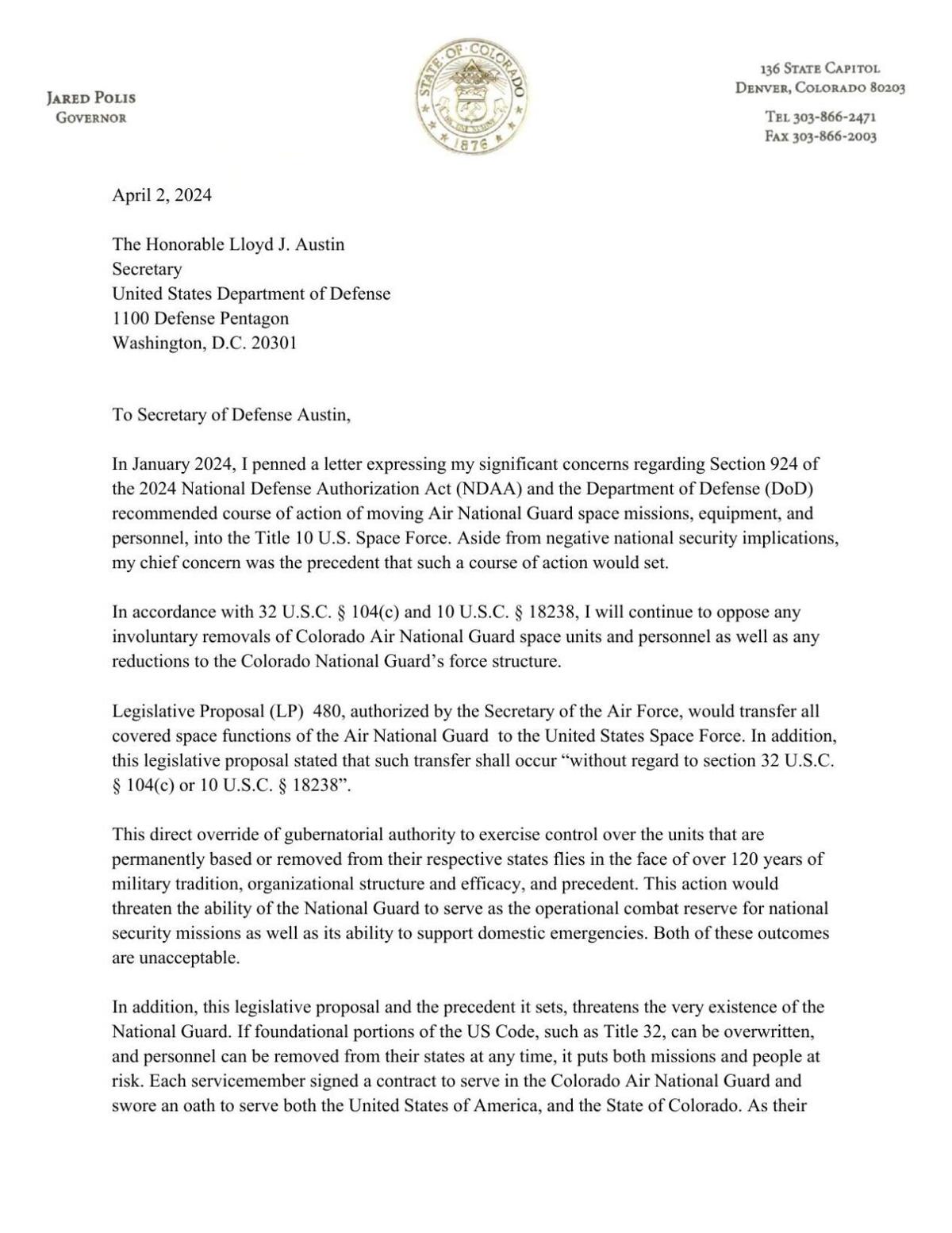
Gov. Jared Polis is pushing back against legislation proposed by the Department of Defense to transfer space-focused Air National Guard units into the active duty Space Force without the consent of governors who oversee the units.
The potential transfer of 14 space-focused units, including seven in Colorado, to the Space Force is also expected to spark many resignations among guardsman, based on survey data provided by the Colorado Department of Military and Veteran Affairs, which oversees the Colorado guard. The February poll showed that 60% to 86% of guardsmen would leave rather than transfer, leaving a major gap in expertise, said Parker White, spokesman for the Colorado agency.
Colorado units work in critical areas including satellite jamming, a capability used to deny enemy fighters GPS signals or communications.
Proposed Space National Guard sidelined in new military spending bill
In a Tuesday letter to Secretary of Defense Lloyd Austin, Polis strongly opposed the legislation because it completely sidelines the governors who are tasked with overseeing National Guard units and it would hurt national security.
“I cannot stand idly by as the servicemembers I am charged with leading are faced with the decision to either leave military service, or serve in a manner that they did not originally agree to,” Polis wrote. “We know that a significant majority of Air National Guard space operators will not transfer to the U.S. Space Force, putting both their military career and national security at risk.”
He went on to say it would have “broader detrimental philosophical implications to the very role of the National Guard, gubernatorial authority therein, and the continued existence of state-based citizen servicemembers.”
Overriding governors’ authority of national guard units would go against 120 years of military structure, he said.
The secretary of the Air Force’s press desk has not responded to a request for comment on Polis’ concerns.
U.S. Rep. Jason Crow, D-Aurora, said in a statement he will also oppose the proposal that originated with the Air Force.
“I have led efforts in Congress to create a Space National Guard because it’s the best approach to safeguard Colorado’s service members and protect national security and workforce readiness. The Air Force’s proposed approach that strips governor authority over the National Guard personnel performing space missions is the wrong move. I will be working in Congress and with the states impacted by this proposal to move it in the right direction,” he said.
The other states with space-focused National Guard missions are Alaska, California, Florida, Hawaii, New York and Ohio.
Space Force Gen. Chance Saltzman, chief of space operations, has promoted the integration of part-time employees into the Space Force. He has termed it a single-component model, which would be new to the military. He said it would allow the space guardians to hold civilians jobs as they go in the National Guard.
Under the new model, the Air Force Reserve’s 310th Space Wing housed at Schriever Space Force Base is slated to be absorbed into the Space Force.
The National Guard Association and lawmakers from states with space-focused units have advocated for a stand-alone Space National Guard, which would allow service members to continue to work in place and preserve their expertise.
Sen. Marco Rubio introduced the latest bill to create a Space National Guard in January. It could compete against the DOD proposal for inclusion in the annual National Defense Authorization Act, a must-pass bill.
Colorado units ‘orphaned’ amid Space National Guard debate
The National Guard Bureau estimates it would take up to nine years and as much as $1 billion to replace those who plan to quit, according to a news release from the National Guard Association.
The wrangling over a Space National Guard has largely hinged on disagreements about how much it could cost. The Biden administration has sided against the idea because of the additional overhead and bureaucracy.
The most recent National Defense Authorization Act called for a study into the different options for handling the space-focused units that were left behind in an Air Force no longer technically responsible for training or equipping them.
The secretary of the Air Force’s press desk did not immediately respond to questions about whether the study is complete.

Tiered or capped? Battle over Colorado’s income taxes might come down to one number
Marianne Goodland
marianne.goodland@coloradopolitics.com
Updated 4 hours ago
The battle between two competing ballot measures — one seeking to cap Colorado’s income tax rate, the other pushing for a tiered system depending on income levels — might come down to whichever ballot proposal gets one more vote. The...
10th Circuit says landowner cannot sue ex-Routt County judge for statements in decision
Michael Karlik
michael.karlik@coloradopolitics.com
Updated 7 hours ago
A Routt County landowner cannot sue a former judge for his allegedly inaccurate statements in a case where the landowner was not a party, the Denver-based federal appeals court decided on Wednesday. Anne Fitzsimmons, who lives in Germany, owns a...
Rubio crushes Vance in Western Conservative Summit 2028 straw poll
Kiara Moore
kiara.moore@washingtonexaminer.com
Updated 10 hours ago
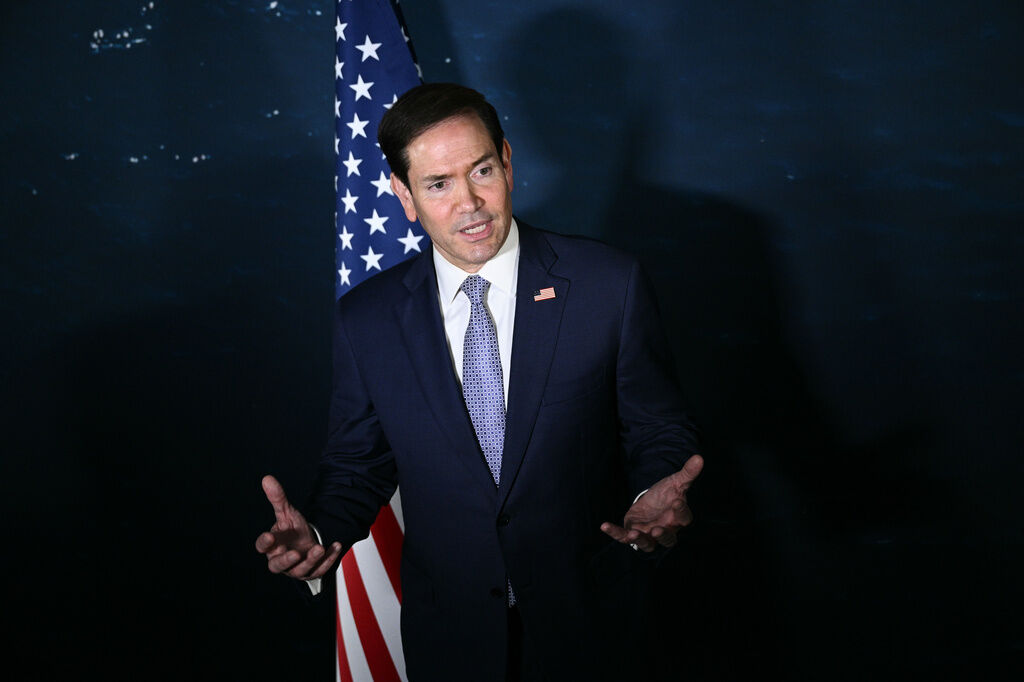
Secretary of State Marco Rubio came out on top in this past weekend’s nonpartisan straw poll at the Western Conservative Summit, outpacing a packed field of would-be 2028 presidential hopefuls. Hosted by the Centennial Institute, Colorado Christian University’s public policy...

Supreme Court to open next term with major climate change case
Jack Birle
jack-birle@coloradopolitics.com
Updated 10 hours ago
The Supreme Court’s next term will begin in October with major cases about costly climate change lawsuits and immigration. The high court announced the cases it will hear in the first month of its upcoming term, as the justices remain...

New Colorado laws going into effect cover AI disclosures, medical marijuana access and gambling limits
Marissa Ventrelli
marissa.ventrelli@coloradopolitics.com
Updated 11 hours ago
More than 100 new Colorado laws take effect Aug. 12, bringing changes to chatbot safety rules, psychedelic research, campus wellness checks and sports betting restrictions. Here is a look at some of those laws set to take effect. The law:...

National House Democrats add Colorado seats held by Lauren Boebert, Jeff Hurd to target list
Ernest Luning
ernest.luning@coloradopolitics.com
Updated 8 hours ago
The national House Democrats’ campaign arm on Wednesday added the Colorado congressional district held by Republican U.S. Reps. Jeff Hurd and Lauren Boebert to the list of targeted seats the party believes are vulnerable in this year’s midterms. The Democratic...

Bennet settles campaign finance complaints, admits violating state law
Marianne Goodland
marianne.goodland@coloradopolitics.com
Updated 6 hours ago
U.S. Sen. Michael Bennet’s gubernatorial campaign has agreed to pay a $7,433 fine for using his Senate campaign account to pay for gubernatorial campaign travel expenses. The July 31 settlement includes an admission by Bennet and his campaign that they...

Colorado to implement new laws on jail standards, safe haven rules, and agricultural labeling
Marissa Ventrelli
marissa.ventrelli@coloradopolitics.com
Updated 12 hours ago
In mid-August every year, a slew of recently passed laws in Colorado go into effect 90 days after the end of the legislative session. This year, all bills without a specified effective date or safety clause — a provision stating...
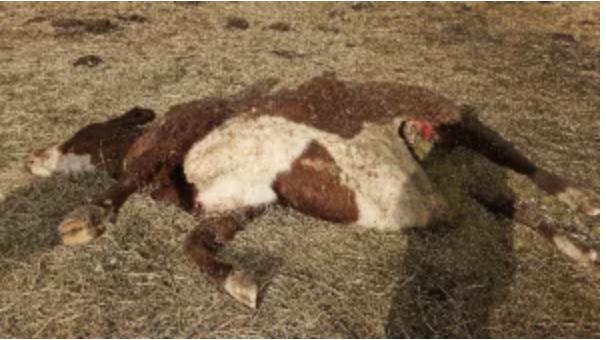
Colorado records 17th wolf death, a yearling tied to livestock losses
Marianne Goodland
marianne.goodland@coloradopolitics.com
Updated 8 hours ago
A yearling male wolf in Grand County has become the 17th wolf to die in Colorado in the past two years. Colorado Parks and Wildlife announced that its staff killed the wolf on Aug. 4 because it was believed to...
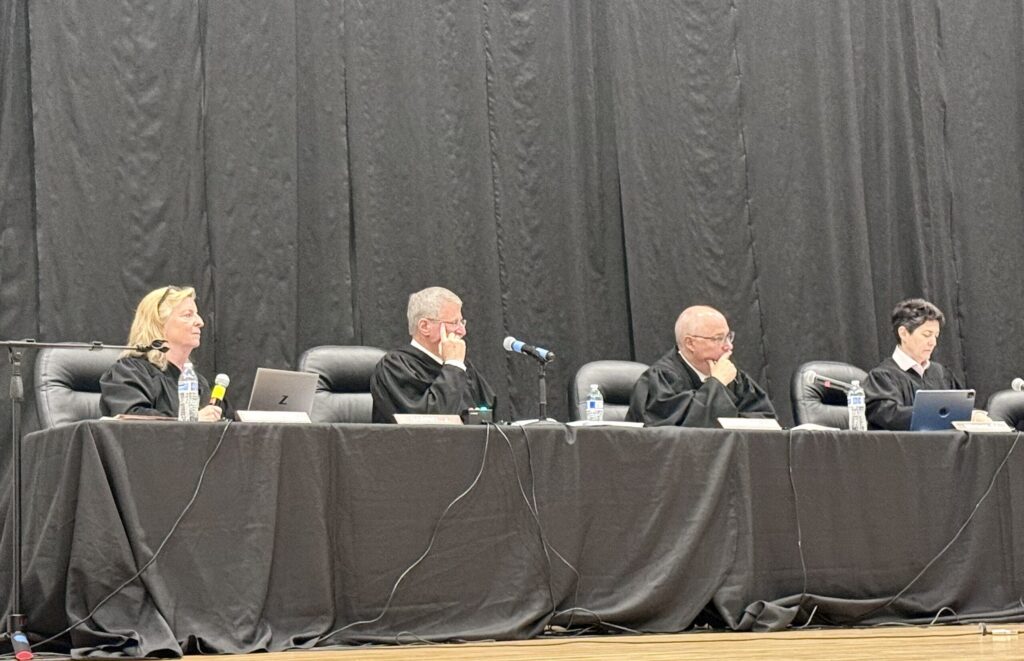
Parole, appeals deadlines and restitution: Colorado justices accept cases
Michael Karlik
michael.karlik@coloradopolitics.com
Updated 1 day ago
The Colorado Supreme Court announced on Monday that it will determine how a defendant’s parole-eligibility date should be calculated in instances where a new trial results in a sentence being imposed retroactively to the date of the original, since-overturned sentence....
PREV
PREVIOUS

Polis opposes DOD proposal to unilaterally move space-focused National Guard units
Gov. Jared Polis is pushing back against legislation proposed by the Department of Defense to transfer space-focused Air National Guard units into the active duty Space Force without the consent of governors who oversee the units. The potential transfer of 14 space-focused units, including seven in Colorado, to the Space Force is also expected to […]
Colorado Senator Faith Winter to seek treatment for alcohol use, checking in to rehab
Sen. Faith Winter, D-Westminster, is entering a rehab facility tied to alcohol use, according to multiple sources. Winter, who is in her second and final term in the state Senate, has been battling a number of health issues, including an auto-immune disorder, over the past year. She also suffered a traumatic brain injury last year […]