

Divided appeals court upholds Denver child sex assault conviction

Colorado’s second-highest court upheld a man’s sex assault conviction earlier this month, although there was disagreement between appellate judges about whether jurors properly evaluated damaging evidence of the defendant’s conduct in light of his unusual defense at trial.
A Denver jury convicted Mohammed Diawarra in 2021 for sexual assault on a child after he impregnated an 11-year-old girl. Diawarra made multiple claims on appeal, including that his Sixth Amendment right to a public trial was violated when the trial judge excluded one person from the courtroom.
Diawarra’s trial took place amid continued COVID-19 precautions, including limitations on in-person attendance. Although a social worker who had been helping Diawarra wanted to attend, as well as the social worker’s intern, District Court Judge Ericka F.H. Englert decided the intern could not be in the courtroom.
The U.S. Supreme Court has recognized that judges may close their courtrooms under specific conditions, and they can even enact a “partial” closure excluding a small number of people. Moreover, the Colorado Supreme Court has ruled that some courtroom closures are “trivial” and do not affect the underlying protections of the public trial guarantee.
Initially, a three-judge appellate panel released its decision in Diawarra’s case in December, finding Englert’s exclusion of the intern did not amount to a courtroom closure because the intern could still watch the trial over a livestream. However, after being asked to reconsider its analysis, the panel released a modified opinion on Feb. 8 and softened its position.
If the intern’s exclusion amounted to a courtroom closure, clarified Judge Terry Fox, the pandemic protocols and the availability of the livestream rendered it trivial.
“While the closure lasted for the duration of the trial, it was a partial closure that only applied to one person,” she wrote. “Importantly, the social worker remained, reminding all parties of their important function during the trial. The closure, while intentional, was for a good reason: public safety in the wake of the COVID-19 pandemic.”
Case: People v. Diawarra
Decided: December 28, 2023 and February 8, 2024
Jurisdiction: Denver
Ruling: 2-1
Judges: Terry Fox (author)
Neeti V. Pawar
Michael H. Berger (dissent)
But the panel diverged on another of Diawarra’s grounds for appeal: Englert’s decision to admit evidence that Diawarra molested his victim on multiple occasions apart from his act of impregnating her.
Englert allowed the evidence of Diawarra’s uncharged misconduct under a legal procedure the Colorado Supreme Court has since abolished. The justices’ concern was that uncharged acts, while sometimes relevant, were turning into a “shortcut” for illustrating a defendant’s bad character to the jury.
Now, judges must instruct juries they are limited in how they can incorporate other-acts evidence in their decision-making.

The Court of Appeals maintained the evidence of Diawarra’s “grooming” behavior was relevant to his unusual defense at trial. Because there was no dispute he impregnated his child victim, Diawarra instead argued the victim’s mother forced him at knifepoint to have sex with the girl.
Fox, writing for herself and Judge Neeti V. Pawar, concluded the grooming incidents could naturally contradict Diawarra’s defense.
“Its logical relevance was therefore that he likely had sexual intercourse with her because he wanted to, not because he was forced to at knifepoint,” she wrote.
It was true, Fox conceded, there was a risk jurors could have concluded Diawarra had bad character and convicted him on that basis after hearing the evidence. But to her, it was more likely jurors used the information to determine Diawarra was not under duress when he assaulted the child.
“The improper use of that evidence (proving Diawarra’s bad character) was less obvious,” she added.
Judge Michael H. Berger dissented. He agreed the grooming evidence was fair game for discrediting Diawarra’s defense. Yet, was not convinced the jury only used the evidence for that purpose due to the lack of any limitation by the trial judge.
“The question is difficult and close but, in the end,” Berger wrote, jurors “could have found that Diawarra was a morally bereft person precisely because of the other act evidence and, because he lacked moral character, rejected his duress defense.”
Because Englert did not provide guardrails for how the jury should use the evidence, Berger indicated he would have ordered a new trial for Diawarra.
The case is People v. Diawarra.


Federal judge green-lights civil trial against ex-Fort Collins DUI officer
Michael Karlik
michael.karlik@coloradopolitics.com
Updated 16 hours ago
A federal judge ruled on Thursday that Fort Collins’ former “DUI officer” will face a civil trial for allegedly investigating a motorist for impaired driving without any reasonable suspicion to do so. In recent years, several people arrested by Officer...

Colorado Supreme Court suspends Mesa County judge pending misconduct investigation
Michael Karlik
michael.karlik@coloradopolitics.com
Updated 20 hours ago
The Colorado Supreme Court suspended Mesa County Court Judge Michael J. Grattan on Thursday amid a misconduct investigation. The court’s Sept. 10 order gave Grattan 21 days to explain why his paid suspension should not continue through the end of...
Colorado Supreme Court changes course, dismisses case about special district bonds
Michael Karlik
michael.karlik@coloradopolitics.com
Updated 15 hours ago
The Colorado Supreme Court declined on Friday to decide a dispute between a large-scale Commerce City development and the various districts financing it, after initially showing interest in the ongoing case. Colorado has roughly 2,800 special districts, which are local...
10th Circuit tosses GEO Group’s pretrial appeal in human trafficking lawsuit
Michael Karlik
michael.karlik@coloradopolitics.com
Updated 1 day ago
The Denver-based federal appeals court dismissed an attempt by The GEO Group on Wednesday to appeal a trial judge’s non-existent decision two months before the company is scheduled to face a civil trial over alleged trafficking violations at the Aurora...
Denver sues Trump to block armed ICE agents from polling sites
Deborah Grigsby
deborah.smith@denvergazette.com
Updated 2 days ago
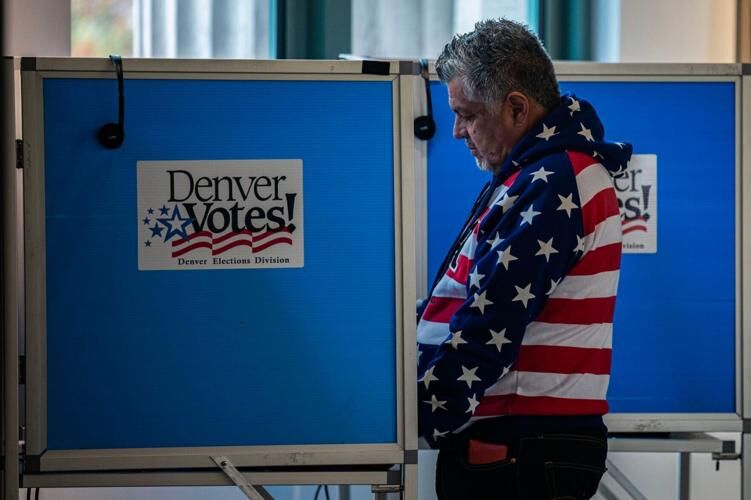
The city of Denver, along with several groups, sued the Trump administration Thursday, seeking to block U.S. Immigration and Customs Enforcement officers who are armed from polling sites during the upcoming midterm elections. In fact, there are no official orders...
Federal judge takes no action against ICE in Colorado after hearing about mistakes, not ‘blatant violations’
Michael Karlik
michael.karlik@coloradopolitics.com
Updated 13 hours ago
A federal judge declined to take action against U.S. Immigration and Customs Enforcement on Thursday after hearing that a pattern of alleged lawbreaking amounted to mistakes and a misunderstanding of the government’s position in court. For nearly a year, Colorado’s...
Colorado doctors, dentists challenge state law on gender‑transition services in new federal lawsuit
Marissa Ventrelli
marissa.ventrelli@coloradopolitics.com
Updated 10 hours ago
A group of Christian doctors and dentists has filed a federal lawsuit challenging a Colorado law they say requires them to provide gender‑transition services that conflict with their religious and ethical beliefs. The lawsuit, filed by the Christian Medical and...
Federal judge directs plaintiff to revise complaint alleging Denver officers’ constitutional violations
Michael Karlik
michael.karlik@coloradopolitics.com
Updated 15 hours ago
A federal judge directed a plaintiff to revise his allegations on Wednesday to more precisely state what two Denver officers and the city itself allegedly did to violate his constitutional rights by facilitating his prosecution for murder until prosecutors dropped...
Lawsuit challenges Douglas County commissioners’ ballot actions
Nicholas Fogleman
nicholas.fogleman@denvergazette.com
Updated 2 days ago
A new lawsuit against Douglas County commissioners seeks to invalidate the board’s intervention in efforts to expand the commission from three members to five and restore the original ballot language approved by more than 20,000 petition signers. The suit marks...
Federal judge explores new sanctions against ex-Colorado judicial discipline director
Michael Karlik
michael.karlik@coloradopolitics.com
Updated 2 days ago
A federal judge on Wednesday directed Colorado’s former judicial discipline director, for the third time this year, to explain why she should not sanction him for his latest conduct in his litigation against the state’s judiciary. Christopher S.P. Gregory, who served...
PREV
PREVIOUS

Colorado lawmakers discuss funding AI software to detect guns in schools
A proposal seeks to prevent shootings by providing schools with funding to acquire, install and operate AI-driven software that – the company behind the technology claims – can detect guns and alert law enforcement within seconds of the weapon’s detection. The Colorado House Education Committee discussed the measure without voting on Wednesday. Sponsored by Rep. Brandi Bradley, […]

Colorado Senate panel rejects Gov. Jared Polis' nominees to wildlife commission
Last year, Gov. Jared Polis appointed three people – allegedly with ties to the animal rights community – to the state’s parks and wildlife commission But those nominees still had to go through a confirmation process with the state Senate, and on Thursday, the Senate Agriculture and Natural Resources Committee rejected two of the three, claiming they […]