

Colorado justices deal blow to urban renewal authorities’ revenue

The Colorado Supreme Court on Monday sided with an interpretation of state law that will result in more revenue going to local governments from urban renewal zones and less money for the entities overseeing redevelopment of those areas.
In a case arising from Arapahoe County, the court addressed the division of property tax revenue from blighted areas designated for “urban renewal.” A portion of the tax revenue in such zones is earmarked for development itself – and the investors who purchase bonds – with the remainder going to schools and counties.
Although the Aurora Urban Renewal Authority argued, and the state’s Court of Appeals agreed, that Colorado’s property tax administrator exceeded her authority by letting local governments reap the benefits of increased property values from general market conditions, the Supreme Court saw no problem with that arrangement.
Justice Maria E. Berkenkotter clarified in the Jan. 22 opinion that it is logical for urban renewal authorities to receive increased property tax revenue only when their own redevelopment activities contribute to the enhanced property values. Otherwise, those entities could do nothing and still benefit from a rising market.
“Put another way,” she wrote, “the Administrator’s methodology is aimed at ensuring that an urban renewal authority receives only property tax revenues produced as a result of its actual urban renewal projects – not simply its urban renewal plans.”

The controversy attracted significant attention from outside groups, with Colorado’s counties arguing their tax revenues could be siphoned off to urban renewal projects even when broader market forces are responsible for a rise in property values. The municipal bond industry, meanwhile, warned that giving counties and school districts a larger share of tax revenues from urban renewal zones would deter investment in blighted areas.
In a system known as tax increment financing, urban renewal areas contain a base value and an “increment.” Broadly, the base is the blighted property’s valuation before the implementation of an urban renewal plan. Tax revenues from the base value are paid to local governments.
The increment is the value attributable to the urban renewal plan and the development that occurs because of it. For 25 years, increases in property value through the increment accrue to the urban renewal authority. Downtown Golden, Denver’s Central Park neighborhood, and the Anschutz Medical Campus in Aurora are among the projects completed under Colorado’s urban renewal framework.

However, Colorado’s urban renewal law requires that when a local assessor routinely revalues property, the base value and the increment are “proportionately adjusted.” The law does not specify what that means, but rather leaves it to the judgment of the state’s property tax administrator, JoAnn Groff.
Under Groff’s regulations, increases in a property’s value that go toward the increment – and to urban renewal authorities instead of counties – must be attributable to changes at property itself. But for any increase in value from “market perceptions” that properties are “more or less desirable” because they are in an urban renewal area, the tax revenue is split between the base and the increment.
Or, in other words, between counties and urban renewal authorities.
In January 2022, a three-judge panel of the Court of Appeals sided with the Aurora Urban Renewal Authority in its challenge to the regulations, with the panel’s majority calling them a “virtual defunding” of urban renewal projects.
Judge David H. Yun dissented, believing Groff’s method was legally sound. The majority, he warned, “crosses the line into the area of public policy” by striking it down.
On appeal, Groff and Arapahoe County’s assessor, PK Kaiser, argued market-based adjustments going proportionally to the base and the increment made sense to prevent urban renewal authorities from sitting on land, not developing it, yet earning tax revenue from increases in value that would have happened anyway.
Berkenkotter, in the Supreme Court’s opinion, acknowledged there may be a better way to allocate property tax revenues between local governments and urban renewal authorities in order to preserve the incentives for redeveloping blighted property.
But “Colorado’s TIF scheme is not intended to advance redevelopment at all costs,” she wrote, referring to tax increment financing. Instead, the goal is “to strike a balance between funding redevelopment and funding other important services, like fire protection and schools.”
Because the legislature left it to Groff’s discretion to allocate changes in property values, the court upheld her regulations. The regulations reflect the “direct relationship” between an urban renewal authority’s actual development and the revenue it receives, Berkenkotter added.
Groff declined to comment on the decision. Aurora and the Arapahoe County assessor did not respond to emails about the ruling.
The case is Kaiser et al. v. Aurora Urban Renewal Authority et al.


Federal judge green-lights civil trial against ex-Fort Collins DUI officer
Michael Karlik
michael.karlik@coloradopolitics.com
Updated 24 hours ago
A federal judge ruled on Thursday that Fort Collins’ former “DUI officer” will face a civil trial for allegedly investigating a motorist for impaired driving without any reasonable suspicion to do so. In recent years, several people arrested by Officer...

Colorado Supreme Court suspends Mesa County judge pending misconduct investigation
Michael Karlik
michael.karlik@coloradopolitics.com
Updated 24 minutes ago
The Colorado Supreme Court suspended Mesa County Court Judge Michael J. Grattan on Thursday amid a misconduct investigation. The court’s Sept. 10 order gave Grattan 21 days to explain why his paid suspension should not continue through the end of...
Colorado Supreme Court changes course, dismisses case about special district bonds
Michael Karlik
michael.karlik@coloradopolitics.com
Updated 26 minutes ago
The Colorado Supreme Court declined on Friday to decide a dispute between a large-scale Commerce City development and the various districts financing it, after initially showing interest in the ongoing case. Colorado has roughly 2,800 special districts, which are local...
10th Circuit tosses GEO Group’s pretrial appeal in human trafficking lawsuit
Michael Karlik
michael.karlik@coloradopolitics.com
Updated 2 days ago
The Denver-based federal appeals court dismissed an attempt by The GEO Group on Wednesday to appeal a trial judge’s non-existent decision two months before the company is scheduled to face a civil trial over alleged trafficking violations at the Aurora...
Denver sues Trump to block armed ICE agents from polling sites
Deborah Grigsby
deborah.smith@denvergazette.com
Updated 2 days ago
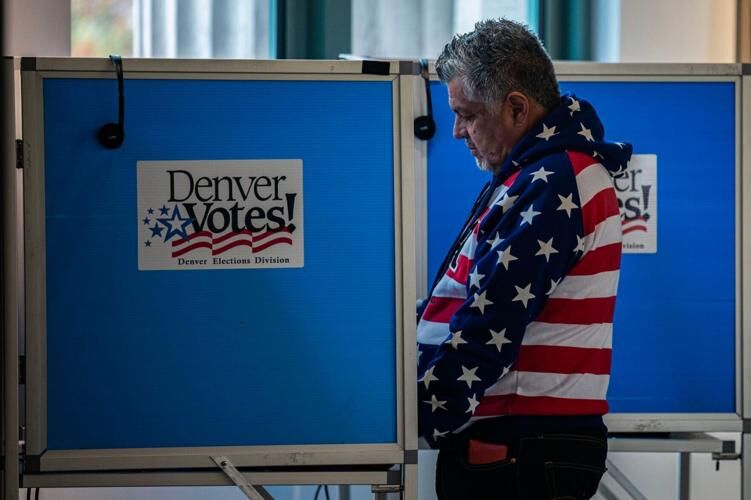
The city of Denver, along with several groups, sued the Trump administration Thursday, seeking to block U.S. Immigration and Customs Enforcement officers who are armed from polling sites during the upcoming midterm elections. In fact, there are no official orders...
Federal judge takes no action against ICE in Colorado after hearing about mistakes, not ‘blatant violations’
Michael Karlik
michael.karlik@coloradopolitics.com
Updated 21 hours ago
A federal judge declined to take action against U.S. Immigration and Customs Enforcement on Thursday after hearing that a pattern of alleged lawbreaking amounted to mistakes and a misunderstanding of the government’s position in court. For nearly a year, Colorado’s...
Colorado doctors, dentists challenge state law on gender‑transition services in new federal lawsuit
Marissa Ventrelli
marissa.ventrelli@coloradopolitics.com
Updated 18 hours ago
A group of Christian doctors and dentists has filed a federal lawsuit challenging a Colorado law they say requires them to provide gender‑transition services that conflict with their religious and ethical beliefs. The lawsuit, filed by the Christian Medical and...
Federal judge directs plaintiff to revise complaint alleging Denver officers’ constitutional violations
Michael Karlik
michael.karlik@coloradopolitics.com
Updated 22 hours ago
A federal judge directed a plaintiff to revise his allegations on Wednesday to more precisely state what two Denver officers and the city itself allegedly did to violate his constitutional rights by facilitating his prosecution for murder until prosecutors dropped...

Lawsuit challenges Douglas County commissioners’ ballot actions
Nicholas Fogleman
nicholas.fogleman@denvergazette.com
Updated 2 days ago
A new lawsuit against Douglas County commissioners seeks to invalidate the board’s intervention in efforts to expand the commission from three members to five and restore the original ballot language approved by more than 20,000 petition signers. The suit marks...
Federal judge explores new sanctions against ex-Colorado judicial discipline director
Michael Karlik
michael.karlik@coloradopolitics.com
Updated 32 minutes ago
A federal judge on Wednesday directed Colorado’s former judicial discipline director, for the third time this year, to explain why she should not sanction him for his latest conduct in his litigation against the state’s judiciary. Christopher S.P. Gregory, who served...
PREV
PREVIOUS

Colorado Supreme Court upholds ability of defense lawyers to abandon clients' claims without consent
The Colorado Supreme Court made it easier on Monday for criminal defense lawyers seeking postconviction relief on behalf of their clients to abandon any claims they wish, even over the client’s objection. Noting courts have long treated trial lawyers as the “captain of the ship,” the Supreme Court clarified that defense attorneys appointed to pursue […]

Army veteran who was college football's oldest player joins GOP primary in Colorado's 5th CD
The Army combat veteran who recently held the distinction of being the oldest Division I player in college football – while still in uniform – wants to represent Colorado’s 5th Congressional District. Joshua Griffin, a Fountain Republican, joined the crowded primary last week for the El Paso County-based seat occupied by retiring Republican U.S. Rep. […]