

Arapahoe County jurors disregarded instructions, gave incoherent murder verdict, appeals court finds

Colorado’s second-highest court agreed last month that Arapahoe County jurors disobeyed their instructions, produced a verdict that did not make sense and, as a result, the defendant’s murder conviction must be overturned.
However, the three-judge panel for the Court of Appeals disagreed over who bore the most blame for the contradictory verdict and whether Jacob Alexander Shockey could be tried again for homicide.
Shockey stood trial for the 2017 killing of Terrence G. Davis in Aurora, stemming from a drug dispute. Two men, Shockey and Parus Mayfield, were both present, but each said the other was responsible for shooting Davis. Witness testimony was unreliable and there was evidence suggesting Shockey left the scene prior to Davis’ murder.
Shockey’s jurors ultimately convicted him of second-degree murder. However, the jury also returned a special form aimed at enhancing Shockey’s sentence, which asked if Shockey used or possessed a deadly weapon.
No, he did not, the jury responded.
With its guilty verdict, “the jury found beyond a reasonable doubt that Shockey shot the victim,” wrote Judge Rebecca R. Freyre in the panel’s Dec. 21 opinion. “But by finding that the prosecution did not prove beyond a reasonable doubt that Shockey used, possessed, or threatened to use a deadly weapon, the jury inconsistently concluded that the prosecution had not proved that Shockey was the shooter.”
The only way the jury could have logically reached that conclusion, she elaborated, was by deeming Shockey a “complicitor” – a legal theory holding someone guilty even if another person actually committed the crime. Problematically, the trial judge never instructed jurors to consider the possibility that Mayfield shot the victim and Shockey was simply his accomplice.
Judge David J. Richman wrote separately to pinpoint how the problem unfolded, in his view. The prosecutor questioned jurors at length about complicity during jury selection, and the trial judge declined to stop her. Then, the judge refused to give an instruction about complicity. Finally, even after acknowledging the jury relied on complicity to reach its verdict, the judge rejected a new trial.
There was a “chain of errors that led to the inconsistent verdict,” Richman argued.
Case: People v. Shockey
Decided: December 21, 2023
Jurisdiction: Arapahoe County
Ruling: 3-0 for reversing conviction; 2-1 for prohibiting a new trial
Judges: Rebecca R. Freyre (author)
David H. Yun
David J. Richman (partial dissent)
‘You feel good about complicity?’
Under a theory of complicity, a defendant can be found guilty for another person’s crime if, among other things, he “aided, abetted, advised, or encouraged” the offense.
Although the government advanced the narrative that Shockey alone was the shooter, prosecutor Victoria Klingensmith spent a significant portion of jury selection asking jurors to think about and react to the idea of complicity. She raised the hypothetical scenario of three bank robbers, one of whom is the lookout and another who is the getaway driver. Her goal was to illustrate that they, too, could be guilty of robbery even if they never went inside the bank.
“You’re OK with that?” Klingensmith, who recently became a trial judge in Arapahoe County, asked one juror.
“They’re all still complicit,” the juror acknowledged.
Although the defense objected on the grounds that jurors would not be asked to evaluate complicity, then-District Court Judge Michael Spear called Klingensmith’s questioning an “opportunity for jurors to kind of break the ice.” He allowed her to continue.
Several more jurors chimed in to say they understood and agreed with a complicity theory.
“So, you feel good about complicity?” Klingensmith pressed.
“Honestly, it doesn’t really matter what we think because if Colorado law has already determined what that is, then you have to rule by the law,” a juror said.
At the end of trial, the prosecution asked Spear to instruct jurors they could find Shockey guilty as a complicator. Spear refused, reasoning the evidence did not support the idea that Shockey and Mayfield were both involved in the murder. Giving such an instruction would “completely confuse” the jury, he said.
Jurors ultimately returned a verdict finding Shockey guilty, but not the shooter.
The defense subsequently obtained statements from two jurors who admitted that their verdict was “based upon the discussion of complicity during jury selection.” Shockey then moved to overturn his conviction.
Spear denied the request, even as he acknowledged jurors likely went beyond their instructions and found “Mr. Shockey should be responsible even if he were not the one who pulled the trigger.”

Inconsistent and mutually exclusive
On appeal, the Colorado Attorney General’s Office insisted that even if the jury’s verdict was logically inconsistent, it was not legally inconsistent. Because Shockey could have contributed to Davis’ death, even if Mayfield actually fired the gun, there was no need to overturn the conviction.
All three Court of Appeals judges disagreed.
“The prosecution’s entire theory of the case was that Shockey was the shooter,” explained Freyre.
Writing for herself and Judge David H. Yun, Freyre concluded not only that Shockey’s murder conviction could not stand, but that prosecutors could not try him again for Davis’ killing. Because jurors had determined Shockey was not the shooter, the prosecution did not prove its case beyond a reasonable doubt. Consequently, the verdict effectively amounted to an acquittal, triggering the constitutional prohibition against double jeopardy.
Richman, a retired judge sitting on the panel at the chief justice’s assignment, disagreed that the government could not put Shockey on trial again. While the verdict was “logically inconsistent and mutually exclusive,” jurors nonetheless found Shockey caused the victim’s death. A guilty verdict was valid, Richman reasoned, but only if jurors viewed Shockey as a complicitor.
“The majority points out that the jury here was not instructed on a complicity theory. I agree. And that is where the trial court’s error comes into play,” Richman wrote.
He proceeded to criticize Spear for allowing Klingensmith to take an “unreasonable” amount of time acclimating jurors to the “irrelevant” idea of complicity. Spear then declined to instruct the jury about complicity, even though “some evidence” supported that notion.
Finally, Spear “didn’t act on” the problem of Shockey’s jury resorting to “a complicitor theory of its own making,” Richman added.
The decision vacated Shockey’s 40-year prison sentence. Mayfield, the other suspect, pleaded guilty to a lesser offense, testified against Shockey and was released on parole in 2021.
The case is People v. Shockey.


Federal judge green-lights civil trial against ex-Fort Collins DUI officer
Michael Karlik
michael.karlik@coloradopolitics.com
Updated 2 days ago
A federal judge ruled on Thursday that Fort Collins’ former “DUI officer” will face a civil trial for allegedly investigating a motorist for impaired driving without any reasonable suspicion to do so. In recent years, several people arrested by Officer...

Colorado Supreme Court suspends Mesa County judge pending misconduct investigation
Michael Karlik
michael.karlik@coloradopolitics.com
Updated 20 hours ago
The Colorado Supreme Court suspended Mesa County Court Judge Michael J. Grattan on Thursday amid a misconduct investigation. The court’s Sept. 10 order gave Grattan 21 days to explain why his paid suspension should not continue through the end of...
Colorado Supreme Court changes course, dismisses case about special district bonds
Michael Karlik
michael.karlik@coloradopolitics.com
Updated 20 hours ago
The Colorado Supreme Court declined on Friday to decide a dispute between a large-scale Commerce City development and the various districts financing it, after initially showing interest in the ongoing case. Colorado has roughly 2,800 special districts, which are local...
10th Circuit tosses GEO Group’s pretrial appeal in human trafficking lawsuit
Michael Karlik
michael.karlik@coloradopolitics.com
Updated 3 days ago
The Denver-based federal appeals court dismissed an attempt by The GEO Group on Wednesday to appeal a trial judge’s non-existent decision two months before the company is scheduled to face a civil trial over alleged trafficking violations at the Aurora...
Denver sues Trump to block armed ICE agents from polling sites
Deborah Grigsby
deborah.smith@denvergazette.com
Updated 3 days ago
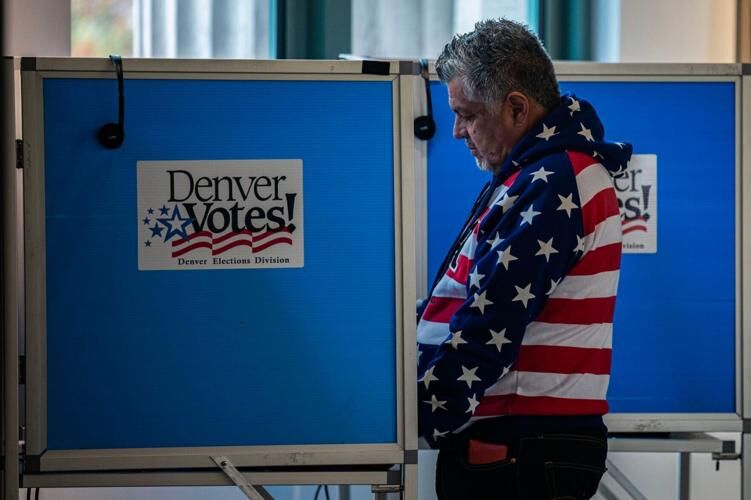
The city of Denver, along with several groups, sued the Trump administration Thursday, seeking to block U.S. Immigration and Customs Enforcement officers who are armed from polling sites during the upcoming midterm elections. In fact, there are no official orders...
Federal judge takes no action against ICE in Colorado after hearing about mistakes, not ‘blatant violations’
Michael Karlik
michael.karlik@coloradopolitics.com
Updated 18 hours ago
A federal judge declined to take action against U.S. Immigration and Customs Enforcement on Thursday after hearing that a pattern of alleged lawbreaking amounted to mistakes and a misunderstanding of the government’s position in court. For nearly a year, Colorado’s...
Colorado doctors, dentists challenge state law on gender‑transition services in new federal lawsuit
Marissa Ventrelli
marissa.ventrelli@coloradopolitics.com
Updated 15 hours ago
A group of Christian doctors and dentists has filed a federal lawsuit challenging a Colorado law they say requires them to provide gender‑transition services that conflict with their religious and ethical beliefs. The lawsuit, filed by the Christian Medical and...
Federal judge directs plaintiff to revise complaint alleging Denver officers’ constitutional violations
Michael Karlik
michael.karlik@coloradopolitics.com
Updated 18 hours ago
A federal judge directed a plaintiff to revise his allegations on Wednesday to more precisely state what two Denver officers and the city itself allegedly did to violate his constitutional rights by facilitating his prosecution for murder until prosecutors dropped...
Lawsuit challenges Douglas County commissioners’ ballot actions
Nicholas Fogleman
nicholas.fogleman@denvergazette.com
Updated 3 days ago
A new lawsuit against Douglas County commissioners seeks to invalidate the board’s intervention in efforts to expand the commission from three members to five and restore the original ballot language approved by more than 20,000 petition signers. The suit marks...
Federal judge explores new sanctions against ex-Colorado judicial discipline director
Michael Karlik
michael.karlik@coloradopolitics.com
Updated 20 hours ago
A federal judge on Wednesday directed Colorado’s former judicial discipline director, for the third time this year, to explain why she should not sanction him for his latest conduct in his litigation against the state’s judiciary. Christopher S.P. Gregory, who served...
PREV
PREVIOUS

Denver City Council postpones $88M purchase of Denver Post building
The Denver City Council on Tuesday delayed considering the purchase of the former Denver Post headquarters for $88.5 million, citing cost concerns and the need for more information. The item will be back in front of the council on Jan. 16. Some councilmembers said at a meeting Tuesday that they had not received a purchase […]

Denver tears down immigrant camp, plans to relocate hundreds to new city shelters
A crew from Denver on Wednesday began tearing down roughly 150 tents that immigrants had set up after crossing the southern border illegally and arriving in the city. Trucks started moving in at the crack of dawn, putting up the barricades and beginning the work of dismantling the tents at the makeshift encampment, which had […]