

Takeaways from the special session on property taxes | ANALYSIS
The four-day special session on property taxes, which concluded this week, may have shown a lot more about what the future holds for the Colorado General Assembly come January.
Here are some takeaways:
The end of a fragile peace in the Senate?
Unlike the House, where Republicans routinely use every tactic at their disposal to slow down agendas and House Democrats regularly shut down debate, senators, for the most of part, get along pretty well.
The special session, indeed, saw a cantankerous House, but the Senate also found itself in a rare, public dispute that seemed out of character for its members.
A dustup on Friday night is now leading to worries that from folks within and without the chamber that tactics to shut down debate could also become the norm in the Senate once the the 120-day session starts on Jan. 10, barely 50 days away. Some senators and observers said that would not be productive, breaking what they described as the only fragile peace that exists in the state Capitol these days.
Indeed, during the special session aimed at offering property tax relief to Coloradans, the public saw plenty of time-outs, as lawmakers negotiated bills and amendments, but just as many breaks to argue about rules and process.
That started in the Senate on Friday.
Here’s what happened. A standard procedure in a special session is for the majority party in the Senate to issue a notice three days before the start to allow for the suspension of rules so that business can move quickly. Why that mattered was on display on Friday, when Senate Democrats tried to bring up a “special orders” calendar – one that had not been given a previous notice – so that they could proceed with the debate on Senate Bill 23B-001, the main primary property tax relief legislation.
But to bring up a “special orders” calendar, the rules had to be suspended beforehand by that three-day notice. Alternatively, the Senate must agree to allow it with a two-thirds majority vote. That’s 24 out of the Senate’s 35 members.
Here’s the conundrum for Democrats – they hold 23 seats, so it means one Republican must cross the aisle and vote in favor of the motion.
That wasn’t going to happen in this special session. The first vote to suspend failed, 23-12, with a roll call vote requested by Republicans.
Senate President Steve Fenberg then called for a second vote, and asked for “aye” votes before Republicans could move for a roll call. Sen. Bob Gardner, the Republicans’ rule master made that request as Fenberg was calling for the “no” votes.
Fenberg nonetheless declared the motion approved.
Despite Fenberg telling Republicans the vote had been cast and “those are the rules,” the rules, in fact, don’t say when precisely that roll call vote has to be requested.
Denied the opportunity for the roll call vote, Gardner appealed the decision, which the majority denied on a 23-12 roll call vote. That turned out to be the last action the Senate took Friday night before adjourning.
Fenberg insisted – in a sidebar conversation that was not on camera but which drew a half-dozen members of the press corps – that both sides had agreed on a three-day session, and to push off the second reading debate for a day would push the session into a fourth day. Republicans, meanwhile, said they wanted the public to have more time to look at the legislation being proposed.
After more than an hour of that discussion, Fenberg returned to the dais and Senate Majority Leader Robert Rodriguez of Denver made the motion to “lay over” the special orders calendar until Saturday, in effect acceding to the Republicans’ request for a one-day delay. Fenberg did not say why.
Bad behavior abounds in the House without consequence
House Democrats have often complained in the last several years about what they deemed to be offensive comments made by Republicans and for which there were little to no consequences. The question now is whether they would apply the same standards to one of their own.
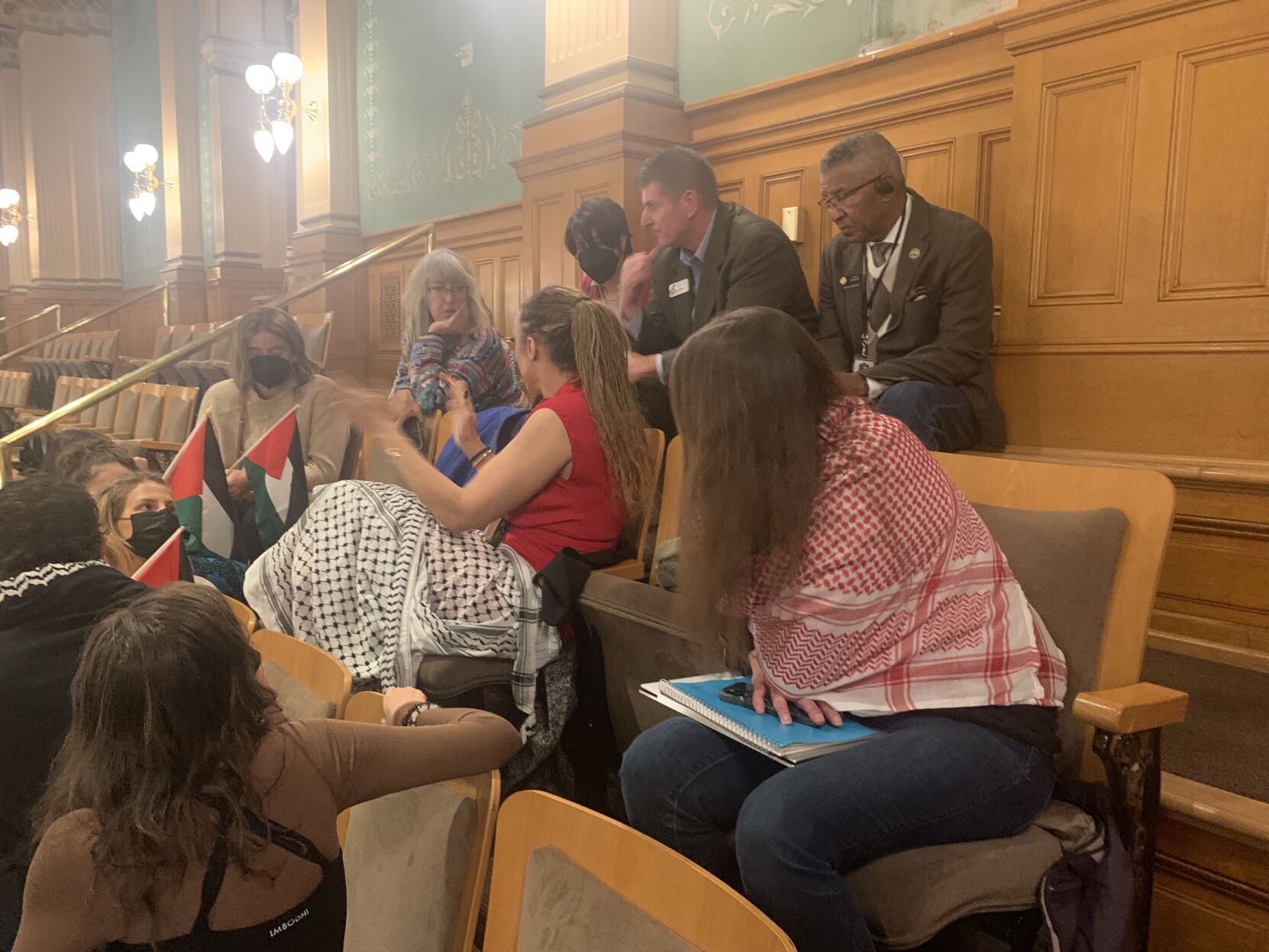
More specifically, how will House Speaker Julie McCluskie and House leaders respond to the actions of Rep. Elisabeth Epps of Denver, who spent 45 minutes on Monday talking about the Israeli-Hamas conflict, claiming Israel was engaging in “ethnic cleansing” and eating up almost all of the time allotted for debate on a bill on a federal food and nutrition program. She ended her comments with “Free Palestine!” and then went into the House gallery and joined Pro-Palestinian protesters in shouting down at the House floor, calling Democrats “fascists” and claiming she’d rather sit with those who oppose “genocide.”
House Rule 23(b) says “no member shall engage in loud private discourse or commit any other act tending to distract the attention of the House from the business before it.”
The House has not invoked that rule in at least 25 years.
Epps’s comments came while Rep. Ron Weinberg, a Loveland Republican who is Jewish, was given time to address her earlier comments.
“We are not enemies,” Weinberg said.
The standoff in the gallery lasted more than an hour. Protesters were asked to leave by the House sergeants, a request they refused to obey.
Epps eventually returned to the House floor and left shortly thereafter.
House leaders said nothing publicly about her actions once the chamber resumed its business and lawmakers wrapped up their work for the special session.
Will this become the standard in the 2024 session? McCluskie has yet to say whether she’s considering action to remind lawmakers about the rules and to avoid the actions that led to Monday’s disruption of House business.
Amid an election year, will Colorado’s lawmakers ‘disagree better’?
If the disruptions that took place in both the House and Senate weren’t enough, 2024 is an election year, in which Republicans will try to claw back seats they lost to Democrats, who, in turn, will seek to main their supermajority hold of the House and extend that to the Senate.
Senate Democrats need to defeat a Republican to claim its 24th seat, giving them a two-thirds majority. House Democrats already hold 46 seats – they just need 43 seats for a two-thirds vote.
The contentiousness of this week’s special session could spill over into in 2024, when lawmakers are once again expected to clash over guns, abortion, property taxes, rent and drug use.
Interestingly, Gov. Jared Polis and Utah Gov. Spencer Cox held a forum at Colorado State University on the very issue of divisive political discourse last week, when they talked about statesmanship, the kind exhibited by the late Sen. John McCain of Arizona. The duo is pushing an initiative by the National Governors Association called “Disagree Better,” whose animating concept is to offer ways for people with disparate views to hold robust and difficult conversations about major problems without shouting at each other.
“I think you have to get at what the reward structures are for politicians. And, currently, too many of them see the easy way, where you become part of the problem and the fire-throwing. You get millions of Twitter followers. You raise tons of money. You demonize the other side,” Polis told Colorado Politics after the forum. “And when that’s the route that propels you to power, you generally are going to govern accordingly. Because that’s the easy thing for you to do.”
“The political industrial complex is full of cowards and people who will just copy whatever works. If tearing the other side down gets you elected, then people will do that. But if we can show a different way – that, actually, (it works) treating people with respect, even if we disagree, the kind of John McCain model that you mentioned, you will see more and more people try and do that,” Cox added. “Even better, you’ll find more and more people that want to run for office who won’t do it now because it’s too toxic.”
Will Colorado’s politicians “disagree better” as Polis urged them to? Stay tuned.


marianne.goodland@coloradopolitics.com

Denver labor acknowledgment proposal faces council committee questions
Deborah Grigsby
deborah.smith@denvergazette.com
Updated 1 hour ago
A proposal to add a labor acknowledgment to Denver City Council proceedings has been delayed by the Finance and Business Committee after members raised questions about its wording, intentions and place in the council’s opening proceedings. The proposal, put forth...
Fauci invokes the Fifth Amendment and declines to testify in GOP-led Senate panel’s COVID-19 hearing
The Associated Press
the-associated-press@coloradopolitics.com
Updated 2 hours ago
WASHINGTON (AP) — Dr. Anthony Fauci on Wednesday invoked the Fifth Amendment and declined to answer questions from senators in a Republican-led committee hearing about his handling of the COVID-19 pandemic. The move injects new drama into the lingering tensions...

Colorado residents rush to buy guns ahead of new restrictions, breaking sales records for several stores
By Debbie Kelley
by-debbie-kelley@coloradopolitics.com
Updated 2 hours ago
Colorado residents are lining up to buy guns ahead of the latest weapons restrictions set to take effect this Saturday. The new law mandates individuals seeking to purchase semiautomatic firearms with detachable magazines to first complete a firearm safety course...

Crime continues to decline in Aurora, police chief says
Kyla Pearce
kyla.pearce@gazette.com
Updated 2 hours ago
Crime in Aurora continued to decline in the first half of 2026, according to Aurora Police Department officials. Crime overall in the city has been on a downward trend since 2024, according to APD. Between Jan. 1 and June 30,...
El Paso County rejects multi-family zoning request near Monument Academy
Savannah Eller
savannah-eller@coloradopolitics.com
Updated 56 minutes ago
The El Paso County Board of Commissioners narrowly rejected a developer’s bid to convert land from low- to high-density residential zoning. The request, made by MA Infrastructure, LLC, would have allowed 12 units per acre on half of a 14-acre...
Atop taxes, here’s how much each Colorado resident pays in fees
Marissa Ventrelli
marissa.ventrelli@coloradopolitics.com
Updated 18 hours ago
Each Colorado resident paid nearly $5,000 in state-sanctioned fees last year, according to a report by a policy think tank. The report, which analyzed how fees have affected Colorado’s economy, found that fee revenue has more than tripled since 2008...

Colorado National Guard, Swiss Armed Forces celebrate partnership
Marissa Ventrelli
marissa.ventrelli@coloradopolitics.com
Updated 19 hours ago
Colorado’s National Guard marked a year of partnership with the Swiss Armed Forces at the Governor’s Mansion on Monday. “This anniversary marks one strong year of friendship and collaboration between the State of Colorado and Switzerland,” said Gov. Jared Polis....
Judge allows Trump to refile $15 billion lawsuit against the New York Times
Emily Hallas
emily-hallas@coloradopolitics.com
Updated 20 hours ago
A federal judge declined to dismiss President Donald Trump’s multibillion-dollar lawsuit against the New York Times on Monday, giving him roughly four weeks to amend his case after the outlet moved to toss it on First Amendment grounds. District Judge...

Q&A with Jeffco Public Schools’ interim superintendent on budget deficit, federal investigation
Matt Kyle
matt.kyle@denvergazette.com
Updated 2 hours ago
For the upcoming school year, Robert Stein will serve as Jeffco Public Schools’ superintendent. The 66-year-old Denver native has been semi-retired for the last few years. He spent 40 years in education, as both a teacher and administrator. Most recently,...

Gov. Polis celebrates Colorado’s first-place education ranking by U.S. News
Marianne Goodland
marianne.goodland@coloradopolitics.com
Updated 17 hours ago
Colorado officials said they have something to celebrate this week, in addition to the state’s sesquicentennial birthday on Saturday. U.S. News & World Report on Tuesday gave Colorado its top ranking for education efforts from pre-K to postsecondary, though it...
PREV
PREVIOUS

Aurora mayor and councilmembers express thanks, share favorite Thanksgiving meals
In the City of Aurora, there is much to celebrate on Thanksgiving from the city’s diverse residents to the opportunities for community engagement, Aurora’s mayor and councilmembers told The Denver Gazette. Part of the city’s diverse tapestry is the backgrounds of its councilmembers, with Alison Coombs saying she’s thankful for her years of practicing Buddhism and […]

Aurora to hold receptions honoring departing city council member, welcoming new ones
Aurora will honor its departing council member and welcome new councilmembers at two receptions the first week of December as the council prepares to shift gears. While election results are not yet official, pending final certification due to the Secretary of State no later than Nov. 29, results as of Thursday show clear leads for […]