

Lawsuit challenges required language description of Colorado ballot measures

A state law proponents say will provide more transparency in ballot measures that raise or lower taxes has earned a legal challenge in federal court.
Advance Colorado Institute filed the lawsuit Monday against House Bill 21-1321, which added requirements to the language in a ballot measure’s title. The conservative group claims the measure is violating people’s First Amendment rights.
Other plaintiffs in the lawsuit include former U.S. Sen. Hank Brown, R-Denver, Logan County Commissioner Jerry Sonnenberg, Mesa County Commissioner Cody Davis, El Paso County Commissioner Carrie Geitner, and Englewood City Councilman Steven Ward. The plaintiffs are represented by former U.S. Attorney Troy Eid.
HB 1321 required measures that reduce state tax revenue through a tax change to include specific language, spelled out in the law: “Shall there be a reduction to [a tax] by [a percentage], thereby reducing state revenue.” The ballot title could identify up to the three largest program expenditures that would be affected by the change. Similar language is required for measures that deal with property taxes.
The lawsuit, which names Gov. Jared Polis and Secretary of State Jena Griswold as defendants, refers to the change as “poison pill language” that violates the plaintiffs “First Amendment right to present their message undiluted by views they [do] not share.”
That’s a quote from the 303 Creative LLC v. Elenis case recently decided by the U.S. Supreme Court.
Information about fiscal impacts from ballot measures began with the General Assembly’s Blue Book in 2001, as a result of Senate Bill 01-025. Legislation in 2015 required fiscal impact statements for ballot measures working their way through the process. In 2020, the law added fiscal impact statements when circulating ballot measures. That information has been produced by the nonpartisan Legislative Council staff.
But the title of a ballot measure, particularly one that would affect taxes, hasn’t been touched until HB 1321.
The bill passed through the General Assembly with little challenge. No one from the public testified against the measure in either of its major committee hearings.
Christy Hargrove, a Republican from Gunnison, spoke in favor of the measure in May 2021. This would give voters the full picture when they cast their ballots, Hargrove told the House State, Civic, Military & Veterans Affairs Committee. She said the Blue Book, a voter guide produced by the General Assembly, only gives a partial picture of what citizens are voting on.
“Voters don’t have staff” who can work through the fiscal policy statements, where the money comes from or where it goes, Hargrove added.
“We don’t have hours to focus on the Blue Book. The ballot should give voters the full picture…We are the ultimate policymakers and should be trusted as such,” she said.
The bill, sponsored by Democrats, won passage in both chambers largely along party lines. Republicans challenged the bill as unnecessary and the language as biased.
The Advance Colorado Institute lawsuit claims the language from HB 1321 is “state-mandated language in the ballot title for citizen-initiated ballot measures that cut taxes.” In a statement Monday, Advance President Michael Fields said because of HB 1321, “every measure must say that it ‘will reduce funding for state expenditures that include but are not limited to education, health care policy and financing, and higher education,'” regardless of the facts.
“The requirement to include this language on citizen-initiated ballot measures represents a clear example of unconstitutional compelled speech, and even worse, it requires compelled false speech,” Fields said. “The language must be used even when there is no guarantee that a reduction in tax rates ‘will reduce funding’ for any particular state program. Even worse, it is required even when it is provably and mathematically false. With Initiatives #21 and #22, Advance Colorado has experienced this firsthand, when the state-mandated language was required to be part of the title in an initiative it submitted to the title board.”
Those two initiatives are currently being circulated for petition signatures for the 2024 general election. Ward is a proponent on both.
Initiative #21 would limit annual property tax increases to 3%, unless the square footage is increased by 10% or the building’s use is substantially changed.
Initiative #22 would temporarily reduce the state sales and use tax rate from 2.9% to 2.89%, from July 1, 2024 to June 30, 2025. The initiative’s fiscal analysis from Legislative Council said it would have no measurable impact on state revenue for expenditures but would likely reduce TABOR refunds.
“We filed this lawsuit because the state is violating the First Amendment by mandating untrue language on the ballot,” Fields said. “Politicians at the Capitol have unconstitutionally stacked the deck against citizen-driven ballot initiatives that reduce taxes, and Advance Colorado is suing to ensure that ballot initiatives generated by citizens are described accurately on the ballot and not subject to compelled speech or government-enforced lies.”
The case is Advance Colorado v. Griswold.
Editor’s note: This story has been updated to clarify that the case was filed in federal court.


10th Circuit dismisses woman’s lawsuit following 10-year attempt to undo restraining order
Michael Karlik
michael.karlik@coloradopolitics.com
Updated 21 hours ago
The Denver-based federal appeals court rejected a woman’s challenge on Friday to a restraining order imposed on her more than a decade ago, finding that she cannot credibly claim she will be prosecuted for violating the restraining order through her...
10th Circuit dismisses woman’s lawsuit following 10-year attempt to undo restraining order
Michael Karlik
michael.karlik@coloradopolitics.com
Updated 23 hours ago
The Denver-based federal appeals court rejected a woman’s challenge on Friday to a restraining order imposed on her more than a decade ago, finding that she cannot credibly claim she will be prosecuted for violating the restraining order through her...
Colorado equal pay law does not require plaintiffs to allege gender-based retaliation, appeals court finds
Michael Karlik
michael.karlik@coloradopolitics.com
Updated 1 hour ago
The 2019 Colorado law aimed at rooting out pay discrimination on the basis of sex does not require a plaintiff to allege their employer retaliated against them for sex- or gender-related reasons, the state’s second-highest court decided on Thursday. Lawmakers...
Hudson faces lawsuit over ICE detention facility
Nicole C. Brambila
nicole-c-brambila@coloradopolitics.com
Updated 1 day ago
A nonprofit organization filed a lawsuit against the Town of Hudson Wednesday, challenging plans to reopen a former federal prison in the town as a U.S. Immigration and Customs Enforcement detention facility. Together Colorado, along with Janet E. Carlson, filed...
Senate committee advances Trump’s 10th Circuit nominee, as Domenico responds to questions about delays
Michael Karlik
michael.karlik@coloradopolitics.com
Updated 1 day ago
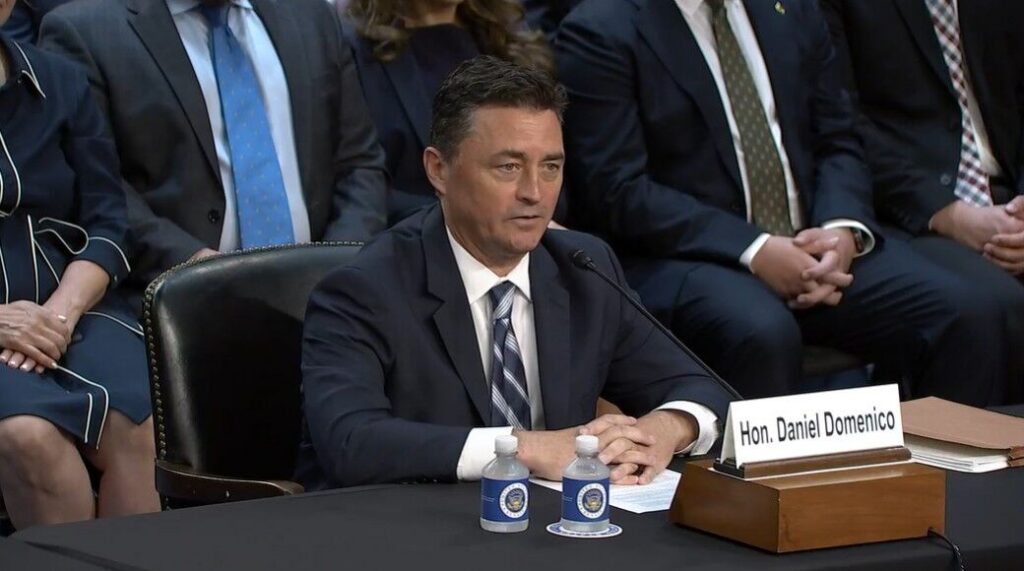
The U.S. Senate Judiciary Committee advanced President Donald Trump’s nominee to the Denver-based federal appeals court on Thursday by a party-line vote of 12-10. U.S. District Court Judge Daniel D. Domenico, who was Trump’s first-term appointee to Colorado’s federal trial...
Colorado justices to hear embryonic donation dispute
Michael Karlik
michael.karlik@coloradopolitics.com
Updated 2 days ago
The Colorado Supreme Court announced on Monday that it will decide whether lower court judges properly applied its framework for adjudicating disputes over the fate of pre-embryos, in which one person wants to use them to become a parent and...

Isolation, emotion, persona: Colorado judicial programming prepares people for life on the bench
Michael Karlik
michael.karlik@coloradopolitics.com
Updated 2 days ago
As a trial judge and now as a member of the Colorado Supreme Court, Justice Carlos A. Samour Jr. has heard the view that being a judge is isolating. “In neither court have I felt isolated. I’ve always interacted a...

Federal judge dismisses Colorado county sheriff’s challenge to law limiting immigration cooperation
Michael Karlik
michael.karlik@coloradopolitics.com
Updated 1 hour ago
A federal judge dismissed a challenge from Mesa County Sheriff’s Office leaders last week to a Colorado law limiting public employees’ cooperation with immigration authorities, concluding that the plaintiffs did not allege they engage in any conduct that the law...

10th Circuit raises bar for fraud victims to sue debt collectors over inaccurate information
Michael Karlik
michael.karlik@coloradopolitics.com
Updated 3 days ago
The Denver-based federal appeals court wiped away a jury’s $500,000 award to a fraud victim on Monday and made it more difficult for consumers to hold companies liable for disseminating inaccurate credit information. The Fair Credit Reporting Act regulates credit...

Montezuma County judge’s censure, suspension approved by discipline panel
Michael Karlik
michael.karlik@coloradopolitics.com
Updated 3 days ago
A three-member disciplinary panel accepted, on Monday, an agreement between a Montezuma County judge and the Colorado Commission on Judicial Discipline that specifies he will receive a censure, a suspension, and additional education for his admitted instances of misconduct. Under...
PREV
PREVIOUS

Colorado struggles to track and educate kids in trouble with the law. Here's how one student graduated, despite the odds
“Look at me now.” David Garcia meant those words for the school administrators who had written him off. His message – tinged with defiance, triumph, perhaps even pride – was about defying the odds for a high school dropout who longed for a diploma, but whose life has taken all too predictable detours. In June, he walked the stage […]

Colorado preschools left with empty seats in universal pre-K debacle
Universal preschool in Colorado covers the cost of half-day pre-K. As of Friday, 9,150 families who thought they were getting full-day pre-K paid for by the state recently found out they are on the hook for the cost of the second half of the day. Caught in the middle are the preschool providers whose classrooms […]