

Colorado Supreme Court shows interest in divorce case, man’s 14-month confinement
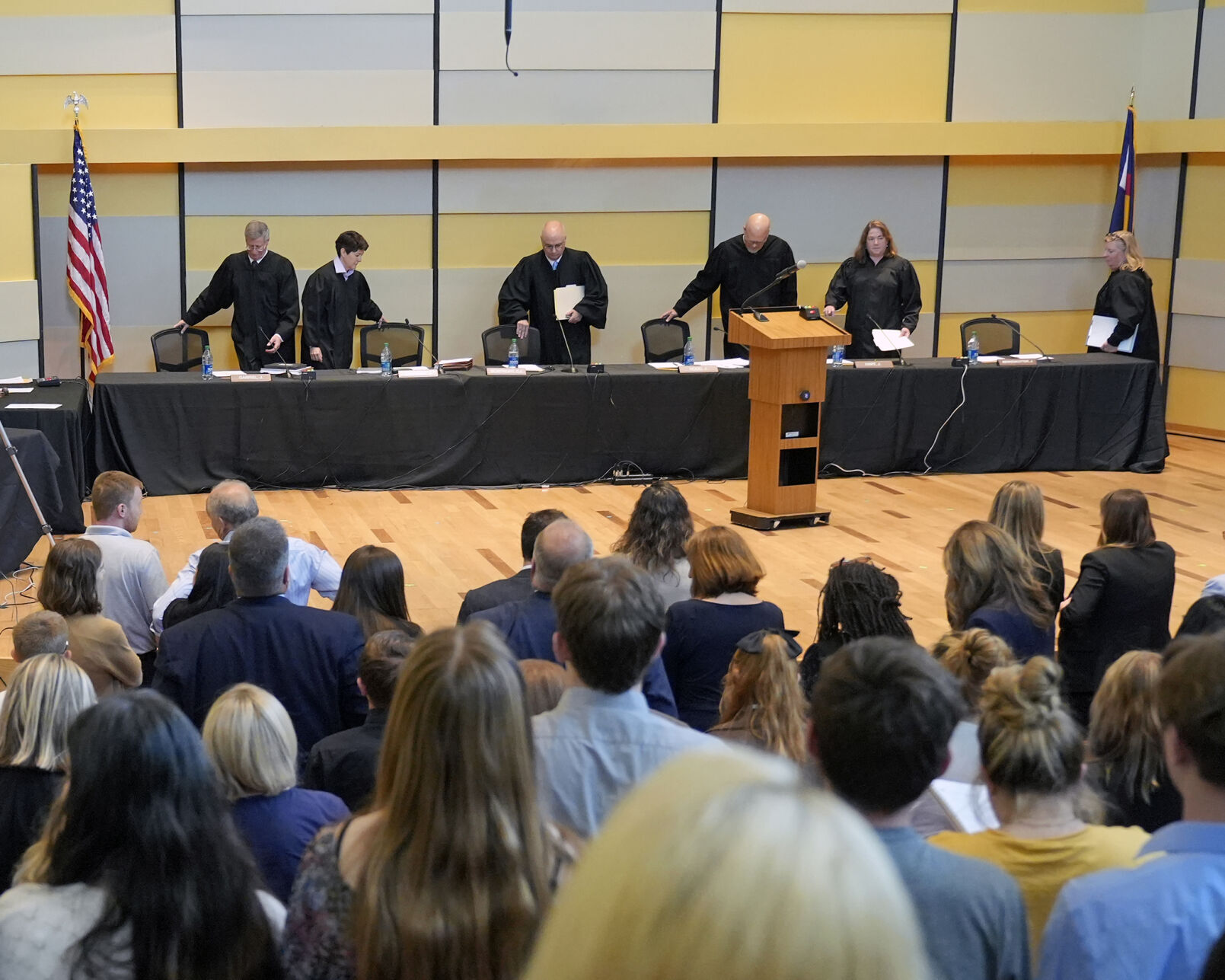
The Colorado Supreme Court signaled recently that it may intervene in a pair of cases – one involving a divorce between a Colorado resident and a Nebraska resident, and the other challenging a defendant’s 14-month confinement before trial.
In the first case, Jeffry H. Green and Barbara Green filed for divorce on the same day in April 2022. However, Jeffry Green filed his motion in Douglas County, Neb., where he lived, and Barbara Green filed hers in Denver, where she lived.
Last month, Denver District Court Judge Christine C. Antoun decided Jeffry Green’s contacts with Colorado were “continuous and systematic enough” that the case was subject Colorado’s jurisdiction, rather than Nebraska’s.
Jeffrey Green appealed directly to the Supreme Court, arguing he was an out-of-state resident whose minimal ties to Colorado should not require him to defend himself in Colorado’s courts.
“Considering his substantial contacts with Nebraska,” his attorneys wrote, “real estate deals and occasional visits to Colorado to visit family do not suffice to make him ‘at home’ here. Husband can hardly be said to be at home both in Colorado and Nebraska.”
On July 6, the Supreme Court ordered Barbara Green to respond to her husband’s arguments.
The case is In re the Marriage of Green.
The Supreme Court also moved toward consideration of a criminal appeal out of Jefferson County. Brian Donald Hollaway has been in custody since November 2020 for a pair of criminal cases. The most serious charge he faced was violating bail bond conditions, which is a low-level felony.
Shortly after his arrest, a judge found Hollaway was incompetent to proceed and ordered treatment for him. One year later, in February 2023, Hollaway became competent to stand trial.
However, Hollaway’s attorney filed a motion to dismiss the cases under a provision of Colorado law that mandates dismissal if a defendant is incarcerated or otherwise confined before trial for at least 50% of the maximum sentence he would have served for his most serious offense.
In Hollaway’s case, he faced 18 months’ incarceration if convicted of the felony. By the time he became competent to stand trial, he had been in custody for 14 months – far longer than the nine months that would trigger dismissal.
District Court Judge Lily W. Oeffler declined to toss the charges. She indicated it was possible Hollaway would actually serve three years in prison if found guilty, based on a potential sentence enhancement that would apply.
Hollaway appealed to the Supreme Court, arguing Oeffler misapplied the law. On June 23, the court ordered the government to respond to Hollaway’s claims.
However, the controversy may now be moot. Court records show that days after the Supreme Court indicated it could intervene, Hollaway entered a guilty plea in a different case. Simultaneously, the First Judicial District Attorney’s Office dismissed the charges that were the subject of Hollaway’s appeal.
A spokesperson for District Attorney Alexis King confirmed the prosecution will likely argue that dismissal of the cases has rendered the appeal moot.
The case is People v. Hollaway.


Misconduct complaints from ex-Colorado judicial discipline director dismissed against federal judges
Michael Karlik
michael.karlik@coloradopolitics.com
Updated 10 hours ago
The administrative body for the Denver-based federal appeals court upheld a finding last week that misconduct complaints against Colorado’s chief federal trial judge and the chief appeals judge warranted dismissal and appeared to be a “litigation tactic” by the complaining...

First-ever Red Rocks naturalization ceremony draws most diverse group of new citizens
Michael Karlik
michael.karlik@coloradopolitics.com
Updated 12 hours ago
Colorado’s federal trial court held its first-ever naturalization ceremony for nearly 300 new citizens on Thursday at Red Rocks Park and Amphitheater. “We’re doing it to commemorate the 250th anniversary of the Declaration of Independence and the United States. Red...
10th Circuit finds no fair housing violation by Littleton landlord for worker’s alleged rape of tenant
Michael Karlik
michael.karlik@coloradopolitics.com
Updated 2 days ago
The Denver-based federal appeals court concluded on Monday that Littleton’s housing authority could not be held liable for a maintenance worker’s alleged rape of a tenant, as the worker’s employment did not provide any special access to the victim. A...

Jeffco Public Schools sues Trump administration to protect funding after alleged transgender policies violation
Matt Kyle
matt.kyle@denvergazette.com
Updated 21 hours ago
In the wake of several threats by the Trump administration to revoke federal funding, Jeffco Public Schools filed a lawsuit against the Department of Education seeking to protect that badly needed money. Jeffco has been under investigation by the DOE’s...
Denver detox center did not violate man’s rights with 10-hour hold, 10th Circuit says
Michael Karlik
michael.karlik@coloradopolitics.com
Updated 2 days ago
The Colorado-based federal appeals court concluded on Tuesday that Denver’s detoxification facility did not violate a man’s rights by holding him against his will for 10 hours until his blood alcohol content was projected to reach zero. Unusually, Brian Garrett’s...

Federal judge clarifies ex-GOP treasurer candidate’s burden to prove defamation claims
Michael Karlik
michael.karlik@coloradopolitics.com
Updated 2 days ago
A federal judge clarified last week that businessman and former Republican statewide candidate Brian Watson will need to surmount a higher hurdle in proving his claim that a party guest’s alleged description of him as a “criminal” amounted to defamation....
Colorado board permits state to appeal injunction against arthritis drug price cap
Marissa Ventrelli
marissa.ventrelli@coloradopolitics.com
Updated 3 days ago
A Colorado board voted Friday to allow the Attorney General’s Office to fight an injunction against a price cap on a drug that treats arthritis. A U.S. district court judge had granted the company Amgen a preliminary injunction, temporarily blocking...

Federal judge rejects constitutional claims, ‘expressions of hatred’ by Club Q defendant
Michael Karlik
michael.karlik@coloradopolitics.com
Updated 3 days ago
A federal judge rejected a defendant’s claims that he received constitutionally ineffective assistance of counsel while facing federal hate crime and firearms charges for murdering five people at a Colorado Springs LGBTQ nightclub in 2022. Anderson Lee Aldrich is serving...

Divided 10th Circuit upholds Colorado congestion fee on car rentals
Michael Karlik
michael.karlik@coloradopolitics.com
Updated 3 days ago
The Denver-based federal appeals court concluded on Monday that a 2024 “congestion impact fee” that lawmakers imposed on short-term vehicle rentals did not conflict with a federal prohibition on certain airport-related charges. Beginning in the 1970s, Congress began limiting the...
10th Circuit dismisses woman’s lawsuit following 10-year attempt to undo restraining order
Michael Karlik
michael.karlik@coloradopolitics.com
Updated 6 days ago
The Denver-based federal appeals court rejected a woman’s challenge on Friday to a restraining order imposed on her more than a decade ago, finding that she cannot credibly claim she will be prosecuted for violating the restraining order through her...
PREV
PREVIOUS

10th Circuit throws out challenge to military's now-rescinded COVID vaccine mandate
The federal appeals court based in Denver dismissed an attempt by two ex-military personnel to halt the U.S. Department of Defense’s COVID-19 vaccination requirement, recognizing on Thursday that the government had already rescinded the mandate and there was nothing for the court to block. A three-judge panel of the U.S. Court of Appeals for the […]

Denver deputy sheriff fired for 2022 confrontations with inmates
Denver’s Department of Safety fired a deputy for verbal confrontations with two inmates in the county jail, in which they reportedly used racial slurs at each other and the deputy told the inmates: “If you’re feeling froggy, jump,” according to the disciplinary letter. Other Denver Sheriff Department deputies said they had concerns about working with […]