

Liz Cheney stands tall at Colorado College | CRONIN & LOEVY
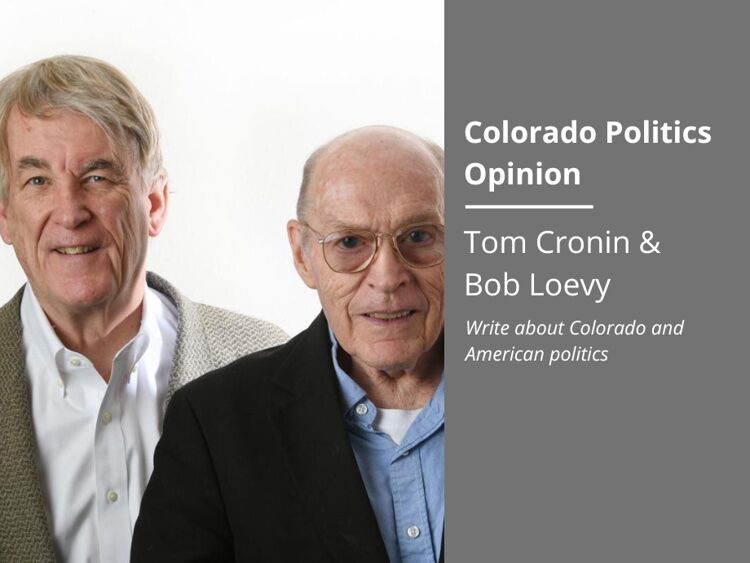
Last Sunday we watched our former student, Liz Cheney, as she was honored at Colorado College. Later that day, we watched the shameless and ugly final episode of the popular television show called Succession.
In 2021 Liz Cheney stepped up to become one of the fiercest Republican critics of former President Donald Trump’s attempted political coup. She exposed and condemned his efforts on Jan. 6, 2021, to allow himself to succeed himself after an obviously failed effort to win a legitimate presidential re-election.
It became one of the most shameless and ugly events in our American Experiment with democracy, representative government, and constitutionalism.
Trump, like the tycoon in the Succession television show, wielded great power and intimidation over those around him, especially the members of his Republican Party.
For her unstinting efforts to stop Trump from stealing the 2020 presidential election from current Democratic President Joe Biden, Liz Cheney was honored at Colorado College by being selected to give the graduation address.
She had recently been celebrated by both the Ronald Reagan and the John F Kennedy presidential libraries for her political courage in opposing Trump so strongly and for so long.
Cheney was a conservative Republican from Wyoming serving in the U.S. House of Representatives.
She was forced to make a tough personal and political decision following the events of January 6th, 2021, when a pro-Trump mob, inspired by a Trump speech, attempted to take over the U.S. Capitol building and reverse the results of the 2020 presidential election.
Cheney had wanted to be the Republican member of the House of Representatives from Wyoming. Once elected to Congress, she had risen quickly in the House Republican leadership. She held the third-ranked position of chair of the House Republican Conference.
Stay up to speed: Sign-up for daily opinion in your inbox Monday-Friday
However, she believed Trump had lost the 2020 election, and that Congress had the responsibility to ratify the results of the Electoral College voting as provided in the US Constitution.
But her Republican Party colleagues in the House, or at least most of them, told her they wanted her “to lie.” She said they wanted her to say the election was stolen, that the insurrection at the Capitol on January 6 of 2021 wasn’t a big deal, and that President Trump deserved to succeed himself in the White House.
“I had,” Cheney said, “to choose between lying and losing my position in the House Republican leadership.”
She chose not to lie, and she was immediately stripped of her leadership post.
She soon made a second high-risk choice. She accepted House Speaker Nancy Pelosi’s offer to serve as vice-chairman of the January 6th Committee created to study the historic attempted insurrection that occurred that day.
Liz Cheney did much more than just serve on the committee. She moved into a special basement office near the Capitol complex. She threw herself completely into the work, helping to see that the committee hearings garnered the largest television audiences possible and helping to recruit convincing witnesses, mostly Republicans, to testify to Trump’s various illegal activities.
It was Liz Cheney who pressured the committee to have each of nine televised committee hearings concentrate on a separate election-stealing scheme of President Trump’s. She also participated actively in the writing and editing of the hearing scripts. She proposed the lines of questioning in the committee’s interview process.
The New York Times Magazine concluded Cheney “had turned the typically ceremonial role of vice chair into a position of unmatched power.” She had “maintained a Captain Ahab like focus on Donald Trump as a singular threat to American democracy.” It was Liz Cheney who “saw to it that each facet was made subservient to the case against Trump.”
Her highly visible and effective service on that committee made her extremely controversial in the Republican Party, despite her being more conservative than Trump on most policy issues.
It also, however, made her a hero among many other Americans for her warnings about authoritarianism and the use of unconstitutional means for trying to stay in power in the presidency.
Donald Trump responded to Cheney by vilifying her. He began a crusade to have her defeated in the Wyoming Republican primary election of 2022. He succeeded. Cheney lost the Republican nomination and was forced to give up her seat in the House of Representatives.
Liz Cheney told the graduating seniors at Colorado College that she knew she was doing the right thing even though it ended her long-desired and promising political career in Congress. She said:
“Resolve to do what is right – even when it’s hard, you’re alone, even when you’re afraid – especially when you’re afraid.”
Former Representative Cheney recalled leading a prayer among her colleagues near the end of her role as chair of the House Republican Conference:
“I prayed that we would know a love and reverence for freedom. I prayed that we would remember that democratic systems could fray and suddenly unravel, and that when they do, they are gone forever.”
In her Forward to “The January 6th Report,” Cheney called out her fellow conservatives. “Today,” she said, “I am perhaps most disappointed in many of my fellow conservatives who knew better, who stood against the threats of communism and Islamic terrorism but concluded that it was easier to appease Donald Trump and keep their heads down.”
Cheney added, “I had hoped for more from them.”
Some people wish she would run for president.. This is unlikely for 2024. She may be bitter at the illegal and unconstitutional succession efforts by the former president, yet she does not seem bitter about politics.
She urges young people to vote and get involved. “You are,” she said, “the inheritors and guarantors of this free society, and we need you to preserve it and leave it better than you have found it.”
She noted as others have said that the arc of history “bends” in the direction of justice and freedom. But it requires ceaseless unbending “benders” in every generation.
This challenge is unending, Cheney said, because constitutional democracy is fragile, and our institutions do not defend themselves.
Cheney’s most serious injunction for Colorado College graduating students, and for us, is that “no party, no nation, no people can defend and perpetuate a constitutional republic if they accept leaders who have gone to war with the rule of law, with the democratic process, with the peaceful transfer of power, with the U.S. Constitution itself.”
Tom Cronin and Bob Loevy write about Colorado and national politics.

Will one unqualified AG replace another? | George Brauchler
George Brauchler
george-brauchler@gazette.com
Updated 11 hours ago
Colorado Democrats are poised to nominate another attorney general candidate with de minimis relevant credentials or experience. Far from disqualifying, Colorado’s recent voting history mirrors that of America in favoring biography over experience, partisanship over policy, and emphasizing what divides...
Pueblo’s mayor keeps stirring the pot | Dennis Maes
Dennis Maes
dennis-maes@coloradopolitics.com
Updated 11 hours ago
Pueblo Mayor, Heather Graham, has clearly proven to be a disciple of the Donald Trump school of governance. And, like her mentor, she is experiencing the same catastrophic results. The format is to ignore what the electorate approved and expects...
The perils of Colorado’s unregulated abortions | GUEST COLUMN
Colorado Politics
colorado-politics@coloradopolitics.com
Updated 11 hours ago
By Tom Perille How did the movement which grew out of a genuine concern for the health and safety of women become the same movement that undermines women’s health and safety today? Despite good intentions, it was a long route...
Sans seniors, what does Colorado’s uninterested early turnout say about our disengaged electorate? | Paula Noonan
Paula Noonan
paula-noonan@coloradopolitics.com
Updated 1 day ago
This primary election is poorly attended. Evidence is in the numbers. About 10% of active registered voters are deciding this year’s primaries with seven days to go. If that number triples by June 30, only 30% of voters will decide...
Who gets to decide Colorado’s economic future? | GUEST COLUMN
Colorado Politics
colorado-politics@coloradopolitics.com
Updated 1 day ago
By Sarah Blackhurst Colorado’s prosperity depends on industries that grow our food, build our future and power our homes. But today, these sectors face an invisible threat from 5,000 miles away: the European Union’s Corporate Sustainability Due Diligence Directive (CS3D)....
We have the chance to change Colorado’s cancer outcomes | PODIUM
Colorado Politics
colorado-politics@coloradopolitics.com
Updated 1 day ago
By Erika Hanson Brown Colorado ranks among the healthiest states in the nation by nearly every measure. Yet even here — amid the Rocky Mountains and our deeply rooted culture of health and activity — cancer casts a long and...
Colorado has a playbook for youth mental health — our next governor must use it | GUEST COLUMN
Colorado Politics
colorado-politics@coloradopolitics.com
Updated 3 days ago
By Karen Ron-Li Liaw From the rural communities on the western slope to the eastern plains, to the major urban regions on the Front Range, Colorado families are navigating an all-too-familiar crisis: kids are struggling, and Colorado’s mental health system...
Pigs engineered to fight alpha-gal syndrome | Rachel Gabel
Rachel Gabel
rachel-gabel@coloradopolitics.com
Updated 4 days ago
If I were an evil genius trying to hamstring animal agriculture, I would create a fly that eats livestock alive and a tick whose bite and spit causes some people to have an allergic reaction to meat. (Insert evil laugh...
Registered voters on the eve of the 2026 primaries | Cronin & Loevy
Tom Cronin Bob Loevy
tom-cronin-bob-loevy@coloradopolitics.com
Updated 6 days ago
The Colorado Secretary of State’s Office has published the latest voter registration figures for the state and its counties as of June. Colorado ranks among the highest states for independent, or unaffiliated, voters. Only Alaska and Massachusetts have more. New Hampshire, New Jersey, Maine and Oregon also rank highly. So here...
A room for Sundance, a reality check for big-government Boulder | Jon Caldara
Jon Caldara
jon-caldara@coloradopolitics.com
Updated 1 week ago
There are few things more satisfying to watch than socialists getting mugged by reality. The Sundance Film Festival is invading my hometown of Boulder early next year. Sundance drew 85,000 attendees last year in Park City, Utah. Boulder’s hotel room...
PREV
PREVIOUS
Artificial stupidity | HUDSON
Miller Hudson Technology was precipitating social and cultural change in prehistoric times. We don’t possess a written record of the cultural impacts of farming, the wheel, irrigation or a host of other innovations that shaped the earliest civilizations. Whether theories of catastrophism accompanied these intellectual leaps is anyone’s guess. Human nature being what it is, […]
The reality of local control in Colorado | OPINION
Sam Mamet This past legislative session reminded me of some wisdom a Senate sage shared with me so many moons ago, “Mamet, I’ve been reading your legislative drivel and you don’t think we support local control down here, well I’m here to tell you that we do… until we don’t.” That bit of counsel stood […]