

DIA ignores recommendations for fair competition in contracts: Auditors
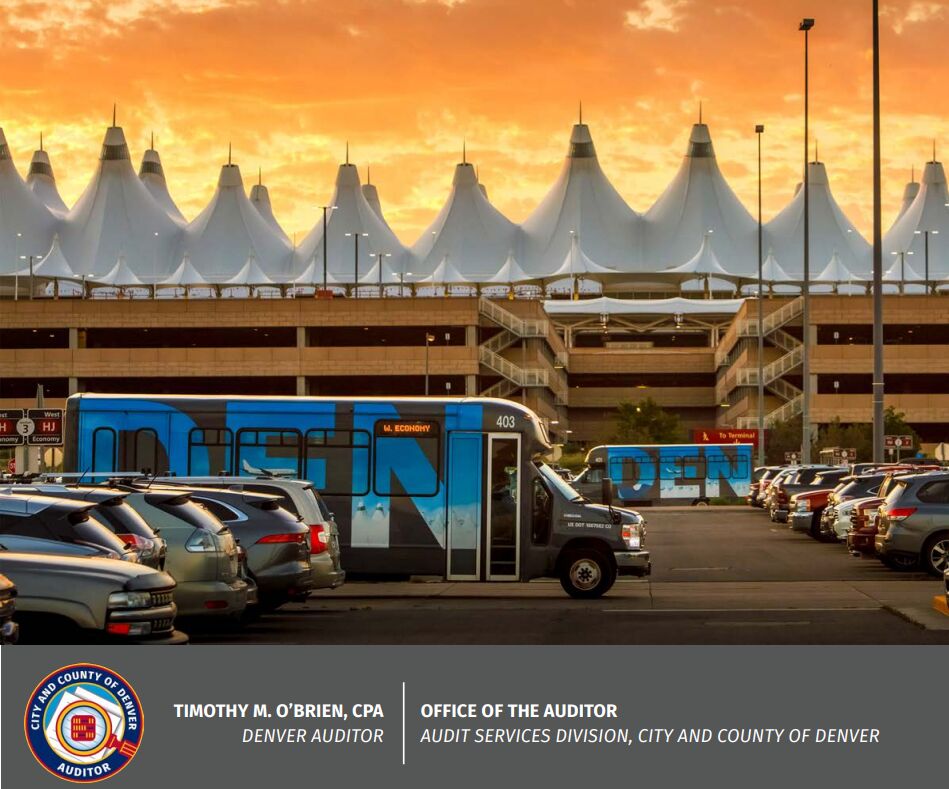
Back in 2016, Denver International Airport authorities structured a multi-year, multi-million dollar contract for shuttle services in a way that effectively favored only one company – its existing vendor, auditors who reviewed that bidding process concluded two years ago.
A follow up audit this year said DIA officials are still ignoring recommendations to ensure fair competition when handing out contracts.
“We’ve completed many audits related to Denver International Airport, all pointing to the same concern: lack of competition in the contracting process,” Timothy O’Brien, the city’s auditor, said in a news release. “This follow-up shows that even after leadership was made aware of the issue, they did not take serious steps to do better.”
A DIA spokesperson said the contract with AMB was made through an “open and competitive process.”
“Since the audit, DEN made some internal organizational changes, has amended and improved our standard operating procedures, and added new technology to help us monitor service hours and improved contract compliance,” DIA spokesman Jose Salas told The Denver Gazette.
United adds 35 flights, 6 more routes to Denver operations
The fundamental issue, auditors said, is that reduced competition in bidding often results in “lower value for the entity seeking goods and services,” while also potentially paying higher prices.
DIA’s shuttle service is lucrative – for a good reason. The airport, which is among the busiest in the country, is Colorado’s primary economic engine, generating more than $33 billion for the region each year. Before the onset of COVID-19, the airport’s shuttle vendor served an average of 6.9 million passengers a year, auditors said.
In its May report, auditors found the same pattern of favoring DIA’s longtime vendor in the work to implement a GPS tracking system aimed at better tracking shuttle services.
Here’s the issue, according to city auditors:
The contract requires the vendor, ABM Parking Services Inc., to provide GPS technology for all buses.
When auditors pressed airport authorities on how much time a new shuttle vendor would have to install and implement its own GPS system, they responded that the technology needs to be operational within 30 days.
New DIA program employs people exiting criminal justice system, offers job support
“Previously, we learned ABM began implementing Lytx in July 2022 with full implementation of the system’s GPS function expected by June 2023,” the auditors said in their report. “Therefore, ABM will have had about 11 months to implement Lytx, but a new vendor will have only one month to install and implement a similar system.”
“Once again, (that’s) giving the same vendor an unfair advantage,” the auditor’s office said in a news release.
That’s not the only problem, auditors said in their May report.
The city’s Business Technologies unit also did not review or approve the GPS system even when the city’s IT and cloud services procedures require such a review, including on technology provided by third parties, auditors said, noting their original 2021 report found that the airport had extended the contract with ABM to procure bus tracking technology on behalf of the city in a “noncompetitive process without involving the airport’s Business Technologies Section.”
A multinational company, ABM provides parking and shuttle transportation for other major airports, such as Dallas Fort Worth, Washington Dulles, and Los Angeles International. From February 2017 through December 2020, DIA paid about $82 million for the shuttle services, auditors said.
ABM has been providing shuttle services at DIA since 1998. Its most recent contract began in 2017 and ended in 2022. On average, DIA pays ABM $1.7 million a month.
Auditors said while conducting a follow up, they found the airport has an amendment extending the contract pending approval, allowing ABM to continue providing services “without a competitive process.”
Airport authorities said the amendment, which would extend ABM’s contract to a total of eight years, gives it time to prepare for a more competitive bidding in the future, according to auditors.
Salas, the DIA spokesman, said the contract’s one-year extension allows the airport to spend more time “working on the new contract scope of work and to incorporate more best practices, as well as the audit recommendations so that when we issue a request for proposals for a new contract this June, we can ensure a fair, open and competitive process with our learnings incorporated.”
All told, airport authorities only fully implemented eight of 22 recommendations from the auditor’s office.
Auditors noted some progress, such as in tracking customer complaints and ensuring a timely response – the records show ABM responds to most complaints within three business days – and taking steps to assess financial penalties when the shuttle service provider fails to comply with certain requirements, such as running buses through parking lots at least six times per hour.
But some of the fundamental issues identified in the 2021 audit persist, according to O’Brien’s office.
Notably, the airport’s Parking and Commercial Transportation Division cannot ensure that its shuttle system contract provides the maximum value to DIA and the public without instituting a more competitive bidding process before awarding contracts.
In 2016, airport authorities awarded to ABM the shuttle services contract that, over its life, could generate nearly $200 million in revenue to the vendor, according to auditors.
That contract process gave ABM the clear advantage, auditors had said.
Denver airport spring break travel tips for navigating the crowds
For example, the request for proposal (RFP) called for two types of buses – small and large. The problem was procuring the larger buses would have required more time, ranging from 10 to 20 months, the auditors said, citing vendors interested in the bid.
And yet it took only nine months between the time the airport issued the RFP and the start of the new contract. If another vendor won the contract, it would have necessitated getting an interim fleet, which must also meet the city’s requirements, notably that the vehicles use compressed natural gas.
Auditors noted that, at the time, another company that made a bid said obtaining the interim fleet would have been difficult and “exceedingly costly.”
But ABM already owned a fleet – buses that the company paid for using revenue from a previous contract with DIA.
“This created a perceived unfair advantage to the incumbent vendor,” auditors concluded.
Auditors said they also noted that the RFP required vendors to describe how they would meet maximum 10-minute passenger wait times, which later became a requirement in the current contract.
But auditors said airport authorities were not enforcing this requirement or tracking compliance to it.
“Therefore, the procurement documents contained a requirement that could have increased the cost of services and deterred some vendors who felt they could not meet this requirement. Longer passenger wait times may have resulted in cost savings to the airport and increased vendor competition,” the auditors said.
Finally, the auditors said DIA still has not performed an analysis to determine the best method of providing shuttle services.
Without conducting one, DIA “cannot know” whether it is economical to continue outsourcing all aspects of its parking shuttle services or whether it’s preferable for the airport to own its own fleet and contract out bus operations.
Auditors said best industry practices call for such a cost-benefit analysis, noting a 2012 review for Fort Lauderdale-Hollywood International Airport in South Florida, for example, recommended that the airport continue owning a shuttle fleet because that structure ensures continuity in case its vendor ceased operations and the potential that public entities could acquire buses at lower prices than private companies.
“The airport needs an open, fair, and competitive process for this and other contracts whenever possible,” O’Brien said in a statement. “City and airport leadership needs to improve contract procurement and oversight as soon as possible.”
luige.delpuerto@gazette.com





Polis administration relaunches Colorado e-bike rebates with $3 million
Scott Weiser
scott.weiser@gazette.com
Updated 1 day ago
Gov. Jared Polis and the Colorado Energy Office announced Thursday the return of the state’s popular e-bike rebate program, with registration set to open later this month. The office plans to provide point-of-sale rebates totaling $3 million from the Community...

Right-to-natural-gas proposal in Colorado qualifies for ballot
Marissa Ventrelli
marissa.ventrelli@coloradopolitics.com
Updated 2 days ago
A citizen initiative that seeks to enshrine the right to natural gas has qualified for the November ballot, Colorado’s election office confirmed on Thursday. Petitions containing signatures for Initiative No. 177 were turned in to the Secretary of State’s Office for review...

Colorado AG urges Supreme Court to let Boulder climate lawsuit proceed
Marissa Ventrelli
marissa.ventrelli@coloradopolitics.com
Updated 2 days ago
Colorado Attorney General Phil Weiser has filed a court brief with the U.S. Supreme Court in a lawsuit brought by Boulder city officials seeking to hold oil companies liable for their environmental impact. The case began in 2018, when the...

New Colorado laws going into effect cover AI disclosures, medical marijuana access and gambling limits
Marissa Ventrelli
marissa.ventrelli@coloradopolitics.com
Updated 3 days ago
More than 100 new Colorado laws take effect Aug. 12, bringing changes to chatbot safety rules, psychedelic research, campus wellness checks and sports betting restrictions. Here is a look at some of those laws set to take effect. The law:...

Denver aerospace company Voyager sees rapid growth in latest earnings
Bernadette Berdychowski
bernadette.berdychowski@denvergazette.com
Updated 3 days ago
A fast-growing aerospace and defense company based in Denver saw record revenues and record bookings in the latest quarter. Voyager Technologies announced it generated $52.7 million in the second quarter, according to its latest earnings report released Monday. Revenues are...

Early bird pricing ends soon for Fill a Plate for Hunger fundraiser | NONPROFIT REGISTER
Joanne Davidson Special to Colorado Politics
joanne-davidson-special-to-colorado-politics@coloradopolitics.com
Updated 13 hours ago
WE DON’T WASTE Denver News: Early bird pricing for Fill a Plate for Hunger, the signature fundraiser for We Don’t Waste, ends on Aug. 10 when the Foodie-level tickets jump in price from their current $225. The 15th edition of this popular event takes place Sept. 10...

Pickleball, anyone? It’s for a good cause | NONPROFIT REGISTER
Joanne Davidson Special to Colorado Politics
joanne-davidson-special-to-colorado-politics@coloradopolitics.com
Updated 13 hours ago
ROCKY MOUNTAIN CHILDREN’S HEALTH FOUNDATION Arvada News: Pickleball is still quite the rage, and to capitalize on its popularity, the Rocky Mountain Children’s Health Foundation will host its first fundraising tournament on Aug. 23. It will be from 2-5 p.m. at Chicken & Pickle, 14225...

Colorado joins 2 lawsuits against Trump administration over TANF, tariffs authority
Marissa Ventrelli
marissa.ventrelli@coloradopolitics.com
Updated 5 days ago
Colorado has joined a coalition of states in filing two new lawsuits against the Trump administration. The first lawsuit alleges the Trump administration’s move to expand the U.S. health department’s oversight of the Temporary Assistance for Needy Families would illegally...

Colorado farmers, ranchers wrestle with hurdles amid extreme drought conditions
Shen Wu Tan (Special to The Denver Gazette)
shen-wu-tan@gazette.com
Updated 6 days ago
Some producers take drastic steps to adapt to dry climate, record-low snowpack This is the first time that Jim Magnuson, who operates a family farm in the rural town of Eaton, can ever recall planting only 75% of his acreage. ...

Federal biotech commission examines Colorado’s role in critical minerals production
Scott Weiser
scott.weiser@gazette.com
Updated 1 week ago
China’s dominance over critical mineral supplies has left U.S. manufacturers vulnerable. Colorado’s biotech and research community is working to ease that dependence. Leaders from the National Security Commission on Emerging Biotechnology met last week at the Colorado School of Mines...
PREV
PREVIOUS

Leaky Colorado orphan oil wells being sealed through public-private partnership
U.S. Sen. John Hickenlooper met with oil industry and environmental officials Thursday at an “orphan” oil well to kick off a remediation program for 42 abandoned oil and gas wells in Adams County. Adams County Commissioner Lynn Baca said there are more than 300 orphan wells in the county, and more than 1,100 statewide. “Orphan […]

House Armed Services Committee launches investigation into Space Command delay, plans for building changing
The House Armed Services Committee is launching an investigation into the delay around a decision on a permanent home for Space Command and changes to the requirements for a future headquarters. The permanent home of Space Command, currently in Colorado Springs, has been a contested issue for two years since President Donald Trump announced it […]