

Micromanaging Colorado’s municipal elections | SENGENBERGER
Right now, the state House is fast-tracking a bill to establish statewide campaign finance limits in municipal elections for the first time. Supporters claim House Bill 1245, which is heading to the House floor after just one State Affairs committee hearing, will achieve the utopian dream of reducing the role of money in local elections. In reality, the bill reflects a brazen, unfair attempt to micromanage campaign finance rules in municipal elections while trampling on free speech and advantaging the powerful.
The bill, sponsored by Democratic Rep. Jennifer Parenti, would amend the Fair Campaign Practices Act to cap donations in municipal races at $250 from individuals and political parties, alongside $2,500 for donations from small-donor committees, among other requirements. Notably, the Colorado Municipal League, which represents Colorado’s cities, opposes it.
Home-rule municipalities with their own campaign donation rules, including Denver, would be exempt from HB1245. For example, candidates participating in the city’s (deceptively problematic) Fair Elections Fund are confined to individual contributions or taxpayer matches totaling $500.
However, as CoPo reported, “there is some question about whether the bill would apply to Colorado Springs despite being home rule, since it doesn’t have its own limits.” Centennial, a home rule city that previously adopted the Fair Campaign Practices Act and is silent on its own spending limits, may fall under the new requirements as well.
“This legislation is not designed to override home rule charters,” Parenti told Colorado Politics. “Where those charters fail to address the matters addressed in this legislation, the new state law would apply.”
Aside from Parenti’s willingness to usurp municipal governments, there are significant free-speech implications. As the U.S. Supreme Court has made clear, money is speech. By significantly restricting municipal campaign donations, as HB1245 does, the legislature threatens to inhibit speech in a way that’s shockingly unfair compared to candidates for other offices.
Parenti’s bill lets municipal candidates raise significantly less money than Parenti herself is allowed.
Currently, a person can donate $225 to one state House or Senate candidate in a primary and again in the general, or $450 total in a given cycle. A candidate without a primary challenger can essentially raise $450 for a general election. Municipal candidates don’t have primaries, so under HB1245, they would be able to raise $200 (total) less than a legislative candidate.
It’s even worse with small donor committees, which could donate $6,200 to Parenti between the primary and the general. Contrast that with HB1245’s $2,500 limit for a municipal candidate.
What about donations from political parties? State House candidates can raise up to $20,457; senate candidates can bring in $28,375. Yet under this bill, a candidate for mayor or city council can only raise $250 from their political party.
One could claim it’s appropriate to restrict candidates for municipal office more because those races are ostensibly nonpartisan, particularly when it comes to political party donations. But, if the goal is to separate political spending from nonpartisan races, why are school board races – which are also nonpartisan – exempt from such strict requirements?
An individual or a political party can contribute $2,500 to a school board candidate. That’s 10 times the amount HB1245 lets a municipal candidate raise. Small donor committees (including the campaign contribution arms of the teachers unions) can contribute up to $25,000 – also 10 times more than the $2,500 cap for municipal candidates.
Why must a city council or mayoral candidate get to bring in donations that are 10% of what a school board candidate can?
Perhaps it’s the teachers unions – driving benefactors of Democrats and massive money players in school board races. For example, prior to the current $25,000 limit on donations from small donor committees, the union gave the Denver school board campaigns of Tay Anderson (who also goes by Auon’tai Anderson) and Scott Esserman more than $65,000 in 2019 and more than $50,000 in 2021, respectively.
Let’s be real: Teachers unions don’t play much in city council and mayoral races. Limiting their financial influence on school board races, though, would hurt their bottom line. And if the law restricted legislative candidates similar to HB1245, legislators would get squeezed.
Though campaign finance limits like HB1245 apply to the amount a candidate or committee can bring, they won’t impact how much influence outside groups can spend. Denver’s $13 million municipal election – the most expensive in the city’s history – shows us how.
Mayoral candidate Kelly Brough, former CEO of the Denver Chamber of Commerce, is the largest fundraiser, at nearly $1.4 million in direct donations and Fair Elections Fund matches. Former state Sen. Mike Johnston comes in second, with nearly $1.2 million. However, independent political groups have raised $1.7 million to support Johnston, while Brough is backed by nearly $1 million in outside spending.
All told, Johnston and Brough have been supported by roughly $2.9 million and $2.3 million, respectively. Do the math: 60% of all Johnston’s financial support is from outside groups; for Brough, that’s 40%. Direct contributions may be limited in Denver, but well-connected candidates can easily make up the difference with outside spending.
Nothing makes sense about the ruinous HB1245 – that is, unless you consider how Democrats and the media want more “public funding” of campaigns, like Denver’s Fair Elections Fund. Forcing tiny donation limits would effectively encourage more municipalities to launch their own matching programs – taxpayer-funded boondoggles that benefit the most well-connected.
On second thought, I guess it makes sense, after all.
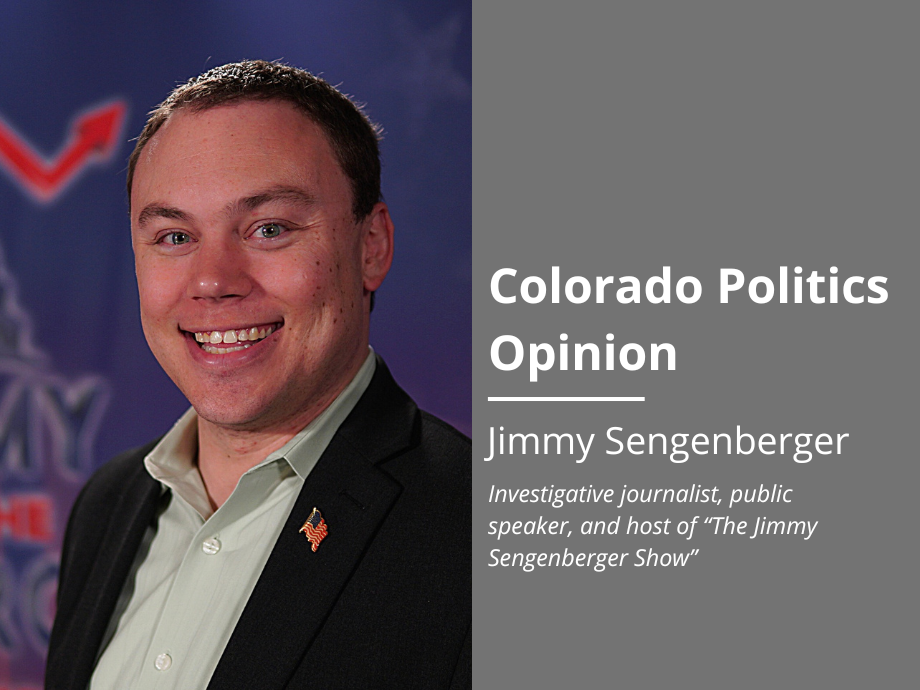
Jimmy Sengenberger is an investigative journalist, public speaker, and host of “The Jimmy Sengenberger Show” Saturdays from 6 a.m. to 9 a.m. on News/Talk 710 KNUS. Reach Jimmy online at JimmySengenberger.com or on Twitter @SengCenter.

The African roots of three Colorado leaders | SONDERMANN
Eric Sondermann
eric-sondermann@coloradopolitics.com
Updated 2 days ago
Colorado’s political transformation is measured in many ways. A once reliably red state (with asterisks) became purple and is now a rather deep blue. For better or worse, probably the latter, power is ever more consolidated along the Front Range...

Fighting for every Colorado rural hospital on the eastern plains | GUEST COLUMN
Colorado Politics
colorado-politics@coloradopolitics.com
Updated 2 days ago
By Lauren Boebert After touring Melissa Memorial Hospital in Holyoke and Wray Community District Hospital — two of more than a dozen rural hospitals in my district — I was again reminded why I fight for them in Washington. The...

Fix Colorado without shortchanging taxpayers | GUEST COLUMN
Colorado Politics
colorado-politics@coloradopolitics.com
Updated 19 hours ago
By Lisa Frizell If we truly want to fix Colorado, we must respect taxpayers, demand accountability and prioritize classroom results. Proposition NN fails the test. The far left put forth this measure, presenting it as the only way to fund public...

New anti-gun legislation is about preventing firearm ownership, not safety | GUEST COLUMN
Colorado Politics
colorado-politics@coloradopolitics.com
Updated 2 days ago
By Ava Flanell It’s been a little more than a month since the most radical anti-gun legislation went into effect in Colorado history: Senate Bill 25-003. Originally intended as an “assault weapons ban,” Colorado Democrat sponsors settled for a complicated...
Colorado ed department must up its competence to prevent waste, fraud, abuse | Paula Noonan
Paula Noonan
paula-noonan@coloradopolitics.com
Updated 2 days ago
The Colorado Department of Education let $24 million fly from its checking accounts from January 2017 through June 2026 to CHE, aka Colorado Homeschool Enrichment. The details show how easily CHE and Education Re-Envisioned BOCES re-envisioned how to convert public...
Remember the injustice of forced unionism | GUEST COLUMN
Colorado Politics
colorado-politics@coloradopolitics.com
Updated 2 days ago
By Mark Mix This Labor Day we celebrated the men and women whose hard work keeps the country running. But in Colorado, many of those same workers face a real threat: pay union dues or lose their job. That’s because...

Should we always blame voters for low civic participation in elections? | GUEST COLUMN
Roland Halpern
roland-halpern@coloradopolitics.com
Updated 2 days ago
This year, like every election cycle, we hear the same complaints — enough citizens don’t vote. Voter turnout is too low. People are disengaged. Citizens are shirking their civic responsibility. If only voters cared more, democracy would work better. Fair...

Lori Gimelshteyn on 3 ballot measures to ‘let kids be kids’ | The OpEdge Podcast
Tony Olivero
tony.olivero@gazette.com
Updated 2 days ago
Lori Gimelshteyn — board member of Protect Kids Colorado and executive director of the Colorado Parent Advocacy Network — joins The OpEdge to discuss three measures headed to Colorado voters this November. Gimelshteyn tells host and investigative columnist Jimmy Sengenberger...
A path toward justice and public safety | PODIUM
Anthony Hartsook
ahartsockop@gmail.com
Updated 2 days ago
Strangulation can be one of the most dangerous forms of assault; despite the lack of visible ailments it is accompanied by. Though strangulation leaves no broken bones, bruises or visible wounds, it is one of the strongest predictors of future...
From moving people to managing them | GUEST COLUMN
Michael Hancock
michael-hancock@coloradopolitics.com
Updated 3 days ago
Transportation policy used to have a fairly uncomplicated purpose: move people safely, efficiently and reliably. Build roads where people drive. Maintain bridges before they fail. Add capacity where growth overwhelms the system. Provide transit where it makes sense. Infrastructure was...
PREV
PREVIOUS

Juvenile justice bill is ‘dangerous,’ lacks data | OPINION
Dan Rubinstein Janet Rowland Dan Robinson The proposed Colorado House Bill 23-1249 poses a threat to successful programs that aim to prevent kids from getting involved in the juvenile justice system. The legislation seeks to prohibit the use of the juvenile justice system for children between the ages of 10 to 12. This would result […]
Trust 'the heck' out of science with HB-1080 | Colorado Springs Gazette
Political leaders have Colorado on the fast track to electrify everything. If they are serious, state legislators will pass House Bill 23-1080 and consider a new asset for our energy portfolio. The House Energy and Environment committee will discuss the bill Wednesday and decide whether to learn more about modular nuclear energy with a state-conducted […]