

State Supreme Court takes up governmental immunity cases for trip-and-fall, speeding officer
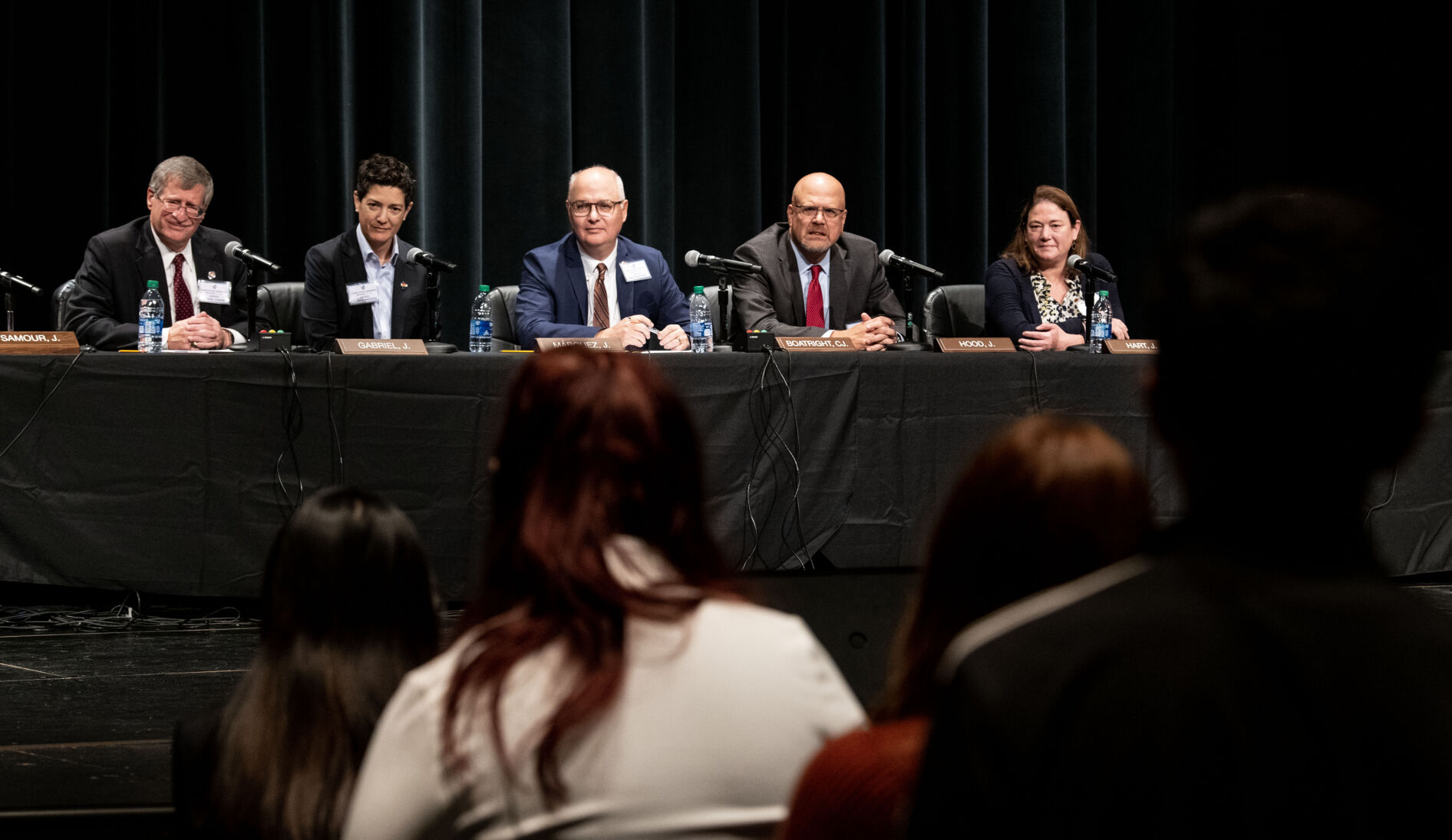
The Colorado Supreme Court on Tuesday agreed to review two appeals questioning the boundaries of the government’s general immunity from civil lawsuits, with one case involving a trip-and-fall in Jefferson County and the other implicating a police officer in Montrose County who killed two people during a pursuit.
At least three of the seven members of the court must consent to hear a case on appeal.
The justices also disposed of two other criminal appeals that reached the state’s highest court directly from the trial court level. Although the Supreme Court initially showed interest in the cases, the parties resolved the underlying issues while the appeals were pending.
Lights and sirens
Officer Justin Hice of the Olathe Police Department was monitoring traffic along Highway 50 in July 2018 when he saw a white Toyota exceeding the speed limit. Hice gave chase, which lasted for 36 seconds. During the pursuit, he reached 103 mph, nearly double the speed limit.
Hice never activated his siren, but turned on his lights in the last five to 10 seconds of the pursuit. At an intersection, a van turned in front of Hice. He hit the van going at least 75 mph, killing occupants Walter and Samuel Giron.
The Girons’ surviving relatives sued Hice and the town of Olathe for wrongful death and negligence. In response, the defendants invoked the Colorado Governmental Immunity Act, which generally shields government entities from civil liability.
Under the CGIA, government employers are not immune for injuries caused from employees operating a motor vehicle. However, the immunity comes back for emergency vehicles. But in another caveat, immunity only applies to emergency vehicles exceeding the speed limit during a pursuit if they are “making use of audible or visual signals.”
District Court Judge D. Cory Jackson initially dismissed the lawsuit after finding Hice used his emergency lights and did not create an unreasonable risk of injury in his pursuit. Jackson credited the testimony of current and former police officers over the motorists who Hice passed at high speed.
But in July of last year, a three-judge panel for the Court of Appeals reinstated the lawsuit. In order to benefit from immunity, the panel concluded, officers must activate their lights or sirens once they exceed the speed limit in a pursuit.
“It is not enough for the officer to activate lights or sirens sometime after exceeding the speed limit,” wrote Judge Sueanna P. Johnson.
The defendants appealed to the Supreme Court, slamming the ruling as unreasonable and imposing a “chilling effect” on prompt law enforcement responses to emergencies. They also argued the decision would eliminate immunity for officers who exceed the speed limit “for even one second” without their lights on.
The Colorado State Patrol and State Office of Risk Management, which handles casualty and liability claims, also urged the Supreme Court to take up the case because of the “absurd” limitations now placed on officer behavior.
“For example, an officer who realizes they may have exceeded a posted speed limit or exercised any other privilege of emergency vehicles while responding to an emergency without emergency lights or siren,” wrote the Colorado Attorney General’s Office, “likely would be required to break off a pursuit or discontinue an emergency response, pull to the side of the road, and stop their emergency vehicle in order to restore their protection from liability.”
The plaintiffs waved aside those concerns, arguing officers simply need to ask themselves if they are in a pursuit and if they will exceed the speed limit. If the answer is yes to both, they will need to activate emergency lights or sirens.
It is “not at all absurd to require officers, as enforcers of the law, to follow the law themselves or be subject to the consequences, just like everyone else,” wrote the plaintiffs’ attorneys.
The Supreme Court will review the appellate panel’s decision. The case is Hice et al. v. Giron et al.
The parking garage illusion
In February 2018, Beverly Stickle was visiting the Jefferson County administration building. She parked on the upper-level of a two-tier garage and walked upstairs to return to her vehicle. The county had recently resurfaced the upper level with gray paint, which made it difficult to see a step-down from the stairway curb onto the parking lot.
Because of the “illusion” of an uninterrupted surface, Stickle tripped on the step-down and broke her arm.


Stickle sued Jeffco, but the county asserted it was immune under the CGIA. Although the law holds government entities liable for the “dangerous condition of any public building,” an inadequately-designed building does not constitute a liability. Instead, the dangerous condition has to stem from negligent maintenance or construction.
A trial judge declined to dismiss the lawsuit and a three-judge panel for the Court of Appeals similarly found Jeffco was not immune. First, the panel decided the parking garage fit under the definition of a “public building.” Second, the appellate judges noted the county had applied the new material to prevent degradation of the concrete.
“The use of the same topping material to resurface the walkway, curb, and parking surface was an act in maintaining the parking structure (i.e., an act done for the purpose of maintenance),” wrote Judge Anthony J. Navarro in July of last year. “In other words, the new topping material helped preserve the facility from decline or failure, which falls within the CGIA’s definition of maintenance.”
The county appealed to the Supreme Court, arguing the Court of Appeals’ decision provided a reason for governments to avoid improving or maintaining their buildings. The State Office of Risk Management, which handles personal injury claims, supported Jeffco’s petition, as did Colorado Counties, Inc., which represents 62 of the 64 counties.
“Allowing individuals to sue Colorado’s public entities for injuries occurring in parking structures generally, as well as significantly blurring if not eliminating the distinction between design and maintenance under the CGIA, greatly expands the scope of liability for all Colorado public entities in Colorado including counties,” wrote Andrew D. Ringel for CCI.
The Supreme Court will evaluate whether the parking garage is a public building and whether resurfacing the top lot to create the step-down illusion opened Jeffco up to liability. The case is County of Jefferson v. Stickle.
Trial court appeals
The Supreme Court also dispensed with two other matters that arose directly from the trial courts.
In Arapahoe County, Cori Ross Speed has been awaiting trial for 3.5 years, accused of stabbing his caretaker. Speed is developmentally disabled and evaluators have repeatedly found him incompetent to stand trial.
Under Colorado law, if an evaluator gives the opinion that there is no “substantial probability” an incompetent defendant will be able to stand trial within the “reasonably foreseeable future,” the court must hold a hearing about whether a defendant will likely have his competency restored. If the answer is no, the criminal case is dismissed and civil commitment proceedings may begin.
A psychologist evaluated Speed three times in 2022, but each time declined to offer an opinion on whether Speed would likely be competent in the foreseeable future. District Court Judge Ben L. Leutwyler opted against holding the legally-required hearing in favor of further competency-restoration services for Speed.
The defense appealed to the Supreme Court, asking it to order Leutwyler to hold the hearing. Last month, the justices signaled interest in the issue and directed the government to respond to Speed’s petition.
However, on Feb. 13, an evaluator issued an updated report, concluding Speed had no substantial probability that he could become competent in the reasonably foreseeable future. All parties agreed Speed now deserved the legally-required hearing. Consequently, the Supreme Court dismissed the appeal.
The case is People v. Speed.
The justices returned a second case to the trial court after the prosecution admitted it was mistaken in challenging the defense’s expert witness.
Alan L. Saville faces charges of assault in Denver for allegedly kicking a nurse at Denver Health. The defense sought to have a forensic toxicologist testify that the sedative midazolam, which hospital staff administered to Saville, would have rendered him involuntarily intoxicated if it interacted with alcohol inside Saville.
The district attorney’s office moved to exclude the testimony, arguing that “we have no idea what was in Mr. Saville’s system.” District Court Judge Jay S. Grant agreed, calling it “complete speculation” to say what amount, if any, of alcohol Saville had inside of him, as no one conducted a blood or urine test.
Saville’s attorneys appealed to the Supreme Court, noting Saville smelled like alcohol, was treated for severe intoxication, and had multiple witnesses – including the victim – believing he was intoxicated.
After the Supreme Court ordered the government to respond to Saville’s petition, Deputy District Attorney Richard F. Lee conceded the prosecution “prompted the district court’s error” and agreed Grant’s decision should be reversed.
The case is People v. Saville.



Parenting from prison: Inmates hope to be present in their children’s lives, while physically absent
Marianne Goodland
marianne.goodland@coloradopolitics.com
Updated 6 hours ago
The room was decorated with balloons, the tables sparking bright with colors as the smell of pizza and cake wafted through the air. As did music. This was, after all, a father-daughter dance. Except this was not a typical father-daughter...
Appeals court confirms Colorado judges can compel electronic records from out of state
Michael Karlik
michael.karlik@coloradopolitics.com
Updated 2 days ago
Colorado’s second-highest court clarified on Thursday that judges are empowered to compel out-of-state companies to produce electronic records under state law. El Paso County jurors convicted Mischa Jargowsky on three counts of money laundering and one violation of Colorado’s organized...
10th Circuit upholds finding of no racial discrimination against family at Denver Chili’s
Michael Karlik
michael.karlik@coloradopolitics.com
Updated 3 days ago
The Denver-based federal appeals court agreed on Wednesday that a Black plaintiff failed to show that a Chili’s manager’s request for her family to provide valid payment at the outset of their meal amounted to racial discrimination. Markesha Futrell-Smith filed...
Appeals court reinstates Mesa County defendant’s request for DNA testing under new Colorado law
Michael Karlik
michael.karlik@coloradopolitics.com
Updated 4 days ago
Colorado’s second-highest court revived a Mesa County defendant’s petition for DNA testing in his three-decade-old attempted murder case on Thursday, concluding that a trial judge wrongly interpreted a recent Colorado law in dismissing the request outright. Jurors convicted Billy Joe...
Appeals court reverses Denver juvenile’s conviction due to improper expert testimony
Michael Karlik
michael.karlik@coloradopolitics.com
Updated 2 days ago
Colorado’s second-highest court reversed a juvenile defendant’s conviction for unlawful sexual contact on Thursday after an expert witness’s testimony improperly suggested the child victim was telling the truth. The defendant, identified as S.H-S., was around 16 years old when he...

Judge orders home confinement for Barry Morphew
Dennis Huspeni
dennis.huspeni@gazette.com
Updated 4 days ago
An Alamosa County district judge has ordered home confinement for Barry Morphew, who is accused of murdering his wife. Barry Morphew, 59, faces a first-degree murder charge in the death of his wife, Suzanne Morphew, who disappeared Mother’s Day weekend...
Appeals court says jury does not need to view porn to determine if it’s ‘obscene’
Michael Karlik
michael.karlik@coloradopolitics.com
Updated 2 days ago
Colorado’s second-highest court ruled for the first time on Thursday that a jury does not always need to view pornographic material to determine if it meets the criteria for obscenity. Mesa County jurors found Shayla Ann Simpson guilty of child...
10th Circuit disagrees Sterling officer had no basis to arrest motorist who lacked insurance details
Michael Karlik
michael.karlik@coloradopolitics.com
Updated 5 days ago
The Denver-based federal appeals court disagreed on Tuesday with a trial judge’s decision to bar evidence from a pat-down search from being used against a defendant. Federal prosecutors obtained an indictment of Jorge Sigala-Baray for being a felon in possession of a...
Colorado Springs officers’ tasing, threats prompt federal judge to block use of suspect’s statements
Michael Karlik
michael.karlik@coloradopolitics.com
Updated 5 days ago
A federal judge blocked the government last month from using some of a defendant’s statements as evidence, reasoning that the defendant made them involuntarily as Colorado Springs officers tased him five times and one officer threatened to kill him. Officers...
Appeals court rejects CDOT employee’s discrimination, retaliation claims
Michael Karlik
michael.karlik@coloradopolitics.com
Updated 3 days ago
Colorado’s second-highest court agreed last week that a Colorado Department of Transportation employee had not shown that his employer discriminated and retaliated against him due to his religion and national origin. Ayman Salloum, who described himself as a 70-year-old Muslim...
PREV
PREVIOUS

Colorado legislature unanimously OKs expanding post-conviction DNA testing
In the 20 years since Colorado’s post-conviction DNA testing law was established, only three people have been exonerated for DNA-related reasons. Colorado lawmakers want to change that with House Bill 1034, an effort to expand access to post-conviction DNA testing. The state legislature unanimously approved the bill on Wednesday with the Senate’s final vote. Now, the […]
East High School students urge Denver City Council to act on gun violence issue
After a shooting injured one student outside of East High School last week, a teacher and two students addressed the Denver City Council Tuesday, sharing their fears of gun violence in and around schools and asking for school resource officers to be re-instated in Denver Public Schools. They spoke during the public hearing portion of […]